ALE lifts 5,134 tonne evaporator
24 May 2018
Heavy lift and transportation specialist ALE claimed to have broken a world record by transporting the world’s heaviest evaporator, weighing 5,134 tonnes, in Saudi Arabia.
ALE was contracted to perform the full delivery scope of the evaporator, plus steam transformers, lime filters and a brine manifold, to the Shoaiba Desalination Plant Project in Shoaiba, 100 km south of the port city Jeddah.
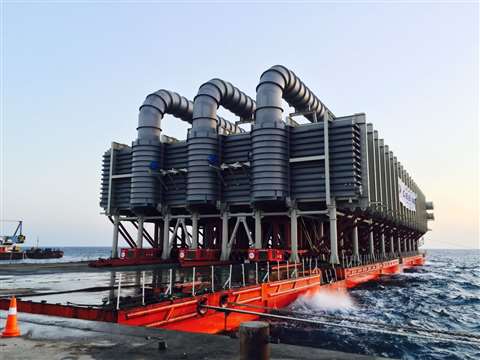
ALE first received and handled the items at the plant’s jetty in April 2018. The evaporator was loaded-in using 186 Generation 3 SPMT axle lines in a 3 x 2 file 62 configuration. Smaller, different configurations were used for the other items. These were then transported 1 km to the Shoaiba Desalination Plant project site.
Once on site, ALE said it had to negotiate a challenging route within the plant. To avoid the unnecessary removal of obstacles, aspects of the cargo structure were modified to pass over fences.
Andrew Spink, general manager at ALE’s Saudi Arabia branch, commented, “It is fantastic to be involved in transporting cargo of this sheer size and scale that makes it such a landmark move. This was a complex operation, not only in terms of the pieces involved, but also the logistics of receiving almost 200 axle lines of SPMT and mobilising an experienced transport crew. It was completed successfully and sailed away within the time constraints all thanks to our team’s flexibility, local expertise and effective co-ordination between the ALE’s Middle East branches.”