Putting the seal on innovative filtration
Partner Content produced by KHL Content Studio
17 December 2025
Marginal gains are a significant talking point in industry today, playing a primary role in moving the productivity needle in the right direction.
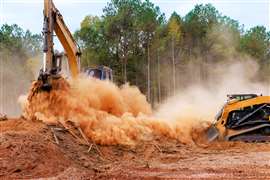 The importance of high-quality air filtration in dusty working environments cannot be overstated. Image: Adobe Stock
However, many industries – particularly those utilizing heavy equipment – could use something more to boost their productivity. Perhaps marginal spend with something more than marginal gains?
Few would see something as unglamorous as air filtration as a magic bullet, but as it relates to the unplanned downtime of equipment, it’s worthy of note – and when dust and contaminants get past an engine’s air cleaner, a decline in machine performance may be just the tip of the downtime iceberg.
That point is made by Mark Sala, director of air product management with Donaldson, a company that has been developing filtration systems for OEMs since 1915.
 In road construction applications, air filters protect both expensive equipment and operators. Image: Adobe Stock
Donaldson is globally recognized for delivering engineering solutions to customer problems – from optimizing engine performance to meeting stringent emissions regulations.
Preventing engine damage from contaminants is at the core of the work undertaken by the company’s air division.
As Sala says, “A turbo fan will often get fouled first, but eventually contamination will get into the combustion reaction itself. Injectors, pistons, sleeves, they all get scored and damaged.
“At that point, you’re losing compression and power, you start burning oil and getting leakage in many places – and emissions become a problem too.”
Downtime from that sort of damage can range from inconvenient to catastrophic, depending on the application and location.
Good filtration is about avoiding those extremes – but also about pushing back on the slower, less visible declines in performance. Both depend heavily on how reliably you can force every liter of intake air through the filter media, and nowhere else.
The problem with the operator interface
“Industry professionals tend to service everything according to a maintenance schedule,” says Sala.
“We’ve discussed this at length in our air division and thought about a product that would align with that expectation, but also offer added value in cost and reliability.”
While scheduled maintenance is the reality, it is also understood that premature maintenance leads to increased risk. During every service, there’s an opportunity to do damage – especially in dusty jobsite environments.
Sala says, “Every time you service a filter, it introduces the possibility of putting contaminants into your system. The worst two days of any filter’s life are when you pull it out to replace it, and the first day you put it in, when it’s the least efficient at doing its job.”
 Mark Sala, Donaldson’s director of air product management
Sala understands that operators working on site will often take matters into their own hands when a machine begins to derate – pulling filters, banging them against tires and reinstalling them, just to get back to work. Time is money, after all. But the combination of cheap filters and the frequent handling they require comes at a cost.
Another air filtration expert with a wealth of in-the-field experience is Steve Campbell, an engineering manager celebrating his 25th year with Donaldson. As an inventor, Campbell has worked with operators as they tackle filtration issues in different countries and regions and across a host of different applications.
In response, he says he has been “…steadily trying to tackle these problems and create better products over time.
“And one thing we hear from our customers is that they don’t want to change their behavior. So, it’s simple, we have to design products that align with that expectation, allowing them to continue doing what they’re happy doing. But we also offer added value to them beyond that – whether it’s through cost, reliability or some way of improving their performance.”
As Sala says, “Anyone can get themselves a cheap filter, but there’s a direct correlation between how much dust goes downstream over the life of a filter and how much impact there is on not just its lifespan but also on engine performance.
“The more times you interact with the filter, the more contaminants go downstream and the more it shortens the time to a major maintenance event. Extending that time for as long as possible is the way to improve the cost of machine ownership.”
Under normal circumstances, this sort of contaminant damage will not result in dramatic engine failure, but, sooner or later, derating at least will occur.
“Generally speaking, you’ll see a long-term, creeping loss in performance,” Campbell explains. “You’ll see a little loss in compression, a little loss in power and it just creeps up on you. That’s why it’s hard to really understand good filtration versus poor filtration; it’s such a long-term investment.”
The seal is the key
At the heart of air filtration lies the seal – the element that ensures all the air passes through the media, with no leakage.
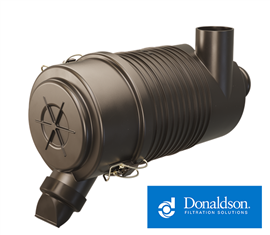 Donaldson Air Cleaner with ArmorSeal™ technology
As Sala says, “If you think about a diesel engine today, for every liter of fuel it consumes, it consumes about 15 liters of air. That’s an enormous amount of additional volume that we have to ensure is protected, compared with some of our liquid counterparts – and we only get one shot at it.
“Oil recirculates, so the filter has plenty of opportunities to capture it. The task in front of us is to capture a very large volume of air at any given time, and it’s constantly flowing. If the filter fails to do that at any point of it, you can have a catastrophic failure.”
The way Sala sees it, there are two crucial aspects to air filtration: the first is the media itself, which filters the air; the second is the seal required to ensure that the air goes through the filter media and nowhere else.
Given that every unplanned service event, due to air filtration, is going to be both a negative hit on performance and a contamination risk, the seal standing between those events becomes critical and must be able to tolerate real-world handling.
At Donaldson, Campbell and the team were given what he describes (only half joking) as ‘the impossible task’ of designing a seal that could help to meaningfully extend service intervals for air filters.
He says, “We knew we wanted to go back to a radial seal, which Donaldson actually invented and patented and brought to market in 1987. That is basically the industry standard that everything is measured against.
“We wanted to get back to the basics of filtration, which meant providing something extremely robust and reliable, but without the inherent additional cost.”
“Of course, we know people are banging filters against tires and fenders – they’re going to do whatever they have to do to keep running when faced with downtime or performance loss, even if that’s going to cause more and bigger problems down the line.
“When Mark gave me the parameters of this job, I knew it was a big deal. It’s actually pretty difficult to develop a seal that can be applied to both large and small equipment. Something that has the capacity to protect everything from a million-dollar engine all the way down to a lawn mower, without having to be changed.”
The impossible task
The challenge Campbell faced began with the fact that the radial seal is, in his words, “basically a stroke of genius”.
 Donaldson’s engineering manager, Steve Campbell
The radial seal is simple but very robust and also one of the most cost-effective solutions ever seen in the industry.
Sala agrees, saying, “We’ve seen bad manufacturing processes and we’ve seen customers abusing filters, but radial seals have an ability to absorb these things incredibly well. We had to find a way to keep that capability, but also iterate on it in a way that is of value.”
These were some of the parameters Campbell had to consider at the start of an intense development process.
Firstly, on the material, he says, “In 2013, I invented a hard–soft urethane combination and when we started discussing the new seal, I decided to do some research into how the material was performing in the field.
“I discovered that we had manufactured 8 million filters since 2013 and had received zero warranty claims against that technology.
“I remember telling Mark how robust a solution that was, and we immediately knew there was something there for us to work with.”
A combination of computer modeling, prototyping and rigorous testing followed until, at around the 500th iteration, the team hit on the version that will soon be released to the market as ArmorSealTM.
“We knew we were onto something when we really couldn’t make it fail in durability testing,” he recalls. “We had an element so full of dust it took two people to lift it off the ground. It actually shot itself out of the air cleaner during testing but remained sealed. When we put it back in, it still passed.”
In a construction context, where filters see vibration, impact, operator abuse and environmental extremes, that kind of margin is significant.
When gains are beyond marginal
But ArmorSealTM isn’t just a new seal geometry, it’s a technology that has benefits for every aspect of air filtration.
As Campbell puts it, “It actually wins on every level, which is why we’re so excited to see it in the market. We see a reduction in restriction, improvements in dust-holding capacity, and we have significant serviceability benefits as well.”
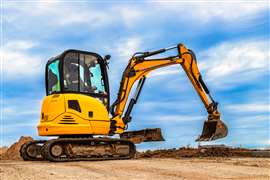 Donaldson’s ArmorSeal promises to be a drop-in filtration solution for both large and small machines. Image: Adobe Stock
Other benefits include the seal’s tactile feedback. As Sala points out, “When you locate the seal on the filter, you know without a doubt that it’s properly seated and you can do this blindly. You could potentially service it one-handed.”
The team’s work on the seal design also prompted Donaldson to rethink how it interfaces with the housing, especially in high-vibration applications where air cleaners are mounted directly on the engine.
“This truly is a drop-in option,” says Sala, “allowing the reuse of components and minimizing customer investment.”
This is due to the fact that the ArmorSeal interface can be paired with different outlet geometries without having to re-validate the seal each time.
And, when ArmorSeal is launched early in 2026, Donaldson will hope it is viewed by OEMs as a seal architecture designed to close off the obvious weak points in air filtration so future innovation can focus elsewhere.
“That’s actually at the core of what Donaldson does,” Sala concludes. “Yes, we sell filters and air cleaners, but what I feel we get paid to do for customers is precisely this sort of customization – it’s all about solving problems.”
Webinar
Evolutionary gains: How Donaldson is redefining air filtration
Register below for a first look at the innovative seal that could keep the toughest off-road machines working harder for longer
On Thursday, February 19, 2026, at 10am (CST) an expert panel will unveil and dissect ArmorSealTM.
This is an opportunity to explore the new seal in granular detail, ahead of its unveiling at the upcoming CONEXPO-CON/AGG exhibition in Las Vegas, and put your questions to the team responsible for analyzing industry pain points, evaluating the material science options and ultimately reimagining radial-seal geometry.
You’ll learn how the invention of a hard/soft urethane combination, with millions of real-world hours and zero warranty claims, inspired a new approach, and how modeling, testing and sheer persistence finally delivered a seal that refused to fail through testing.
What you’ll discover in this session:
- What it takes to innovate beyond an industry-standard radial seal
- Why seal integrity is the hidden driver of long-term equipment performance
- How ArmorSeal reduces restriction, increases dust-holding capacity and improves serviceability
- Why tactile feedback, robustness and drop-in compatibility matter for operators and OEMs alike
Whether you specify equipment, manage fleets, design engines or maintain machines in demanding environments, this webinar offers a rare, behind-the-scenes view of how meaningful innovation happens.
REGISTER HERE to secure your free place at this event and see how Donaldson is putting the seal on the next era of filtration innovation.
--------
Please note: If you are unable to attend the live event, all registrants will receive a recording of the webinar within 48 hours of its conclusion
--------
This article was produced by KHL Content Studio, in collaboration with experts from Donaldson
--------
All uncredited images courtesy of Donaldson
--------