ALE on France’s first floating wind turbine
03 January 2018
Global heavy lifting and transport contractor, ALE has completed the installation of wind turbine components for France’s first floating wind turbine, Floatgen, at Saint Nazaire, Brittany.
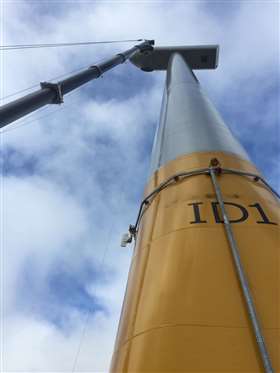
ALE was contracted by French floating offshore wind specialist Ideol – the company behind the design and engineering of the floating foundation – to perform the mechanical and electrical completion of a 2MW V80 wind turbine generator onto a floating foundation.
Each component was lifted using a 1,200 tonne capacity crane. There were two tower sections; a nacelle; a hub; and three blades. A 100 tonne capacity auxiliary crane was also required to erect and lift the two tower sections in tandem.
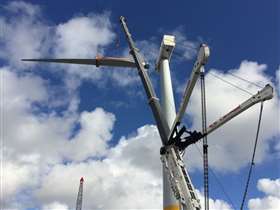
To maintain the stability of the floating foundation, ALE simultaneously performed foundation ballasting operations during the lifting operation. Four submersible pumps were used to supply water to the ballast tanks situated at the corners of the floating foundation.
Once the wind turbine was fully mounted on top of the foundation electrical components and cables were connected and assembled and the client’s sensors and measuring equipment installed.
Antonio Martin Garcia, ALE project manager, commented, “This was a unique job for ALE and the first time we have undertaken such a complex scope of work in this sector. We were able to provide a bespoke solution for this challenging operation and by providing experienced operators with expertise in each discipline, including the installation, ballasting, and lifting, as well as coordination we could ensure smooth project management.”