3D printed concrete bridge is ‘first of its kind’

21 July 2021
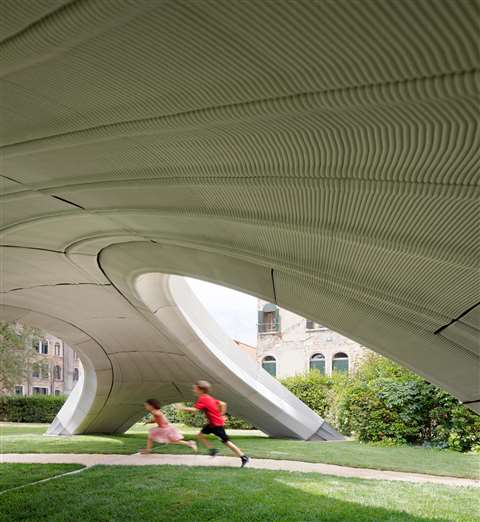
A 3D printed concrete bridge in Venice, Italy, has been unveiled that holds together through compression with no reinforcements, applying computational design and 3D printing for minimal material use and maximum strength.
Designed by Block Research Group and Zaha Hadid Architects, in collaboration with incremental3D and Holcim, the companies say the bridge, named Striatus, is both digitally and environmentally advanced.
Striatus is a complex structure made possible by a specific, custom-made ink, from Holcim’s TectorPrint range, developed by its 3D concrete printing research team. It was built using advanced technologies, from computational design to 3D concrete printing.
Shajay Bhooshan, Head of CODE, Zaha Hadid Architects’ Computation and Design research group, said, “Striatus stands on the shoulders of giants: it revives ancestral techniques of the past, taking the structural logic of the 1600s into the future with digital computation, engineering and robotic manufacturing technologies.”
It was noted that 3D concrete printing enables delicate layering and precision to reflect perfect and that the bridge.
Jan Jenisch, CEO of Holcim added that the bridge, “demonstrates the infinite possibilities of 3D Concrete Printing to enable more sustainable, faster and effective building structures, without compromise on aesthetics and functionality. Its digital and circular design uses concrete at its best, with minimal material use and blocks that can be repeatedly reassembled and infinitely recycled.”
The bridge is now open to the public in the Marinaressa Gardens during the Venice Architecture Biennale until November 2021. Holcim is working on a range of 3D concrete printing applications, from complex infrastructure to affordable housing.