First new Fassi used in Finland

21 April 2022
Finland-based Kuljetusliike Knuutinen Oy has taken delivery of the first Fassi F1450R-HXP Techno crane. It was mounted on a Scania truck and put to work.
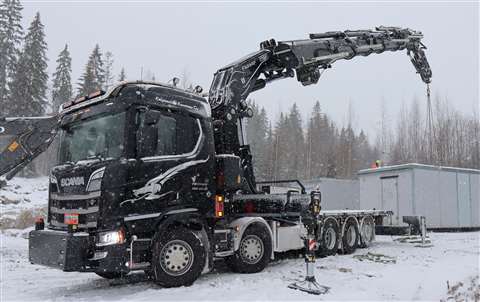 The crane has a total outreach of 37 metres (Photo: Fassi)
The articulating or knuckle boom crane has a 110 tonne lifting capacity and eight telescopic extensions with a specially created L826 jib. The company chose to include three mechanical extensions. The complete combination allows for a total outreach of 37 metres.
Fassi said the boom elements have a decagonal profile, known as X-Design, which provides increased resistance to flexing and guarantees lifting capacity with a reduced overall weight. This offers advantages in terms of residual vehicle capacity.
The accessories chosen by the Finnish company include a personnel basket, stability control and the Extra Power (XP) system.
Other features of the Fassi F1450R-HXP Techno include new electronics and larger data processing due to multiple CAN bus and ethernet lines.
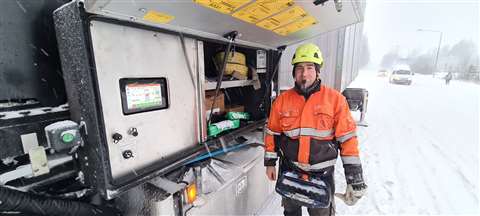 Jarkko Knuutinen, Kuljetusliike Knuutinen Oy (Photo: Fassi)
Jarkko Knuutinen said, “Practical and easy to use, as well as to put into operation, the automatic ACF opening and closing system is ideal for automating operations, which usually take up precious minutes.
“Even in the tight spaces, where stabilisers cannot be fully extended, the crane is still able to operate safety, providing me with clear indications via the display of the lifting and outreach capacities in accordance with the current state of stabilisation.
“This function allows me to work without worrying, and to concentrate on the load, because I know that the new Techno electronics will handle the rest”.
“Thanks to the XP system I have a power reserve that allows me to handle more challenging loads.”