JCB unveils new compact backhoe loader

09 September 2015
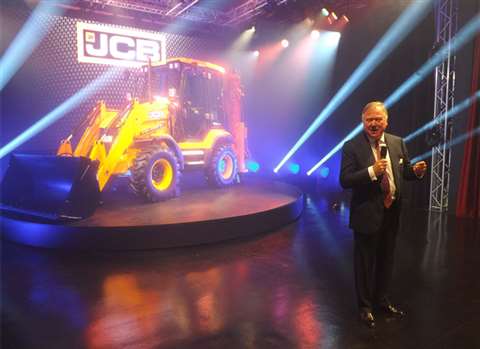
JCB has launched the 3CX Compact, the successor to the 2CX compact backhoe loader. The company says the new machine has been designed from scratch to meet the requirements of urban construction work. Key improvements over the 2CX include a higher travel speed and tighter turning circle.
The 3CX Compact has been designed for road resurfacing and repair work, utilities, ground workers and municipalities working on congested urban construction sites. It measures 1.9 m wide and 2.74 m high, while offering a turning circle diameter of 5.8 m thanks to four-wheel steering. This means it can turn around on a standard single-carriageway road.
The machine features a hydrostatic transmission with a top speed of 40 km/h. This is 17% faster than the 2CX and means it is feasible to self-drive the 3CX Compact between sites, as opposed to bringing in a 2CX on a trailer.
The front-end loader comes with a range of buckets and provides a load over height of 2.98m and max forward reach at full height of 1.11m. This allows the loading of on-highway trucks.
JCB chief innovation and growth officer, Tim Burnhope said, “It outperforms a mini excavator at digging and it outperforms a compact wheeled loader at loading.”
Power comes from a 55 kW ‘JCB Diesel by Kohler’ engine which meets Stage IIIB emissions laws in Europe – there is no Stage IV requirement for engines under 56 kW – and Tier 4 Final requirements in North America. This is achieved without the use of a diesel particulate filter (DPF) or selective catalytic reduction (SCR) technology, which cuts down on day-to-day running costs as well as servicing requirements.
The absence of a DPF means there is no need to periodically clean or replace this unit, and there is no need to use high grade low ash oils. The absence of an SCR system means there is no need to periodically fill up with diesel exhaust fluid (DEF) – marketed under the AdBlue trade name in many countries – which again is a cost saving.
The use of this engine forms a key part of JCB’s strategy, with its deployment across a range of equipment.