A Chinese OEM’s view of construction equipment today – and tomorrow
Partner Content produced by KHL Content Studio
01 April 2026
For construction equipment manufacturers, the operating environment may never have been more complex.
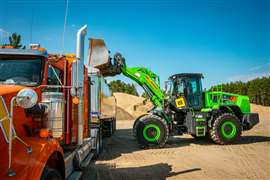 LiuGong’s 856HE battery-electric wheel loader
A combination of tariffs, shifting trade routes, greater customer expectations and the slow shift from diesel to electric are putting pressure on traditional business models.
For Chinese OEMs in particular, the question is no longer simply whether they can compete globally – it is whether they can localise deeply enough to make headway in mature markets while continuing to move faster than established rivals.
Global strategy, local execution
Andrew Ryan, president of LiuGong North America, believes the companies best placed to succeed will be those that pursue globalisation with disciplined local execution.
As he puts it, “globalisation actually means localisation.”
That sounds simple, but it is a significant shift in emphasis. In practice, it means building regional teams close to customers, working closely with dealers and feeding market insight back into engineering and design.
For manufacturers headquartered in China, that model matters because mature markets tend to choose machines that meet their specific needs, rather than those simply produced at scale.
Machine performance, cab design, controls, serviceability and configuration all have to match local operator expectations and jobsite realities.
Ryan argues that this is where companies like LiuGong are changing perceptions.
Rather than exporting a standard machine and asking the market to adapt, the company is using local product teams to shape what gets built.
He points to the latest North America-focused product launches, saying they are “the first suite of machines that’s been fully influenced by our North American regional product management team, in collaboration with the design teams in China.”
This approach is reflected in LiuGong’s latest product introductions for the region. The T Series wheel loaders, including both diesel and electric variants unveiled at CONEXPO 2026, incorporate operator feedback gathered across North America over the past two years. Enhancements include improved cab ergonomics, more intuitive controls and redesigned ground-level service points with integrated LED lighting to support safer inspection and maintenance in low-light conditions.
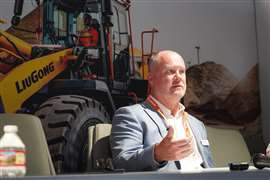 Andrew Ryan, president of LiuGong North America, speaking at the ConExpo exhibition in Las Vegas. Image: KHL
Beyond loaders, LiuGong’s 4215 motor grader was recognised among the “Top 100 New Products” in North America in 2025. The company is also in the final stages of integrating Trimble blade control technology, positioning it among a small group of manufacturers offering this capability to improve grading precision and jobsite productivity.
This is a significant shift, with Chinese OEMs understanding that to grow in North America and Europe, they will need more than competitive pricing; they will need local infrastructure, regional product influence and a manufacturing footprint that can withstand geopolitical disruption.
Competing in the face of trade disruption
Ryan is pragmatic about tariffs and other market shocks. “Whenever you have cost pressures, it makes you refocus your efforts to be lean and be a better competitor,” he says.
In that sense, tariffs are only the latest in a long line of recent industry shocks – shocks that include armed conflict, freight spikes and raw material surcharges. While wishing they didn’t happen, the lesson is to redesign the business around them.
Ryan is clear on where that responsibility lies. “We can’t just simply say, well, this happened, Mr Customer, and now it’s your responsibility to deal with it.” Instead, LiuGong is actively working to mitigate these pressures by improving supply chain coordination and reducing logistics-related costs, helping to limit the impact of external disruptions on customers. At the same time, the company is continuing to diversify its manufacturing footprint to better align with its global growth ambitions and ensure a stable, cost-effective supply of products for North American dealers and customers.
Ryan clearly understands the competitive truth in the equipment market, which is that customers will judge OEMs not by headline claims but by whether they protect uptime, preserve margins and reduce ownership risk.
Service as a differentiator
That is also why service strategy matters so much. In North America, Ryan sees a clear opening among contractors who are large enough to need dependable support but not large enough to command top priority from the biggest brands.
These are businesses where relationships still matter, and where an OEM or dealer can win by being responsive, potentially more than simply being recognisable.
Ryan describes the opportunity bluntly, saying some customers have paid for a premium machine expecting premium support, only to discover larger fleet owners were being given priority.
By contrast, he says of LiuGong’s target customers, “They’re not our twentieth best customer. They’re all our best customer.”
That service-led logic extends into a sector focus and Ryan highlights aggregates, ready-mix, recycling and waste transfer as segments where wheel loaders – and increasingly electric wheel loaders – can bring a strong value proposition.
Cutting through the technology hype
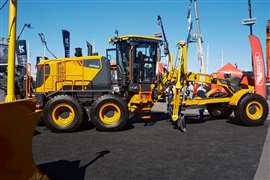 LiuGong displayed its latest 4215D motor grader at the recent ConExpo exhibition in Las Vegas, US
He believes that, particularly in enclosed or semi-enclosed applications, electrification is about much more than emissions targets – it’s about ventilation costs, noise exposure, operator comfort and site safety.
This is where the conversation around intelligent equipment and electrification becomes more grounded than hype within the industry might suggest.
Ryan defines intelligent machinery in straightforward commercial terms, saying, “We’re using the available technology to integrate into our machines in ways that lower the customer’s costs.”
That definition is refreshing, cutting through the noise around autonomy, telematics and digitalisation by asking whether the technology really can reduce cost or risk in the real world.
In Ryan’s view, it can. He says autonomy remains part of the long-term development path, but in the short-term progress is more likely to come from integrated telematics, safety systems and jobsite coordination tools that help customers run mixed fleets more efficiently.
Electrification as an economic decision
The real breakthrough, however, is battery-electric equipment.
What is striking in Ryan’s argument is how little it relies on abstract discussion of sustainability. He makes the case in economic terms, saying, “We’ve gone way beyond the feel-good elements of battery. These are hard-core economic drivers now.”
He points to measured life-cycle savings of up to 70%. In North American ready-mix applications, LiuGong has observed fuel and energy cost reductions of 80–90%, alongside a roughly 50% decrease in oil and filter changes. Electric machines also eliminate the need for engine and transmission rebuilds, which are typically among the most significant lifecycle cost events for diesel equipment.
“The total cost savings that’s attributable to having a purely electric drive machine is massive,” he says.
That claim matters because it reframes electrification from a compliance issue into an asset strategy. If electric machines can avoid the overhaul cycle that pushes many owners to trade out after three to five years, then ownership models could materially change.
The question Ryan raises is what if a productive machine could stay in service for 10 or 12 years because the major rebuild burden associated with a diesel-powered machine had disappeared?
In terms of the machines being manufactured by LiuGong, he is clear that this is “not a science project” and “not some kind of future promise,” but proven equipment already working in the field.
Machines that meet expectations
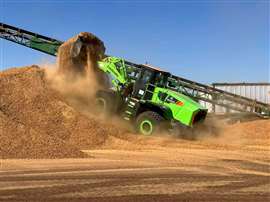 The 856HE wheel loader makes light work of a stockpile
That said, Ryan does not see technology adoption following the timelines being laid out by the industry’s futurists. Equally, he does not see construction being transformed by some entirely new machine class.
Rather, he says, progress will be more incremental and more practical, with broader product ranges, better distribution, more intuitive controls, greater automation in factories and steadily improving battery performance.
Ease of use will be central to that adoption curve. Ryan says every manufacturer has to ask, “How can this be as easy to use as an iPhone?” That may sound obvious, but it captures a genuine shift in operator expectations. The more advanced machines become, the more important it is that the interface becomes simpler, not more complex.
“If you look at the new LiuGong models, you’ll see there’s a huge amount of controllability given to the operator via the monitor – and the monitors are extremely intuitive, with a simple menu structure allowing operators to get the performance they want out of the machine.”
For Chinese OEMs, all of this points to a bigger conclusion: the companies that gain share will not necessarily be those with the loudest market entry, but those that combine product improvement, local commitment and commercial realism.
They will need to show they can listen, localise, support and innovate at the same time.
Ryan believes LiuGong should be seen through exactly that lens – committed to mature markets, serious about service, advanced in electrification and broader in capability than many buyers may assume.
Whether every buyer is ready to move at the same pace is another question. But the broader point stands: in a market defined by uncertainty, forward-thinking OEMs will be the ones that make technology practical, localisation real and total cost of ownership impossible to ignore.
On that measure, LiuGong is making a credible case that it deserves a place on more customer shortlists.
--------
This article was produced by KHL Content Studio, in collaboration with experts from LiuGong
--------
All uncredited images are courtesy of LiuGong
--------