A greener mix: How burning wood dust in an asphalt mixing plant paid dividends
Partner Content produced by KHL Content Studio
16 February 2026
When Baustoffzentrum, a long-established Swiss construction materials supplier, began exploring options to modernise its asphalt production in 2018, two important questions emerged: The first was how can we reduce emissions? The second was how can we remain competitive in a market increasingly focused on sustainability?
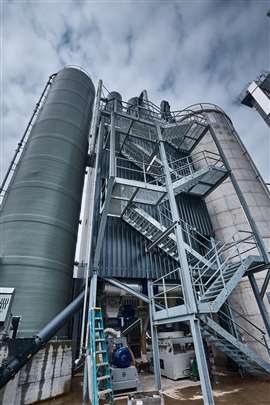 Baustoffzentrum’s asphalt mixing plant at Boningen
Six years later, the company has answered both questions, by taking two ageing fossil-fuel plants out of service and commissioning a single new facility powered primarily by wood.
The project has reduced Baustoffzentrum’s net carbon emissions by roughly 95% and improved production capacity, operational efficiency and even the company’s prospects for winning future infrastructure contracts.
Yet, as operations manager Martin Jost points out, the process is not a one-size-fits-all solution. The success of an installation like this depends greatly on regional conditions and on fuel supply.
From tradition to transformation
Baustoffzentrum operates five production sites across northwest Switzerland, producing gravel, recycled aggregates, concrete and asphalt for delivery across a wide area, from local concrete customers within 20km to asphalt clients as far as 100km away.
Each year, the company delivers an average 130,000 tonnes of asphalt – up to 170,000 tonnes in peak demand years – alongside 200,000 m³ of gravel, 80,000 m³ of recycled material from demolition waste and 120,000 m³ of ready-mix concrete.
Until recently, asphalt was produced by two plants in Boningen that were commissioned in the 1970s. While still in good order, their oil- and gas-fired burners were optimal at a time before climate targets or carbon pricing were serious business considerations.
“When the first plant was built in 1970, no one talked about CO₂,” says Jost. “But today, we have to. Switzerland’s target is to be carbon neutral by 2050, and every industry is expected to contribute.”
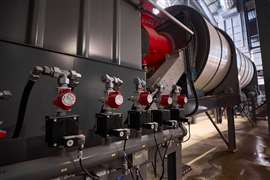 The new plant can deliver up to 320 tonnes per hour and boasts two wood-dust burners
Ideas for a replacement plant were first discussed in 2018, but momentum grew in 2022, as energy markets fluctuated and tenders from the Swiss authorities began to place greater importance on environmental performance.
“We realised that more and more projects – especially government contracts – were being looked at not only on price, but also on ecological performance,” Jost explains. “To stay ahead, we had to operate more sustainably.”
That year, Baustoffzentrum committed to replacing both of its older asphalt plants with a single, high-capacity installation capable of delivering 320 tonnes per hour. The new plant would include two wood-dust burners – technology refined over the past decade that uses the dust from milled and dried wood residues (pellets, wood chips, etc) as the primary energy source.
Construction began early in 2024 and by December of the same year, operations started at the mixing plant. Jost says interruptions to production were minimal, with only around 10,000 tonnes of asphalt having to be sourced externally during the transition.
Sustainability that pays
In practice, the burner operates with about 95% wood dust and 5% natural gas, with gas used for ignition and during the first few minutes of operation, until the wood dust combustion stabilises. After that, the plant runs almost entirely on renewable biomass.
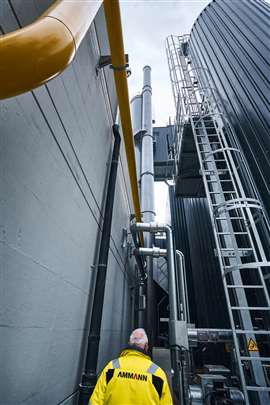 An expert from the Ammann team inspects the newly-erected plant
“The system is really efficient,” says Jost. “The wood must be dried to less than 11% humidity, then milled down before it enters the burner. The mills don’t use much energy, and the whole process works very smoothly.”
As wood dust is considered CO₂ neutral – its combustion releases only the carbon absorbed during the tree’s growth – the plant’s CO₂ emissions are reduced by about 95% compared with traditional oil or gas firing.
Also, although wood dust does not guarantee lower fuel prices, Baustoffzentrum’s experience shows that environmental performance and economic value can align.
Jost explains, “In the end, the fuel costs are similar. When oil and gas prices rise, wood pellet prices also go up. But where we save money is on the CO₂ side.”
Under Switzerland’s carbon-pricing framework, companies burning fossil fuels have to purchase CO₂ certificates. Switching to wood dust not only eliminates that expense but can even generate income, as unused allowances can be sold on the market.
“We are actually earning money by saving CO₂,” says Jost.
As well as saving on direct operating costs, there are strategic advantages to the wood-dust-burning plant. Clients – particularly public authorities – are increasingly favouring suppliers that can document sustainable practices. “In tender processes, environmental performance now carries weight,” Jost says. “Being able to demonstrate real emissions reductions helps us score higher and improves our chances of winning projects.”
High production, half the footprint
The new plant came from the Swiss engineering firm, Ammann, which also developed and manufactured the wood-dust burner.
Given that the new plant was purchased to replace two facilities, Jost was impressed to learn it was more than capable of maintaining their combined production capacity. It is now producing up to 320 tonnes per hour – enough to serve multiple sites simultaneously.
Baustoffzentrum now has 11 large silos with a total of 600 tonnes of ready-mix storage, allowing continuous production even when trucks are delayed.
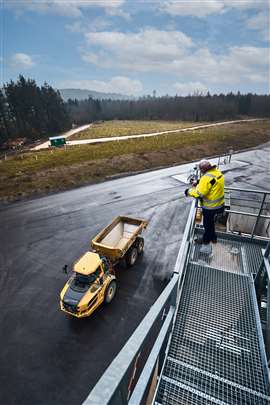 One of the first haulers arrives at the new Boningen plant
The plant has Ammann’s ADX drying system, which automates the burner power and drum speed based on temperature readings from the mineral feed. This prevents overheating – common in manual systems – which subsequently reduces unnecessary fuel consumption.
Peter Maurer is head of sales from the concrete division of Ammann. He explains that the ADX drying system is “like an autopilot”, adding that, “Before it was introduced, operators had to watch and adjust controls constantly. Now, temperatures stay within a narrow range, which saves energy, and the mix quality is more consistent, which makes life much easier for the operator.”
Jost says the technology integrated in the new plant results in lower fuel use, fewer production interruptions and more predictable output. It also allows the company to process high percentages of recycled asphalt pavement (RAP). In theory, the plant could run on 100% recycled material – a capability that aligns well with Switzerland’s circular-economy goals.
Maurer says, “With this plant, we can show that asphalt production doesn’t have to be dirty or smelly. In fact, it’s modern, clean and efficient.”
Jost says government officials and engineers frequently tour the new facility, which Maurer describes as “the most modern asphalt plant in Switzerland.”
Challenges and caveats
Despite the project’s success, Maurer cautions that wood dust is not a universal answer. Its viability, he says, depends heavily on local fuel availability.
But this does not appear to be a problem for Bausoffzentrum. Jost says, “We have a long-term contract with a supplier and can get high-quality pellets nearby.”
He does admit, however, that “if several plants in the same region start using wood dust, supply could become tighter.”
Regions without strong forestry or wood-processing industries may find sourcing sustainable wood dust more challenging or expensive. In such cases, Maurer suggests looking at other renewable fuels, such as biogas, hydrogen or even electrification, before reverting to fossil fuels.
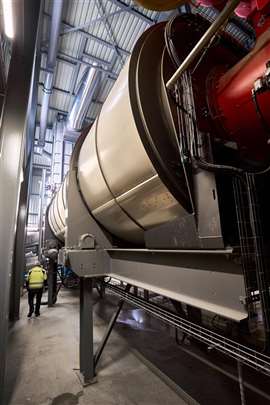 High-recycling technology is one of the features that distinguishes more sustainable asphalt mixing from traditional plants
“It’s important that each company looks at its own situation carefully,” he advises. “If you can secure local wood dust at a fair price, it’s a simple calculation; you save emissions, avoid CO₂ costs and strengthen your position in the market. But it depends on the region.”
Wood-dust burners are not entirely new. The first installations appeared in Germany more than a decade ago, and since then, the technology has been refined and scaled up. Today, Ammann has more than 50 asphalt plants worldwide operating with the systems, collectively producing over 20 million tonnes of asphalt and reducing hundreds of thousands of tonnes of CO₂ emissions.
The technology’s maturity means that performance compromises are minimal. Baustoffzentrum reports no loss of output or quality compared with its previous gas and oil systems. Furthermore, the burner’s capacity to burn oil and gas, as well as wood dust, offers a measure of supply security.
A win–win for the future
For Baustoffzentrum, the new plant is more than an environmental investment; it is a strategic foundation for long-term competitiveness.
“We are now ahead of others in our market,” Jost says. “We have the capacity, we can produce continuously, and we can show real CO₂ reductions. That’s what customers and authorities are looking for.”
Ultimately, the message is not that every asphalt producer should rush to install a wood-dust burner; it’s that sustainability decisions should be made on the basis of local or regional interests and planning for the long term.
“It was clear from the start that this was the direction we had to go,” says Jost. And for Baustoffzentrum that foresight is already paying off.
--------
This article was produced by KHL Content Studio, in collaboration with experts from Ammann and Baustoffzentrum
--------
All images courtesy of Ammann
--------