

Accessing aging infrastructure: Choosing the right AWP for the application
Partner Content produced by KHL Content Studio
01 September 2026
Aging infrastructure is rarely afforded the luxury of standing still. Bridges, tunnels, viaducts, elevated highways and other critical assets must be inspected, maintained and repaired while continuing to carry traffic, support utilities and serve the communities around them.
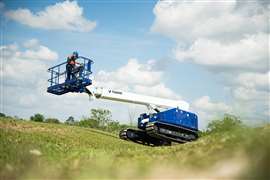 The stability and excellent weight distribution of crawler AWPs give operators the confidence to trust them on challenging terrain
For contractors, the challenge is therefore not only to complete the work, but to do so within restricted programs and with as little disruption as possible.
Before any repair can begin, workers must first reach it.
Many of the structures now requiring attention were built decades before modern access equipment became available. Maintenance teams may need to work beneath bridge decks, above waterways, alongside live traffic or across terrain that was never intended to support construction machinery.
“The biggest hindrance in maintaining aging infrastructure is accessing it,” says Tyler Brown, AWP Business Manager at Tadano. “A lot of these structures are in difficult-to-reach areas.”
Factors affecting AWP selection
Selecting the right aerial work platform (AWP), involves far more than matching working height and platform capacity to the task. Site access, ground conditions, travel routes and the frequency with which a machine must be repositioned can all influence which platform is best suited to the application.
Those considerations are often overlooked once the required working height has been established. For many contractors and rental customers, machine selection begins and ends with height and platform capacity, even though those specifications answer only part of the question.
“What people do sometimes forget when choosing an AWP is that there’s more involved than capacity and height,” says Erik Elzinga, VP of AWP Business Development at Tadano.
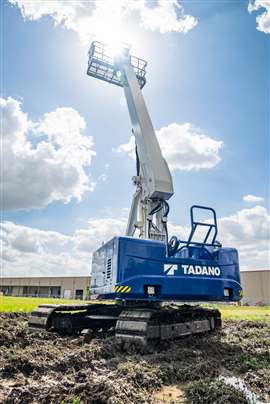 A combination of high reach and maneuverability on challenging terrain makes crawler AWPs ideal for infrastructure operations
“Do you have to reach over something? How are you going to get the AWP to its specific location on site? What are the ground conditions? How many locations must you move it to?
“Choosing the right access machine for the application is in these details. Go beyond capacity and height. Go to the details.”
Those details begin with identifying a suitable position from which the work can be carried out safely, before considering how the machine will reach that location. Once that process begins, characteristics that receive far less attention than height or platform capacity often become the deciding factors.
Ground conditions are among the first of those considerations. As Brown explains, “A traditional wheeled machine, which represents around 95% of the AWP industry, is generally designed to operate on prepared construction site surfaces.
“Crawler technology allows an AWP to travel across a much wider variety of conditions, whether that’s mud, snow, ice, sand or rocky terrain.”
The misconception about tracked AWPs
That capability has largely shaped how crawler-mounted platforms are perceived. They are often viewed as specialist machines intended only for steep gradients, soft ground and remote locations where wheeled platforms cannot operate. Brown believes that perception has created one of the industry’s biggest misconceptions.
“A lot of people think you should only be operating a crawler machine in mud, snow, ice, or challenging ground conditions,” he says. “That’s not true.”
Modern crawler-mounted AWPs are designed to operate across a much broader range of environments than many contractors realize.
“Just because the machine has tracks doesn’t mean that you can only operate it in very, very challenging conditions,” Brown says. “You can also operate everywhere that a wheeled machine operates.
“For example, machines fitted with non-marking rubber tracks can travel across freshly paved surfaces and, in some applications, even carpet – but they also have low ground pressure and traction that make the tracked undercarriage effective on softer terrain.”
That broader operating envelope can prove particularly valuable on infrastructure projects, where site conditions often vary within a single job. A platform may need to travel across an embankment to reach a bridge, work on finished paving beneath the structure, then relocate to another area where the ground conditions are entirely different.
Low ground pressure spreads the machine’s weight across a larger surface area, reducing the risk of damaging sensitive ground, while a compact footprint and tight turning radius can make it easier to maneuver through confined working areas.
These characteristics don’t change the height a platform can reach; what they do is allow the platform to be positioned where that height becomes useful.
Thinking beyond the project
While Brown focuses on the capabilities of crawler technology in the field, Elzinga believes contractors and rental companies also need to think more broadly about how those capabilities support the varied demands of infrastructure maintenance and repair.
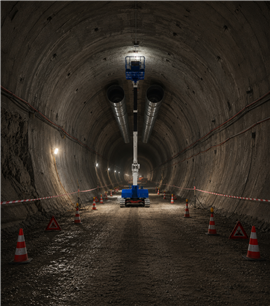 This type of AWP is ideally suited to operations within under-construction tunnels
Infrastructure maintenance never involves the same conditions from one project to the next – or even from one day to the next. A machine selected for one project may spend years working across a wide range of infrastructure sites, making versatility an important consideration when building a fleet.
“That fleet of AWPs could be as efficient, or more efficient, if maybe half of them were crawlers,” he says. “You can still send the crawlers out for the same job that the wheeled machines could do, but when you have crawler technology in the fleet, you can do something you’ve never been able to do before.”
Elzinga does not see crawler-mounted platforms as a straight replacement for wheeled machines. If an infrastructure project involves travelling long distances over firm, prepared ground, his advice is clear: “Go rent a wheeled machine. That’s what should be done.”
Where routes include soft ground or conditions that are likely to deteriorate during the course of a project, a crawler can allow work to continue without changing machines.
For contractors and rental companies supporting infrastructure work, this broader operating range can also extend utilization into the spring and autumn months, when softer ground may restrict conventional wheeled platforms.
As Elzinga explains: “In the spring and the fall, when the ground is not as hard and compact, you can use them more during those periods.”
Beyond the purchase
Greater utilization also places greater emphasis on machine availability. For contractors and rental companies supporting infrastructure projects, maintaining AWPs and minimizing downtime are essential to keeping work moving.
Preventive maintenance, Elzinga argues, is fundamental because it allows potential problems to be identified before they result in an unwanted issue. “Do what you’re supposed to do, within the recommended time frames,” he says. “Good maintenance helps you identify the part that the customer tells you needs attention.”
Regular inspection helps minimize unplanned downtime and keep machines available for work, reducing the risk of disruption on projects where delays can have wider consequences for the public, asset owners and other contractors.
Ownership considerations also extend beyond maintenance. Infrastructure work frequently requires platforms to be transported between sites, making loading and unloading a routine part of day-to-day operations.
Tracked platforms function differently from wheeled machines when loading onto trailers, particularly as they pass over the crest of loading ramps. Features such as smooth low-speed controls and articulating track rollers are designed to provide greater control during loading and unloading, helping operators position machines more safely and precisely.
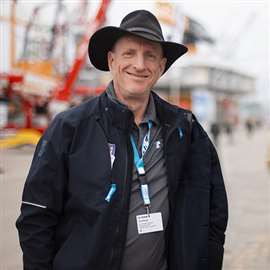 Erik Elzinga, Tadano’s VP of AWP Business Development
As infrastructure owners continue to extend the service life of aging assets, access equipment will play an increasingly important role in helping contractors complete inspections, maintenance and repairs safely and efficiently.
For Tyler Brown and Erik Elzinga, choosing the right AWP is far more than working height or platform capacity. Ground conditions, project duration and the wider demands of the worksite all influence whether a platform is capable of delivering the performance a project requires.
As Elzinga puts it: “It’s important to consider the complete worksite when you are choosing your piece of equipment.”
Ultimately, selecting the right access solution has become an increasingly comprehensive exercise, one that means looking beyond the headline figures of the specification sheet.
Understanding how and where a machine will operate – and how it will be maintained once in service – is just as important as how high it can reach.
--------
This article was produced by KHL Content Studio, in collaboration with experts from Tadano
--------
All images courtesy of Tadano
--------