An intelligent machine ecosystem: Zoomlion’s approach to the future of mining
Partner Content produced by KHL Content Studio
16 June 2026
Mining operators around the world are under increasing pressure to produce more material while reducing environmental impact and improving workforce safety.
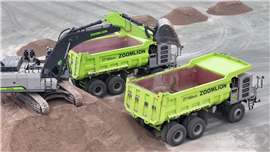 Zoomlion’s autonomous haul trucks integrated with remotely operated excavators enable fully unmanned shovel-load-haul-dump operations
Factor in labour shortages, rising energy costs and stricter sustainability targets, and the logic of investigating automation, electrification and digital intelligence becomes clear.
Today, we are increasingly seeing autonomous haulage systems, remote-controlled equipment and real-time operational intelligence moving from pilot projects into large-scale deployments in open-pit mining operations.
A number of industry studies have identified the benefits, with a report from Ernst & Young forecasting that digital transformation could deliver an improvement in mining productivity of up to 23% by 2030.
At the same time, these technologies are helping operators improve asset utilisation, reduce downtime and optimise energy consumption.
According to Yu Xiao Ying, Head of Smart Mining Projects at Zoomlion, today’s productivity targets, safety requirements and sustainability objectives are significantly changing the way mining operations are designed and managed.
These changes are shaping Zoomlion’s approach to mining, with the company focusing on integrated solutions built around green power systems and full-stack intelligence.
This strategy is already being deployed at scale, with hundreds of Zoomlion autonomous mining trucks operating across mining projects in Xinjiang and Inner Mongolia, while the company’s hybrid and electric mining trucks have each accumulated more than 8,000 operating hours.
The evolution of smart mining
The concept of the intelligent mine has evolved significantly over the past decade. Early digitalisation initiatives focused primarily on equipment monitoring, fleet management and operational reporting.
More recently, however, advances in machine vision, artificial intelligence, connectivity and autonomous vehicle technology have expanded the possibilities for automation.
While fully autonomous mining operations remain relatively uncommon, many sites are already implementing elements of autonomy, including autonomous haulage, remote-controlled excavation and predictive maintenance systems.
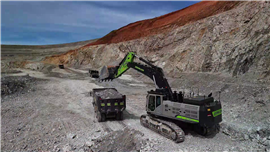 Zoomlion mining excavators and haul trucks operating at an open-pit mine in Inner Mongolia, China
These technologies are increasingly being viewed as practical solutions to long-standing industry challenges such as risk reduction and workforce shortages.
For Zoomlion, the intelligent mine is built around a three-layer architecture encompassing machine intelligence, fleet intelligence and cloud intelligence.
At the machine level, autonomous haul trucks can perform functions including path planning, automatic parking, obstacle avoidance, yielding and excavator-truck coordination.
At the fleet level, Zoomlion’s self-developed technology enables unmanned shovel-load-haul-dump operations by integrating autonomous trucks with remotely operated excavators.
The third layer is cloud intelligence. Through its smart mine supervision platform, Zoomlion combines digital twin technology, equipment health monitoring and operational analytics to provide managers with a real-time view of operations across the site.
As Yu observes, “Intelligent mine operations are no longer a concept. They are becoming a systematic reality.”
The objective is to create an operating environment in which machines, software platforms and management systems work together to improve decision-making, productivity and overall mine performance.
The power of system-level coordination
One of the defining characteristics of modern smart mining is the growing emphasis on system-level optimisation.
While autonomous vehicles often attract the most attention, many industry experts believe the greatest productivity gains come from coordinating entire workflows rather than maximising the performance of individual machines.
Zoomlion recently deployed a complete smart mine solution at a large open-pit metal mine in northern China, combining autonomous mining trucks, remotely operated excavators and an intelligent fleet scheduling platform within a fully unmanned shovel-load-haul-dump workflow.
Operating continuously throughout the year, the system increased average daily haulage trips per truck by more than 10%, while reducing waiting times and improving fleet utilisation.
In this example, the key enabler is dynamic fleet coordination. By continuously synchronising trucks, excavators and haul roads, the scheduling platform reduces queuing, minimises empty travel and improves material movement throughout the operation.
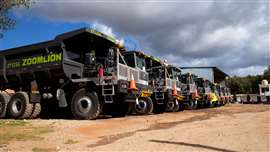 Delivery of Zoomlion ZT125G mining dump trucks to a customer in Peru
“The smart mine is essentially a complex system of multiple equipment types and processes, not just a collection of individual machines,” says Yu. “The fleet scheduling system acts as the central nervous system connecting everything together.”
The work being undertaken by Zoomlion reflects a broader trend within mining, where software and operational intelligence are increasingly becoming as important as the machines themselves.
From pilot projects to production fleets
Autonomous haulage systems are one of the most mature applications of mining automation, with large-scale deployments around the world now demonstrating their potential to improve equipment utilisation and reduce operational variability.
Research by McKinsey & Company has suggested that autonomous haulage deployments can deliver productivity improvements of around 20% in certain mining operations.
Achieving reliable autonomous performance in real-world mining environments, however, remains a considerable engineering challenge.
Unlike controlled industrial settings, mines present highly dynamic and often unpredictable conditions, with dust, unpredictable terrain, vibration and extreme weather all able to affect the performance of autonomous systems.
These challenges have shaped manufacturers’ technology development.
Zoomlion, for example, has invested heavily in proprietary technologies designed specifically for mining applications, including native drive-by-wire truck platforms, advanced path tracking systems, 3D vision technology and point-cloud semantic segmentation for dust filtering.
Safety has also been a major area of focus and the company has developed multiple layers of redundancy within critical control and braking systems to ensure continued safe operation in the event of component failures.
“Core control systems and braking systems require multiple levels of redundancy,” Yu explains. “If a single point fails, the system must automatically switch over while maintaining safe operation.”
Combined with intelligent obstacle avoidance and emergency braking capabilities, these technologies are intended to provide the reliability required for continuous 24-hour autonomous operation.
Converging technology pathways
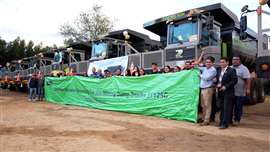 Customer in Peru welcomes the delivery of the new Zoomlion ZT125G mining dump trucks
Across the mining industry, automation, electrification and digitalisation are often discussed as separate technology trends. Increasingly, however, operators and equipment manufacturers are recognising the close relationship between them.
As mines pursue decarbonisation targets, demand is growing for low-emission equipment and alternative power systems.
At the same time, autonomous fleets generate large volumes of operational data that require increasingly sophisticated software platforms to manage and optimise performance.
The result is a growing convergence between energy systems, autonomous equipment and digital intelligence.
Zoomlion views these technologies as three interconnected pillars of the future mine.
“Automation, electrification and digitalisation are the three pillars of the smart mine,” says Yu. “None can be absent and they must evolve together to deliver maximum benefit.”
Autonomous haulage systems, for example, depend on digital fleet management platforms to coordinate equipment movements efficiently, while electric fleets increasingly require intelligent energy management systems capable of balancing charging schedules with productivity targets.
One mine, one tailored solution
As mining operations become more technologically sophisticated, many equipment suppliers are moving beyond traditional equipment sales toward more consultative approaches.
Zoomlion describes this philosophy as “one mine, one tailored solution”.
Rather than offering standardised equipment packages, the company develops site-specific solutions tailored to each operation’s geology, production requirements, infrastructure and automation readiness.
The process extends beyond equipment selection to include site surveys, operational planning, software calibration, deployment strategies and ongoing optimisation.As hardware technologies become increasingly comparable across manufacturers, software is emerging as a key differentiator. The ability to manage data, optimise machine behaviour and coordinate fleet activities is becoming central to overall mine performance.For equipment suppliers, this represents a broader shift from delivering machines to delivering outcomes.
The “one mine, one tailored solution” concept extends well beyond the deployment of smart mining technologies. Rather than focusing solely on equipment selection, Zoomlion works with customers to develop customised solutions covering equipment configuration, application matching, service support, spare parts supply, maintenance planning and long-term operational requirements throughout the lifecycle of the mine.
This customer-focused approach has also delivered tangible market results. In 2025, Zoomlion accelerated its expansion into China’s high-end mining equipment market. Internationally, the company’s products entered 99 new mining operations, while overseas sales revenue increased by more than three times year-on-year.
The next phase of mining transformation
Fully autonomous mines may still be a prospect for the future, but the pace of technological development is accelerating.
Autonomous haulage is already taking place at scale, while remote-controlled excavation, intelligent drilling systems and advanced fleet management platforms are becoming increasingly sophisticated.
Artificial intelligence is also expected to play a major role in the next phase of development. McKinsey & Company has estimated that as much as 30% of manual mining tasks could be automated by 2030, as AI, autonomy and advanced analytics continue to integrate into mining operations.
Zoomlion believes these technologies will eventually support capabilities such as autonomous digging, self-learning machinery, advanced obstacle avoidance and highly coordinated fleet operations.
At the same time, mining business models may continue evolving beyond traditional equipment ownership toward service-based approaches focused on equipment availability, operational efficiency and lifecycle performance.
Despite this progress, Yu believes the transition to fully unmanned mining operations will take time.
“Fully unmanned mines are a long-term goal,” she says. “Over the next five to ten years, we expect open-pit mines to achieve a very high degree of automation, with personnel moving from on-site operation to remote monitoring and maintenance.”
What is becoming clear is that the future mine will not be defined by a single technology. Rather, it will depend on the successful integration of autonomous equipment, low-carbon energy systems and digital intelligence into a connected operational ecosystem.
For companies capable of bringing those elements together, the next generation of mining is already beginning to take shape.
--------
This article was produced by KHL Content Studio in collaboration with experts from Zoomlion.
--------
All images courtesy of Zoomlion.
--------