Building operational resilience in industrial engine applications
Partner Content produced by KHL Content Studio
10 September 2026
Across today’s industrial landscape, reliability has become one of the industry’s most frequently used – and often misunderstood – terms.
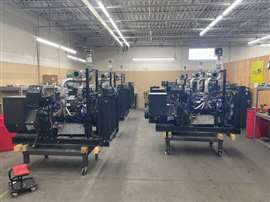 EPA Certified Reliable Horsepower engines in the production cell
For years, reliability was largely measured by a straightforward question: Will the engine run? Today, the conversation is considerably broader.
Across agriculture, oil and gas, power-gen, and other industrial applications, operators are evaluating reliability through the lens of operational resilience – how quickly equipment can be serviced, how effectively lean maintenance teams can support growing fleets, how readily parts and technical expertise are available, and ultimately, how much unplanned downtime a business can afford.
According to Jay Canada, VP of Sales & Engineering at IIS/Reliable Horsepower, the industry’s definition of reliability has fundamentally evolved.
“Uptime has become a bit of a buzzword,” he says. “But what people are really concerned about is minimizing unplanned downtime. Reliability is understanding when there has to be planned downtime – and avoiding the ‘Oh my gosh, now we’ve got a big problem’ downtime.”
Canada believes that shift accelerated as equipment costs climbed over the past several years. “As capital investments have increased, so too have customer expectations around uptime, service life, and long-term performance,” he points out.
And the expectations extend well beyond whether an engine starts every morning. “Lost production is a huge thing,” he says. “But you’re also paying your labor team, service labor hours, travel time for technicians, and a lot of other things that you may not think of right on the surface.”
 Jay Canada, VP of Sales & Engineering for IIS
Those costs often continue long after the equipment is back online, says Blake Thompson, Engine Package Sales Lead with IIS/Reliable Horsepower. “That downtime can also erode customer confidence and brand reputation – not to mention additional downstream costs like emergency labor, expedited shipping, and lost opportunities.”
As those financial pressures have grown, so has the conversation surrounding long-term ownership. According to Canada, customers today are placing greater emphasis on maintenance strategy.
“Because of the cost of labor, parts, and components, end-users and OEM customers are increasingly looking for longer maintenance intervals,” he says. “It’s not just about performance on day one anymore. “It’s, ‘What’s ownership going to be like five, ten, or fifteen years from now? Is there going to be support down the road – not just right after the sale?’”
Keeping it simple
The industry’s labor shortage is also reshaping maintenance strategies. According to Canada, operators are increasingly looking for longer maintenance intervals that allow smaller teams to support more equipment without sacrificing reliability.
“Today’s maintenance technicians need a different skill set than they did 15 years ago,” he explains. “They need to know how to run software systems, connect to engine ECUs with a laptop, and diagnose electrical issues. It’s a broader skill set within what’s already a challenging labor pool.”
Aaron Vancura, IIS/Reliable Horsepower’s Engineering and Technical Support Manager, adds that those realities are driving demand for equipment that’s easier to diagnose and support. He says, “Comprehensive troubleshooting guides, supporting documentation, and strong dealer networks have become increasingly valuable as companies work to maximize lean maintenance teams.
“That ultimately extends beyond maintenance intervals to serviceability itself. In many applications, serviceability is just as important as engine performance.
“Customers are asking how quickly they can access parts, where those parts come from, and whether they have the right support network to keep equipment running.”
Vancura notes that simpler equipment naturally reduces downtime because it’s faster to service and less prone to maintenance errors.
“That’s important,” he says, “because, more commonly, customers are placing greater emphasis on localized parts inventories and nearby service support before making purchasing decisions.”
Within reach
Such discussions also challenge some common assumptions operators make when evaluating long-term ownership. According to Thompson, many focus heavily on upfront costs while overlooking questions that ultimately determine the total cost of ownership.
“Questions like, ‘Is this engine still going to be around in five or ten years?’ ‘Will I still be able to source components?’ ‘What happens when it comes time for service and replacement?’ Those are questions a lot of people aren’t asking.”
Canada points to another common mistake: stretching or skipping factory-recommended maintenance intervals in an effort to reduce costs.
 Blake Thompson, Reliable Horsepower’s Engine Package Sales Lead
“Longer maintenance intervals have to be engineered into the application,” he says. “They need to be discussed and agreed upon before an engine is put into service – not something operators decide to stretch later because they think they’re saving money. It usually ends up costing them much more in the long run.”
As equipment becomes more sophisticated, Thompson acknowledges that reliability also depends as much on support infrastructure as it does on the engine itself. “If parts availability and the supplier support aren’t there, you can run into quite a few downstream implications.”
Canada adds, “There’s a big difference between service parts being in stock locally and having them sit in a manufacturer’s warehouse halfway across the country—or even in another country. Understanding the true lead time for parts and service components is really important for customers in the field.”
The philosophy extends into equipment design as well, says Vancura. “The goal is to keep engine packages as straightforward and serviceable as possible, particularly in remote applications where a technician may face hours of travel – or even a helicopter flight – before reaching the equipment.”
Beyond price
The growing use of telematics is also changing how maintenance is planned and executed. Vancura describes remote monitoring as another tool – not a replacement for sound maintenance practices, but one that allows operators to identify potential problems before they become failures.
“It turns a lot of engine shutdown conditions into warnings,” he says. “You can collect and trend data, watch for degradation or loss of efficiency, and catch a lot of these things before they become problematic.”
Beyond reducing unexpected downtime, the technology also allows maintenance teams to better prioritize their time. Rather than making routine trips simply to check equipment status, notes Canada, technicians can focus on servicing the units that actually need attention – which lays the foundation for predictive maintenance and represents a significant advantage for operations spread across multiple or remote locations.
“It’s not a magic wand, but it’s a very important tool in the toolbox,” he emphasizes. “By looking at operating parameters and duty cycles, we’re able to better understand how an engine has actually been used, and adjust maintenance intervals accordingly.”
The result, he says, is a more proactive maintenance strategy that enables lean service teams to support more equipment with the same personnel.
Fuel selection, meanwhile, has become an increasingly important part of the maintenance conversation. According to Vancura, cleaner-burning fuels, such as propane, reduce many of the contaminants that can accelerate engine wear, while less consistent fuel sources may require additional treatment, shorter service intervals, and more frequent maintenance.
Thompson says differences in fuel selection have expanded such conversations well beyond price. “Maintenance, emissions compliance, availability, and technician familiarity are increasingly part of the evaluation as operators consider how different options will affect equipment throughout its lifecycle,” he says.
And Canada points specifically to the maintenance differences between modern diesel and spark-ignited systems. “Servicing or replacing a three-way catalyst on a spark-ignited engine is less expensive than servicing a DPF or SCR system on a comparable diesel,” he explains. “All of those things factor into the overall cost.”
 Aaron Vancura, Technical and Engineering Support at Reliable Horsepower
Fuel flexibility is another contributor to operational resilience. Rather than relying exclusively on a single fuel – and accepting the exposure that comes with price fluctuations or supply disruptions – operators can increasingly build redundancy into their power strategy.
Vancura offers oil and gas as an example. “Operations running on wellhead gas can use propane as a backup when the quality or quantity of that fuel declines, allowing equipment to remain operational until the primary supply returns,” he says. “Two fuels, one engine.”
The right solution
Looking ahead, Canada believes the industry’s approach to reliability will become increasingly proactive rather than reactive.
“Operators and owners have come to understand that preventative maintenance is paramount to reliability,” he says. “You’ll continue to see collaboration between owners, end-users, engine manufacturers, and package integrators to tailor maintenance to the application.”
That same philosophy, he notes, is shaping equipment long before it reaches the field. Vancura adds that the engineering focus extends to reducing unnecessary complexity wherever possible.
“While modern engines inevitably require specialized diagnostic capabilities,” he says, “the goal is to make those tools accessible and the diagnostic interfaces as intuitive and human-readable as possible.”
Ultimately, Thompson believes the industry’s future lies in collaboration rather than standardization. “We work closely with our OEM customers to develop what’s right for their specific application,” he says. “They know what they need, they know their end goal, and that collaboration helps us deliver the right solution at the end of the day.”
--------
This article was produced by KHL Content Studio, in collaboration with experts from IIS/Reliable Horsepower
--------
All images courtesy of IIS/Reliable Horsepower
--------