

Building the intelligent mine: Why integration will define mining’s next era
Partner Content produced by KHL Content Studio
30 June 2026
Yu Xiao Ying, Head of Smart Mining Projects at Zoomlion, talks to KHL Content Studio about how mining – and mining equipment – is changing…
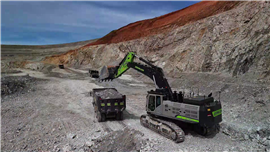 Zoomlion mining excavators and haul trucks operating at an open-pit mine in Inner Mongolia, China
At Zoomlion, we see three forces shaping the future of mining: productivity, safety and sustainability.
Together, they are driving the adoption of autonomy, electrification and digitalisation at a rapid pace.
For this reason, these three elements are the three pillars of the smart mine. None can be absent, and they must evolve together to deliver maximum benefit.
Moving beyond individual machines
One of the biggest misconceptions about mining automation is that it is simply about autonomous trucks or remote-controlled equipment. In reality, the value comes from connecting machines, people and data into a single intelligent ecosystem.
At Zoomlion, our smart mine architecture is built on three layers: machine intelligence, fleet intelligence and cloud intelligence.
At the machine level, autonomous haul trucks can perform functions such as path planning, obstacle avoidance, automatic parking and excavator-truck coordination.
 Yu Xiao Ying, Head of Smart Mining Projects at Zoomlion
At the fleet level, autonomous trucks and remotely operated excavators work together to enable fully integrated shovel-load-haul-dump operations.
Above this sits cloud intelligence, where digital twins, equipment health monitoring and operational analytics provide real-time visibility across the entire mine.
The smart mine is essentially a complex system of multiple equipment types and processes, not just a collection of individual machines.
The fleet scheduling system acts as the central nervous system, connecting everything together.
This system-level coordination is critical. Even highly intelligent machines cannot deliver their full value if they operate independently. The real gains come from reducing waiting times, minimising empty travel, optimising equipment utilisation and improving decision-making across the entire operation.
Turning smart mining into measurable results
The benefits of this approach are already being demonstrated in the field.
At a large open-pit mine in Xinjiang, Zoomlion deployed a complete smart mining solution integrating autonomous mining trucks, remotely operated excavators and intelligent fleet scheduling software.
The project operates in an extremely challenging environment, with winter temperatures falling to -25°C and strong winds creating difficult operating conditions.
Despite these challenges, the mine now operates with 40 autonomous trucks running continuously, achieving equipment availability above 95%.
The results have been significant, with transportation efficiency up by around 10% and overall output by approximately 15%.
Why software is becoming the differentiator
In the mining industry, manufacturers have access to increasingly similar components, whether in powertrains, sensors or hydraulic systems. What increasingly differentiates machine performance today is software.
Software determines how machines perceive their environment, how fleets coordinate activities, how energy is managed and how operational decisions are made.
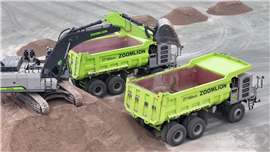 Zoomlion’s autonomous haul trucks integrated with remotely operated excavators enable fully unmanned shovel-load-haul-dump operations
At Zoomlion, we have invested heavily in full-stack development, from drive-by-wire vehicle architecture and autonomous control systems to fleet scheduling platforms and cloud-based management tools.
This allows us to adapt solutions quickly, improve performance continuously and respond to the specific requirements of different mining operations.
The ability to collect data, refine algorithms and continuously optimise performance creates a cycle of improvement that becomes increasingly valuable over time.
One mine, one tailored solution
Geological conditions, production targets, haul distances, infrastructure and workforce requirements differ from one mine to the next. That is why successful smart mining cannot rely on standardised solutions.
We work closely with customers to understand their individual objectives and design a roadmap that matches their operational reality.
For some sites, that may mean implementing autonomous haulage at scale. For others, it may begin with remote excavator operation, fleet optimisation or electrification initiatives.
The goal is measurable improvements in safety, productivity and sustainability.
The road ahead
While fully unmanned mines could become a reality at some point, they remain a long-term objective. That said, progress is accelerating: autonomous haulage is already operating at scale; remote excavation technologies continue to mature; artificial intelligence is opening new possibilities for autonomous decision-making, obstacle avoidance and fleet coordination.
Over the next five to ten years, I expect many large open-pit mines to achieve very high levels of automation, with workers increasingly moving from frontline operations into remote supervision, maintenance and data-driven decision-making roles.
Importantly, automation does not eliminate people. It removes people from dangerous, repetitive and physically demanding tasks and creates new opportunities in higher-value technical roles.
Ultimately, the future mine will be defined by the successful integration of autonomous equipment, intelligent software and low-carbon energy systems into one connected ecosystem.