

Compaction is becoming smarter – and that’s changing how we build better roads
Partner Content produced by KHL Content Studio
21 September 2026
Caterpillar’s Rolf af Klinteberg believes the latest mapping and measurement technologies could bring significant changes in soil compaction, leading to benefits for both contractors and asset owners…
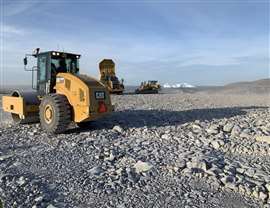 A Caterpillar soil compactor works on a project in Greenland
af Klinteberg says...
When people think about building roads, they naturally focus on the surface they can see. I tend to think about what’s beneath it.
In my experience, soil compaction is one of the most important – and one of the most underestimated – parts of any earthmoving or roadbuilding project.
Get it right and you create the conditions for long-term durability; get it wrong and the consequences - which may not appear until months or even years later – can be settlement, rutting, cracking or costly maintenance.
The truth is, compaction is relatively inexpensive to do properly during construction, but exceptionally expensive to correct once the project has moved on.
That’s why I believe it’s time we stopped thinking of compaction as a routine compliance exercise and started treating it as a critical performance process.
From passing tests to building consistency
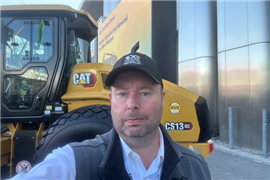 Cat Paving’s Rolf af Klinteberg
One of the biggest issues I see is that many projects still focus on passing isolated spot tests rather than achieving consistent compaction across the whole site.
Traditional density and moisture testing has an important role, but by its nature it only samples selected locations. Large areas can remain unverified, even though they ultimately determine how an asset performs throughout its life.
The real objective should not simply be passing a specification at a handful of points; it should be delivering uniform soil behaviour across the entire working area.
This is a subtle but important shift in mindset, but it changes compaction from something you check afterwards to something you actively manage while the work is taking place.
Experience matters – but data makes it stronger
Compaction has always depended heavily on operator judgement. Skilled operators develop an instinct for reading machine response, changing soil conditions and diminishing returns from additional passes.
The challenge is that those experienced operators are becoming harder to find.
As the industry faces ongoing skills shortages, many newer operators simply haven’t had years of mentoring on site.
Technology cannot replace that experience, but it can accelerate learning by providing immediate feedback and helping operators connect what they are seeing and feeling with measurable results.
This is where intelligent measurement and mapping technologies are making a real difference. Rather than relying solely on fixed pass counts or habit, operators can see how the ground is responding in real time, identify weaker areas sooner and avoid wasting time compacting material that has already reached the desired condition.
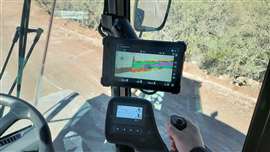 Operators have a real-time view of compaction progress with Caterpillar’s mapping technology
I don’t see data replacing operator judgement. The best results still come when experience sets the direction and measurement validates, refines and supports those decisions.
Seeing the whole picture
One development I’m particularly excited about is the growing use of compaction mapping.
Basic measurements tell you what happened at one location. Mapping shows you what happened everywhere. That wider view allows contractors to identify patterns, transitions and weak zones that isolated tests cannot reveal.
Accurate positioning is fundamental. High-precision positioning technologies, including Virtual Reference Station (VRS) services, mean mapping data can be trusted and compared across different layers, shifts and work areas, without relying on local base stations.
For contractors, that can turn into practical benefits: fewer unnecessary passes, reduced fuel consumption, lower machine wear and less rework.
Just as importantly, it creates a much stronger quality record that supports project delivery and future asset management.
At Caterpillar, we’re increasingly integrating these capabilities into compaction workflows. The value isn’t in collecting more data, but from giving operators reliable information they can use while they’re working.
Building connected jobsites
Looking ahead, I expect compaction to become an increasingly connected part of the wider construction process.
Compaction data is already beginning to integrate with grading, paving, quality assurance and project management systems.
Over time, we’ll see more operator-assisted automation, smarter machine guidance and increasingly automated documentation that improves traceability without adding to the administrative burden.
Artificial intelligence will also have an important role – not by replacing people, but by identifying patterns, highlighting potential risks and helping supervisors make better-informed decisions.
Ultimately, I believe the future of compaction is not about removing human judgement, but about reducing uncertainty.
When operators have better information as decisions are made, projects become more consistent, more efficient and more predictable.
And for an industry under pressure to deliver higher quality with fewer experienced people, that’s a significant step forward.
--------
This article was produced by KHL Content Studio, in collaboration with experts at Cat Paving
--------
All images courtesy of Cat Paving
--------