

Crawler-mounted boom lifts rise to the challenge of bridge work
Partner Content produced by KHL Content Studio
11 June 2026
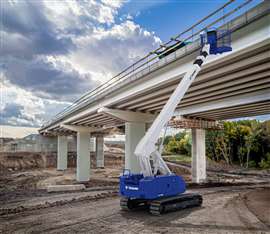 Crawler-mounted boom lifts are becoming increasingly important on bridge inspection and repair projects
When it comes to bridge construction, inspection and maintenance, crawler-mounted boom lifts are often the only sensible solution, particularly when it comes to those crossing rough or soft terrain such as creek beds or sandy environments.
In the US alone, more than 222,000 bridge spans require repair, and 76,600 bridges need to be replaced, according to a 2023 report by the American Road and Transportation Builders Association.
In Europe and across much of the rest of the world, this scope of work is likely to be similar.
Growing rental awareness
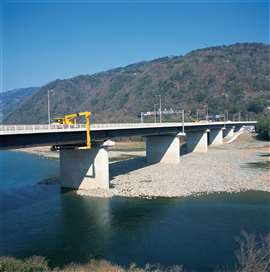 Tadano's BT-400 truck-mounted lift is specifically designed for carrying out bridge inspections
As things generally stand today, says Tyler Brown, National Business Manager for AWPs at Tadano America, “The general rental industry uses standard wheeled units, and if a bridge job came in, they would try to rent out what they already have, that being the wheeled boom lift, and, in many cases, require the need to utilize a crane to place the machine at the base of the bridge.”
This highlights, he says, the need to build awareness of the crawler mount’s potential for the rental sector “from the ground up” – including for bridge work in challenging terrain.
“When people think of bridges,” says Erik Elzinga, VP Business Development, AWPs, “they often think about famous and iconic bridges such as the Golden Gate bridge.
“Those bridges are important, but the majority are found on highways or railways which go for hundreds of miles through the wilderness and pass over marshes, shallow rivers or sandy spots, and that’s where crawler technology is widely used.”
This type of terrain is in stark contrast to the prepared surfaces one might find below bridges found in urban environments where the common self-propelled wheeled boom lift is a suitable option.
“It’s the unprepared surface that is the main challenge,” says Elzinga. “If you’re on a construction site for an office block or residential building, there is the obvious incentive to pre-prepare the ground, partly because you’re going to need parking areas and sidewalks once you’ve finished.
“So, you will bring in the dirt moving equipment and then it’s very easy to bring a wheeled aerial work platform or any wheeled product onto the site.”
Where a bridge spans a remote creek bed, there is no incentive to prepare the ground surface.
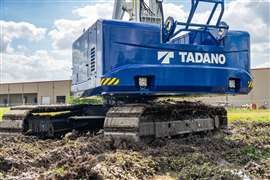 Crawler lifts are often utilized on bridge projects in remote areas, or within challenging terrain
In fact, says Elzinga, there is a disincentive as there is often a requirement for the environment and wildlife to return to its natural state once the work is done.
“Therefore, the nature of bridge work requires a solution for difficult terrain and the solution is always going to be crawler technology, versus wheeled self-propelled units, which have a tendency to sink into soft ground,” says Elzinga.
Performance advantages of crawlers
Key to crawler-mounted booms is the low ground pressure that they provide. Pounds per square inch (PSI) can be as low as 5.8psi (1000 Pa) for units operating without a jib. A typical wheeled boom lift can be rated at 80psi and even up to 112psi (770 kPa), depending on the model and attachments.
“One of the differences with wheeled machines is they have what is like a road going truck tire.
“You would never drive across an unprepared surface with a heavy rig and that’s why you need a true excavator-style crawler,” says Brown.
 Erik Elzinga
Strong gradeability and zero turning radius are also key attributes of the crawler boom lift, helping them negotiate the steep, muddy banks leading to the underbridge areas.
The zero-turning radius of a crawler-mounted lift also compares well with a typical boom lift, which can have a turning radius of up to 11ft (3.4 m).
Crawler mounts can have a gradeability of up to 57%, compared with the 45% offered by the average wheeled mounted lift.
“You can go in and out of a lot of places, whether it’s urban, suburban, rural, muddy, sandy, snowy, or icy, all with the same machine,” says Elzinga.
Sitting between wheeled and crawler boom lifts are aerial lifts, with all terrain quad tracks.
These are essentially optional attachments to standard boom lifts that can offer a PSI of 25 (170 kPa). “They can be successful, but not all the time,” says Elzinga, “If you want to make sure you don’t get stuck, you really need that true crawler base.”
He adds that transportation is also no problem for crawler boom lifts, as they are as easy to deliver as any other aerial lift, on the back of a truck.
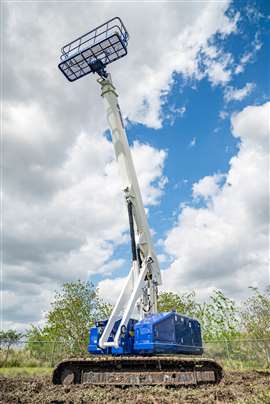 Crawler lifts typically have a slower travel speed than a wheeled lift, but their dramatically increased traction over unprepared and uneven terrain is hugely beneficial
“The only downside of crawler booms is that their maximum speed is typically slower than standard wheeled equipment,” he says. “Although, I would argue that this is a positive in rough terrain environments where control and safety is critical.”
Bridge inspection options
When it comes to bridge construction, aerial work platforms complement other onsite equipment such as cranes, earthmoving machines, concrete pumps, scaffolding and formwork equipment.
In this situation a crane would lift the steel bridge structure beams into position while the operator in the aerial lift bolts or welds it into place.
Although bridge construction is a major application for crawler-mounted boom lifts, bridge inspection is often where new bridge work starts. “Whether it’s a light or major repair, it all starts with inspections,” says Elzinga.
There are alternative equipment options when it comes to bridge inspection, including truck-mounted underbridge inspection units which park on the bridge, lower a basket with an operator and position them under the structure, where it can be checked for damage or wear and tear.
Drones are another potential choice, which can easily be deployed at a relatively low cost. But they have a significant drawback, in that they cannot detect defects that lie under foreign objects that have lodged on the bridge structure.
Brown explains, “If you send a drone up it may see a lot, but it won’t see a cracked weld that is hidden under a bird’s nest, for example. So, there’s really no replacement today for sending a human being up there with a stick and a poke to see what’s there and be certain you haven’t missed anything.”
The broad footprint of the crawler-mounted boom lift is also useful in other environments where bridges are found, for example where they cross waterways, including rivers and canals, which means the work must be carried out using barges.
 Tyler Brown
While wheeled boom lifts can be used on barges, crawler-mounted boom lifts lend themselves more easily to the task.
“The crawler mount is a preferable option,” says Elzinga, “as you can drive a crawler over a gap between the dock and the barge a lot easier than you can a wheeled machine, and then once you’re on the barge you can use its zero turning radius to skid steer into position.”
A growing opportunity for rental
Today, the crawler-mounted boom lift, while being a specialty product in comparison to mass produced standard wheeled boom lifts, holds huge potential, says Elzinga, particularly as an investment for rental companies interested in offering them for bridge-related work.
One of the disadvantages of offering a standard boom lift, with high PSI wheels, for bridge work is the potential need to also prepare the ground with the appropriate cribbing to ensure the machine can cross the terrain safely and efficiently.
Adding to that point, Elzinga says, “If every rental company had one or two crawler-mounted boom lifts in their fleet, it would open up a business avenue in bridge work that they maybe don’t currently have.
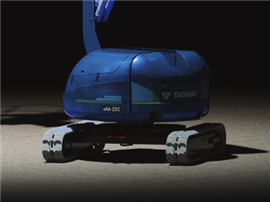 Non-marking rubber tracks allow the latest AWPs to traverse concrete without marring it
“One of the things that rental yards may be worried about with crawlers,” he adds, “is what they will do with them when the muddy season is over.”
An answer lies in applications on prepared concrete surfaces and indoors, thanks to the advances in non-marking white rubber crawler tracks.
“In the past they used carbon black in the rubber to make it last,” explains Elzinga. “However, technologies in rubber have improved over the decades and now, non-marking rubber tracks allow you to work on concrete that you typically find on a traditional jobsite.
“Now you can rent these machines to general contractors, property owners, and all other customer types without fear of marring the environment.”
The advantage of owning a crawler-mounted boom lift is clear, both for prepared ground and especially when to comes to rough terrain environment.
As Brown says, “These machines have low ground pressure that allows them to float on an unprepared surface and enough engine for a power-to-weight ratio that pushes through anything they encounter.
“Added to that is their ability to climb a hill that most people wouldn’t want to walk up. Put those things together and you start to see what makes a crawler successful.”
--------
This article was produced by KHL Content Studio, in collaboration with experts from Tadano
--------
All images courtesy of Tadano
--------