

Cutting the scrap: The true cost of a demolition shear
Partner Content produced by KHL Content Studio
05 October 2026
For a demolition contractor investing in a new shear, doing your due diligence might seem relatively straightforward. Purchase price, weight, cutting force and carrier requirements can all be compared before an attachment reaches the jobsite.
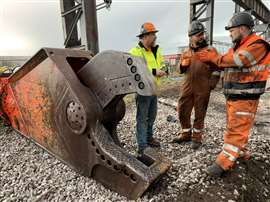 A strong relationship with the manufacturer can prolong the life of your investment
But for Ian Musto, director of UK demolition contractor HCD, that is only the start of it. Years of buying and operating specialist attachments have given him a much broader view of what due diligence really means – because the value of a shear cannot be separated from everything and everyone connected to it.
Some of those connections only become apparent once the equipment starts working.
Why the shear size is only part of the equation
“A lot of operators and company bosses think: ‘Yeah, we bought the bigger shear. It’ll cut through anything.’ No, it won’t,” says Musto.
A former machine operator himself, he knows that choosing the right shear is only part of it. Getting the best out of it depends on knowing how to use it.
 Ian Musto, director of UK demolition contractor HCD. Photo: HCD
At Tata Steel’s Llanwern site in South Wales, HCD has been using a ShearCore shear to process steel sections weighing around 21 tons each, and measuring around 1.8m wide and 7.6m long.
Initially, it took HCD’s machine operator about an hour to break each one down. Within a couple of days, he had refined the sequence of cuts and reduced that to around 40 minutes. “The ShearCore equipment is massively capable, but the operator is still a big part of what it can achieve,” says Ian.
It is also why Musto is wary of judging an attachment simply by watching it work. When a dealer recently sent him footage of a new shear, he called him back within 20 seconds.
“I said: ‘Don’t send that video out to anybody else. The machine driver is making a complete hash of that. You’re not going to sell shears after seeing that.’”
The contrast is telling. Experience allowed one operator to get more from the equipment; a lack of it made another shear look less capable than it was. If you are going to compare attachments, you first need to understand what – and who – you are actually comparing.
Why a cheaper shear can cost more in the long run
The same scrutiny applies to price. “If you’re looking to buy an attachment and you see one for £40,000 and another of the same size for £28,000, you’ve got to ask yourself why there’s £12,000 between them,” says Musto.
“I do my research. I look at how robust it is, how well it is made. And then I look at what a complete new set of cutting blades is going to cost.”
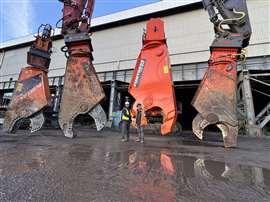 Ian Musto, right, at the delivery of HCD’s latest ShearCore Fortress FS-245 shear
This is where Musto’s interpretation of due diligence begins to reach beyond the upfront purchase price.
On HCD’s largest shear – a 20-ton Fortress FS245 from ShearCore – a set of blades costs a considerable amount of money. It is an expense that Musto never puts off. Under sustained heavy use, the contractor may turn the blades after around two weeks and replace them after four.
“A lot of other demolition companies won’t spend the money that we would spend on changing blades and turning them,” he says. “But that’s how we keep our attachments in good condition.”
Because cutting costs on blades does not necessarily save money. Leave them in service too long and, Musto says, the shear has to work harder to make the same cut, increasing stress on seals and rams as well as wear on the carrier.
Fuel consumption and carbon emissions increase too, while greater vibration makes the work harder on the operator.
The saving has not disappeared. It has simply moved somewhere else – into fuel, repairs, machine hours, lost productivity or the demands placed on the operator. All of which changes the total cost of owning and operating the attachment.
So, the question is not how long HCD can avoid another £10,000 or £11,000 bill. It is what spending that money protects elsewhere.
Minimising demolition shear downtime
Where possible, the contractor sends fitters to sites at weekends, using periods when machines are already standing to turn blades and carry out maintenance.
That planning is backed up by what the company keeps both on site and in stock.
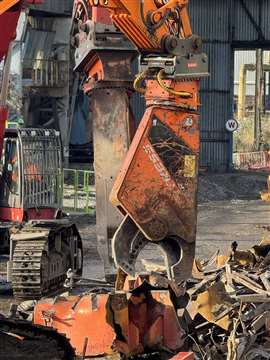 HCD bought its first Fortress FS25 Mobile Shear from ShearCore in 2022
Across its operations, HCD holds £300,000 to £400,000 worth of shear blades and spare parts. “When we use one set of blades, another is ordered,” says Musto. “For valves, we have ten in our store and when it gets down to five we order more.”
At its two Tata Steel sites in Wales, Llanwern and Port Talbot, the same approach extends to repairs that might otherwise stop a machine.
Fitters have dedicated pipe stores housed in shipping containers, complete with fittings and swaging equipment for making replacement hoses.
“When I see pipes slightly weeping on a machine, we replace them, because if you don’t, that’s the sign it’s going to blow,” says Musto.
If one does blow, HCD’s fitters can manufacture and fit a replacement hose, limiting downtime to around 20 minutes – potentially less time than it would take to travel from the working area to the gatehouse on sites of Tata Steel’s scale.
“We try to sort the problems out before they actually come to us,” he says.
Few contractors will carry the same stock or have the same facilities. But that is not really the point. The due diligence is in knowing what the business can deal with itself – and where it will need someone else.
And that is something Musto wants to know before HCD buys the attachment. What does the dealer hold? What is available from the manufacturer? How quickly can it get to site? The answers help determine what HCD needs to keep on its own shelves.
“The price is one thing, but it’s the quality and speed of the backup support we really look for,” Musto says.
That brings the support available from manufacturers such as ShearCore into the purchasing decision, rather than leaving it as something to think about once the attachment is already in the fleet.
A transaction that goes beyond the purchase
Support is not entirely one-way, either. No manufacturer, however thorough its development and testing, can replicate every material, application or condition an attachment will encounter on a demolition site.
Contractors inevitably learn things from using it that can be fed back into the next iteration of the product.
“If there’s an issue with a shear, a concrete cracker or a machine, we take that information back to the manufacturer and bring it to their attention,” he says.
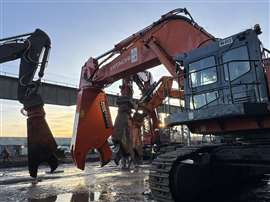 The true value of a shear goes beyond both its size and its purchase price
“As contractors, we’re the ones putting these makes and models through their paces on site. We’re going to find the problems and the weaknesses, and when we do, it’s important that we feed that back to the manufacturers.”
That exchange is also part of a relationship that can last for as long as the attachment remains in the fleet. For Musto, getting to know the equipment means getting to know the people behind it too.
He says contractors should take the time to build relationships with their dealers and manufacturers, rather than treating each attachment purchase as a transaction in isolation.
HCD bought its first Fortress FS25 Mobile Shear from ShearCore in 2022, for example, and that relationship has since grown alongside a fleet that now includes around 14 ShearCore attachments.
“They’ve got time to listen to you,” Musto says. “If you give them feedback on something they could do differently to make the product work better for you, they’re willing to listen.”
How attachment choices feed into project costs
Connections such as this are only part of what HCD has learnt over the years. Its operators and fitters, the machines and attachments working together, and the projects themselves have shown how decisions made in one part of the operation feed into another.
Musto says managers who have worked alongside him for years have come to understand those connections too. Which brings Musto back to “doing your due diligence”.
Purchase price, weight, cutting force and carrier requirements are all part of that calculation. But they are only the most immediately visible parts of it.
The attachment has to work with the machine; both depend on the operator and site team; keeping them productive brings in maintenance, parts, logistics, dealers and manufacturers; and what they can achieve ultimately feeds into the project, the contract and its price.
Seen that way, the £12,000 separating a £40,000 premium shear from a £28,000 cheaper model – or the tens of thousands that can separate them at the top end of the market – is only part of the equation.
The purchase price is just the starting point; the due diligence lies in understanding everything that connects to that decision to determine the total cost of ownership.
--------
This article was produced by KHL Content Studio, in collaboration with experts from ShearCore and HCD
--------
All uncredited images courtesy of ShearCore
--------