Dieci pushes Antarctica limits
13 June 2016
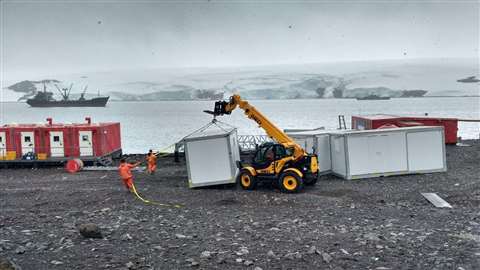
Carlini Base, on King George Island -the largest of the South Shetland Islands- lies 120km off the coast of Antarctica.
The leading international scientific research centre, which performs oceanographic, glaciological, biological and climate change research, is also home to the South Shetland Archipelago region’s only airport.
Even during the short Antarctic summer, 90% of the island is covered by ice, and temperatures range from -30° to 1°. The spring season, when the sea warms up faster than the mainland, sees large formations of cold moving up from the interior of the continent, causing storms during which wind speed may exceed 300 km/h.
One of the machines chosen to work in these adverse conditions is a Runner 40.13 telehandler, manufactured by Dieci. Rather than being customised for the work, the 4 tonne capacity machine, with a 12.4 tonne lifting height is a standard production vehicle. A handful of extra features, which are optional extras on all units, include a preheater for the engine air intake duct, a water heater and underbody protection, due to the rugged terrain.
For the majority of tasks carried out on the island: material loading and unloading, maintenance, towing, excavation and construction, the machine is also fitted with quick attachment for accessories, with hydraulic control from the cab, as well as a fork and a toothed excavation bucket.