

Engineering certainty: Lift planning’s expanding role in heavy industry
Partner Content produced by KHL Content Studio
23 April 2026
Across heavy industrial markets, lift planning is no longer a back-end exercise – it’s a genuine front-line requirement.
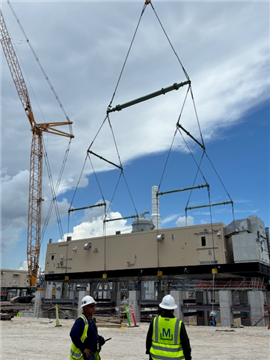 An LNG plant’s motor control center - containing delicate climate-controlled electrical equipment - required a 7-bar lift to ensure precision positioning
Facilities are tightening critical lift procedures, modules are growing heavier, and jobsite margins leave little room for error.
At the same time, experienced field labor continues to age out, forcing contractors to rely more heavily on documented plans, digital modeling, and standardized processes rather than institutional memory. In this environment, lift planning isn’t just about compliance – it’s about control.
For LGH Rental Representative Gregg Lamon, who works daily with refineries and crane companies along the Houston Ship Channel, that shift has reshaped both customer expectations and competitive realities.
But before anything can happen, says Lamon – a former crane operator who eventually moved into supervision and project management – you need workers.
“Even with union access to a hiring hall here in Houston, we’re seeing a structural shift,” he says. “What I believe has happened in a lot of industries is that in order to deal with less and less skilled labor – more experienced guys aging out and retiring – they’ve modified the equipment so the skilled work happens in a shop somewhere. By the time it arrives on site, they’re really just bolting it together.”
Complexity, in other words, is increasingly engineered upstream. Modular construction, pre-assembly, and detailed planning reduce the need for improvisation in the field.
But in markets like the Houston Ship Channel – where new facilities, refinery expansions, and compliance-driven retrofits are all occurring simultaneously – demand continues to rise. And that tension between growth and shrinking field experience has real implications for how lifts are executed.
Clarity as efficiency
When the conversation turns to lift planning specifically, Lamon draws a distinction. The labor shortage is most visible in field execution – but planning faces its own supply gap. “Lift planning and CAD drafting aren’t widely recognized career paths, even though demand is clear,” he says.
 LGH’s Gregg Lamon
In his immediate geography alone, the need is obvious. “I have six competitors within 60 miles of where I’m sitting. Every one of them would hire nearly every 21-year-old kid with a CAD certificate and train them in-house, if they could. But there just aren’t many of them out there. Most of those jobs are remote as well.”
For Taylor Savage, LGH’s Lift Planner, the labor conversation connects directly to what happens on the ground. “A well-designed plan is essentially an instruction manual,” he points out. “If you have inexperienced riggers, as long as they follow the plan, it makes the process much simpler in the field – and serves as an extra check.”
Savage sees uneven field experience as one of the defining realities of the current workforce. “The limited experience is the biggest factor. But sophisticated plans give clear direction. And in terms of labor shortages, you may only need two people to rig a very complex piece because they have a defined process to follow.”
According to Savage, clarity reduces dependency on tribal knowledge. “It lowers the need for additional bodies on site simply to compensate for uncertainty. And in high-cost industrial environments, that clarity translates directly into efficiency.”
In that sense, lift planning isn’t just a documentation exercise. It’s becoming a structural response to the labor reality shaping modern job sites.
Immediate Impact
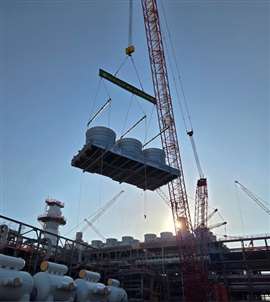 The custom-built 100T X 40 multi-hole bar used on this lift has multiple configurations, allowing it to accommodate all 12 styles of fin fan
If labor shortages help explain why lift planning matters, Lamon is equally clear about how it evolved. “As rental vendors built deeper product knowledge and developed their own CAD capabilities, owners started thinking, ‘If we’re going to rent all this equipment from this company which has the ability to do these drawings, then we can free up our guys to work on something else and we’re renting equipment from a vendor that really knows their rigging.”
From there, expectation shifted. “They started telling their vendor, ‘We’ll rent it from you, but we need you to provide the drawings as well,’” he indicated.
By the time Lamon joined LGH in August 2023, lift planning wasn’t a differentiator in Houston, it was table stakes.
And increasingly, it’s not just competitive, it’s required, says Savage. “I’d say it really has a lot to do with the critical lift process – you’re seeing more and more of a requirement for a lift plan, because a lot of facilities now require one for any kind of lift.”
In order to follow a project’s critical lift procedures, he adds, “…it helps to provide one sheet that has all the rigging information you need. Your capacities, your load, your configuration. Tension weights. A one-stop shop for the rigging of the project.”
For Savage, CAD-based planning is a roadmap that fundamentally changes the equation. “It allows folks in the planning process to visualize what the plan is and to see the rigging, the links, and the rigging height. It also helps once the rigging shows up to the job site. You have a list of where everything goes.”
That value also feeds alignment. A digital file can be shared across project managers, crane operators, safety personnel, and rigging crews – everyone looking at the same configuration, the same load path, the same numbers. “Right now, we’re doing a lot in 2D, but you can do 3D,” Savage says. “Eventually everything will be 3D.”
 LGH’s Taylor Savage
Even in two dimensions, Savage acknowledges that the impact is immediate. “On a single sheet, rated capacities sit beside calculated loads. Sling angles, tensions and rigging heights are visible at a glance. The main thing is that it lets them visualize the configuration and see exactly what they’re looking at. In that way, the plan becomes both blueprint and safeguard.”
Bridging the gap
Since implementing CAD services, Lamon has seen measurable results.
“Our plant rental revenue from refineries is trending upward. Our crane company rentals are trending upward. And specifically, below-the-hook rigging – spreader bars, shackles, slings – is going up.”
But growth is only part of the story. Precision planning raises the internal bar.
“When you do a CAD drawing for a lift, it’s imperative that every piece of equipment in that drawing is in good shape and at equal lengths,” Lamon says.
In the past, close enough was good enough. Not anymore. “When you’ve made that representation to the client and something is off, you’ve painted yourself into a corner,” he explains. “If that sling that’s supposed to be 20 feet is actually 20 feet 2 inches, that changes everything.”
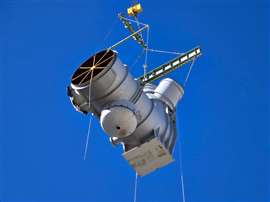 To lift this steam duct - weighing more than five Ford Mustangs - the LGH team incorporated a 100T multi-hole bar into the rigging to safely achieve a level lift
That mindset has forced tighter inventory control, closer inspection and stronger coordination between planning and rental teams. And in Lamon’s view, such discipline sharpens execution.
“The point of doing the drawings and having the plan is to ensure we are inspecting the rigging more than normal as it goes out the door.”
Detailed modeling exposes what guesswork hides. Uneven load distribution. A choker that should be upsized. Boom length that won’t clear headroom.
“Catch that on lift day and you’re burning money,” says Lamon. “Catch it in planning and you adjust before equipment mobilizes.”
In a niche industry where credibility is hard earned but can be quickly lost, CAD becomes more than a drafting tool. “It’s a credibility bridge,” he says. “The reps are trained on our equipment – the specs, what it can and can’t do – but where the rubber meets the road, things can occasionally be missed or miscommunicated. CAD and lift planning help bridge that gap.”
And when a drawing lands in a client’s inbox, assures Lamon, the message is unmistakable. “You get that drawing and there is no doubt that whoever did it knows exactly what they’re doing. You’re in good hands.”
--------
This article was produced by KHL Content Studio, in collaboration with experts from LGH
--------
All images courtesy of LGH
--------