

Five earthmoving technology trends in 2026
Partner Content produced by KHL Content Studio
18 June 2026
The pressure to do more with less has never been higher in earthmoving.
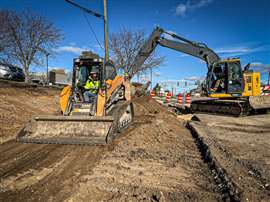 A skid steer loader operating with Trimble’s Siteworks machine guidance positioning system
Contractors are being challenged to deliver projects to tighter timelines and with lower budgets. At the same time, they must manage rising costs and a shortage of skilled labor.
Together, these factors are leading to project delays. “A lack of skilled workers means jobs take longer to complete – but also increases the risk of rework,” says Cameron Clark, Senior Director, Earthmoving Solutions at Trimble.
He adds, “Construction workflow is rarely one single waterfall of activities. Very often there are parallel work streams which converge at various points. An issue today can lead to much bigger delays downstream.
 Cameron Clark, Senior Director, Earthmoving Solutions at Trimble
“Contractors have to navigate these waters, but the good news is that the technology now exists to address these challenges. Innovative solutions can help them reduce waste, cut costs and optimize workflows.”
Here Clark identifies five key technology trends in earthmoving:
--------
1. The shift from manual to digital operations
A recent KHL earthmoving survey, in partnership with Trimble, found that around 88% of respondents were already using technology to enhance their earthmoving operations – a clear sign that the industry is embracing digital tools.
The three most popular tech tools with respondents were GPS or GNSS positioning, grade control and machine control automation.
In line with these findings, Trimble has seen a significant shift in tech adoption for earthmoving.
“At past trade shows you would have smaller contractors asking questions about what the technology is and what it does,” says Clark. “But at ConExpo this year, visitors already knew about the technology; their main question was, ‘when and where can I start?’.”
In the past, tech such as grade or steering control and workflow management were perceived as designed for larger contractors, but this is also changing. “Smaller contractors know they have to be competitive, and they now understand that technology can help them achieve that,” he adds.
--------
2. Faster, more accurate decision-making
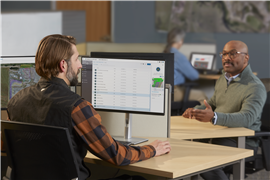 Trimble WorksManager allows designers to send construction-ready models to machine operators and survey crews
Clear communication between workers on site and in the office has always been challenging. But technology is making collaboration easier, enabling faster and more informed decision-making.
“Tech is driving better collaboration which in turn helps people make the right decision,” says Clark.
“In addition, you can overlay data-driven insights. For example, if you’re starting a job that is very much like one you recently completed, you can repeat what worked well on the new job.”
In addition, remote access capabilities mean office support is more readily at hand for troubleshooting. “We had one example where an operator in the USA called a contractor who was on vacation skiing in Europe,” says Clark.
“They got on a ski lift and by the time they got off at the other end, they had logged in, identified the problem and resolved it for the operator.”
KPIs can vary significantly between contractors and jobs. “Sometimes it’s as simple as understanding where a piece of equipment is located and its utilization,” says Clark. “Larger contractors are often balancing several projects at once, so, if an asset is being underutilized on one job, it can be redeployed on another.
“Similarly, technology can ensure contractors always have the right amounts of materials and the right number of borrow pits.”
--------
3. Impact of automation and machine control
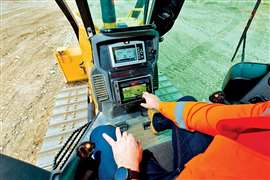 An operator checks grading progress using Trimble Earthworks
Automation drives consistency and productivity in earthmoving.
A Trimble study found that assisted steering on soil compactors reduced total compaction time by over 29% and cut fuel consumption by more than 26%.
Meanwhile, just under 70% of respondents in KHL’s survey said they had seen measurable improvements in either project speed or budget control by using machine control automation.
“For certain machines or tasks, automation is now expected,” says Clark. “Not so long ago, you had to have a grader following behind a dozer, to get the finish you wanted. Thanks to automation, the dozer can do that by itself. This is transforming the assets required to do a job.”
Fundamentally, technology must be easy to use and improve a worker’s life. Clark insists, “We are not aiming to replace workers, but we are addressing the skills shortage and making work more enjoyable, with more consistent and productive outcomes.”
Automation also means contractors can do more with smaller assets. “The extra horsepower OEMs can get out of compact tracked loaders, coupled with machine control, is really changing how contractors can use these machines,” says Clark.
He sees automation not only helping address the skills shortage, but also improving fleet management.
“Sometimes an inexperienced operator can push a machine too hard or try to make it do things that it isn’t designed to do,” he says. “Automating those processes helps to reduce that risk, leading to better machine health and longevity.”
And by combining all that data from the fleet on site, contractors can take best practice from experienced operators and use it to upskill their less experienced colleagues.
--------
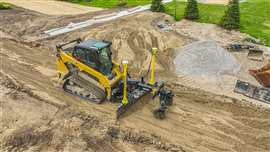 A compact loader utilizing the Trimble Earthworks grade control platform
4. Predictive maintenance
The combination of sensors and telematics data from machines means that predictive maintenance is making huge strides forward. Fleet managers and OEMs can start predicting when a component is likely to fail and schedule maintenance before it becomes a problem.
Clark says, “Metrics on reducing downtime are hard to calculate but anecdotally our customers absolutely are telling us that they do make a difference.”
For contractors and rental companies, the data can also give them insights into which brands work best for them. “Are there certain brands that are more reliable, or do they get better service from certain dealers?”
Even ease of access to digital service records is a big benefit, providing transparency on who carried a service and what was done.
--------
5. Lower barriers to entry
Three of the biggest drivers in technology adoption for smaller contractors are lowe of entry thanks to subscription-based models, scalability, and improved ease of use.
Subscription-based models mean there are no large up-front fees and more flexibility, while modular or tiered systems offer staged adoption and customization.
“Smaller contractors do not need the more expensive and more complex systems that are so valuable to larger contractors,” says Clark. “They want a tiered offering that can scale up as they grow.”
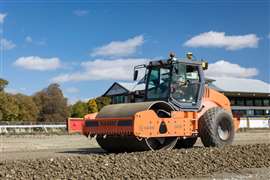 Trimble has a specialized Earthworks grade control system designed specifically for soil compaction equipment
Another critical element is that technology must add value to their current processes. “If you start trying to force contractors to change how they work in order to get the technology to work, you will encounter real resistance and pushback,” says Clark.
“Also, you don’t have to try and do everything at once. Start small, demonstrate it works, then scale up.
“Focus on an area where it can have a high impact and one which you can control – and ensure that everyone is bought in. Don’t try to go too big too quickly.”
--------
Project impacts
Fundamentally, technology is helping to address hidden costs for contractors by ensuring high quality and optimal productivity.
But Clark sees more to it. “On top of that,” he says, “you can now access real-time information on workflows – you no longer have to wait until the end of the game to see the score.
“Contractors increasingly view technology as an asset that goes beyond cost-saving. In particular, we’re seeing more contractors using technology to manage digital workflows, improve efficiency through collaboration – and just really enjoying doing the work.”
--------
This article was produced by KHL Content Studio, in collaboration with experts from Trimble
--------
All images courtesy of Trimble
--------