

From scale to flexibility: Inside the development of Zoomlion’s Smart Factory
Partner Content produced by KHL Content Studio
03 February 2026
Mr Shi Heng, assistant to the general manager of Zoomlion Zvally Co Ltd, talks to KHL’s Content Studio about fundamental changes the company is making to its manufacturing processes, and what they could mean for the construction industry...
--------
When we talk about the manufacture of heavy equipment, the image tends to be of very large factories producing long runs of identical machines, year after year.
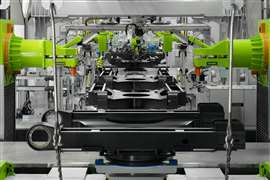 Automation and AI play key roles in the Earthmoving Machinery Manufacturing Smart Factory
The assumption has always been that operating at scale in this way brings efficiency and stability.
Unfortunately, in challenging market conditions, this assumption no longer matches reality.
In more volatile markets, customers want more choice and the balance between efficiency and flexibility breaks down.
When scale stops being a competitive advantage
That was the backdrop when we first considered building the Earthmoving Machinery Manufacturing Smart Factory in Zoomlion Smart City, here in Changsha.
From the beginning, we were clear that this would not be an automation upgrade; instead our aim was to dismantle and rebuild our entire manufacturing philosophy.
By its nature, the construction machinery industry is a high-mix, low-volume environment. Excavators sit at the heart of this manufacturing challenge, integrating mechanical, electronic and hydraulic elements at a very high level.
They also operate intensively in the field and exist in many different configurations. Historically, that complexity has made them difficult to produce in a flexible way and, because of this, long changeover times have been accepted as a fact of life.
At Zoomlion, we decided that needed to change.
Taking the toughest challenge to redefine a system
Between 2020 and 2022, we spent three years designing and building a factory that could handle excavators at their most complex, because we believed that if we could solve the problem there, the approach could more easily scale to other product lines.
We sometimes describe excavators as the ‘jewel in the crown’ of construction machinery. From a manufacturing perspective, they are certainly the hardest test of manufacturing capability we could set ourselves.
Operationally, the most visible change within the new Smart Factory is what we call shared mixed-flow manufacturing.
Instead of dedicating a line to a single model, we designed a system in which more than 100 different excavator models can be produced on the same line, one after another, with no stoppages.
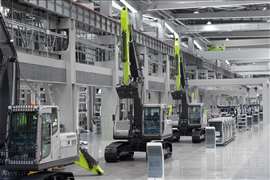 Zoomlion’s Smart Factory is able to produce an excavator every six minutes
In practical terms, that means building one model with a specific process and thousands of parts, then automatically switching to a different model, with no manual reset.
Moving beyond the idea of the fixed production line
To make this work, we had to rethink the shopfloor in detail. We designed 21 flexible workstations equipped with AI vision, force control and multi-modal sensing.
Within these workstations, welding adapts to variations automatically, machining stations reconfigure themselves and tightening processes adjust in real time.
Behind all of these processes is an AI-driven scheduling engine that must balance thousands of components and required resources.
The system, which is continually learning and improving, now allows us to roll out an excavator every six minutes – a feat that cannot be matched in the industry.
Moreover, the entire journey from steel plate to finished excavator now takes about 6.5 days.
Another important transformation within the Smart Factory has taken place in logistics. Put simply, mixed-flow manufacturing collapses if materials arrive late or in the wrong sequence.
We recognised that traditional logistics operations would not be sufficient to optimise our manufacturing plan. The answer was to replace storage with transport.
Treating logistics as a dynamic flow, not a buffer
In the new factory, heavy-duty three-dimensional logistics systems move components through the factory via coordinated air and ground transport, guided by AI forecasting models.
In this way, structural parts no longer sit idle – they flow to where they are required. As a result, inventory for work currently in process has fallen by around 70%.
Every component is digitally coded and tracked and more than 30 AI-based inspection technologies operate across welding, machining and assembly.
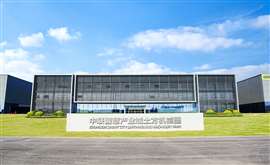 More than 20 smart factories have already been commissioned to follow the ‘one blueprint’ strategy
Digital twins and process simulations help us identify deviations early, when they are still easy to correct.
This full-process approach has pushed us toward a practical goal of zero defects, not as a marketing slogan but as an operational target.
One major non-technical transformation has been the move from make-to-stock to make-to-order.
In the past, standard machines were built, shipped to agents and sold, usually over the course of several months. Now, customers specify what they need and production starts from raw material.
For domestic orders, delivery can happen within two weeks. This alignment between sales and production reduces inventory risk and cushions the impact of market cycles.
Why manufacturing transformation is ultimately organisational
It is important to acknowledge that none of this was easy. Skills had to change, both on the shopfloor and in management.
People needed to learn how to work with data, algorithms and digital systems, not just with machines.
Suppliers had to be brought into the same digital environment, to ensure there were no information gaps.
Zoomlion’s leadership also became more comfortable making decisions based on real-time system feedback rather than on experience alone.
The Smart Factory has shown us that heavy equipment manufacturing does not have to choose between scale and flexibility.
We are still learning, still refining and still encountering challenges, but I believe we now have a system that can adapt and in today’s industry, that is crucial.
--------
All images courtesy of Zoomlion
--------