Hallite launches low-friction seals, bearings at IFPE
27 March 2023
Hallite launched a new range of low friction rod seals, precision bearings and the piston seals for fluid power applications at IFPE.
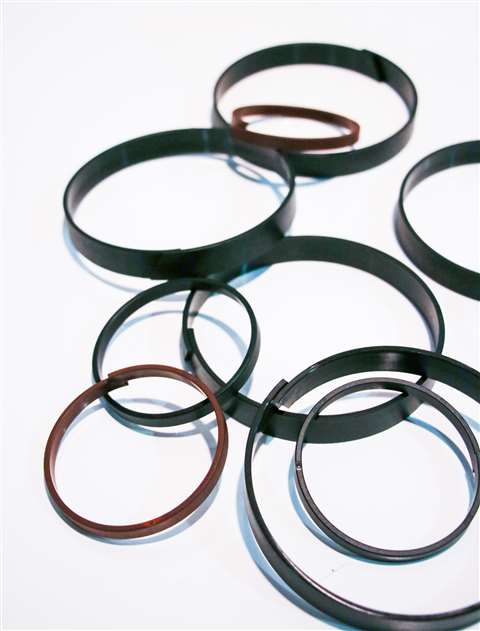 Hallite’s new 565 bearings. (Photo: Hallite)
The 565 bearings and wear bands are designed for reciprocating, oscillating, and slow rotary movement applications, such as construction material handling equipment, cranes and forklifts. They are designed to provide a high degree of dimensional stability and radial accuracy to reduce radial displacement, improve seal effectiveness and provide extended life.
The bearings are available in sustainable materials, including advanced polymers and renewably sourced nylons, the company said, and will also be offered in polyoxymethylene (POM) for applications that operate in water-based fluids. Hallite said the 565 products provide unrivalled tolerance in molded bearings, reducing failure caused by metal-to-metal contact.
Hallite also showcased its 683 low friction rod seal, an asymmetric single-lipped rod seal designed with precision-trimmed sealing lips to provide a dry sealing solution in light and medium-duty applications. Its design provides low friction to help lower fuel consumption, reduce emissions and optimize performance, the company said.
Hallite also reintroduced its 777 double-acting, energized piston seal. The seal has been redesigned to include imperial sizes to fit a range of industry-standard grooves and is now available in more cost-effective material options for less demanding applications.