Haulotte hydrogen aerial platform partnership

13 June 2022
Haulotte has announced a collaboration with Bouygues Energies & Services to focus on using hydrogen energy to fuel its lifting equipment.
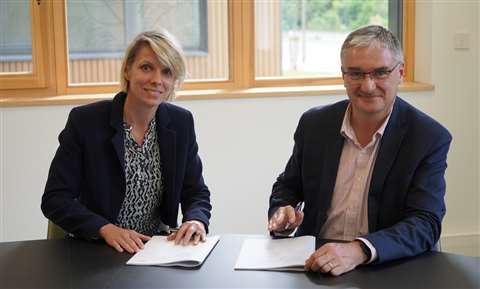 Caroline Mazzoleni, head of Smart Energy Division, Bouygues Energies & Services; and Patrice Metairie, COO, Haulotte Group.
Under the initiative between the two companies, engineering and services specialist Bouygues will test a Haulotte MEWP equipped with a hydrogen fuel cell system under real conditions on several of its construction sites over one year.
Bouygues will also study the hydrogen supply ecosystem for the entire construction sites on which the MEWP will be operating.
Bouygues Energies & Services, a subsidiary of Bouygues Construction, is a key player in energy and digital transition across a range of industries and buildings.
Haulotte said, “This partnership between the two groups aims to confirm the technical feasibility of using hydrogen technology in the construction sector to provide a low-carbon, zero-emission solution in response to climate, environmental and public health issues.”
In addition, Haulotte is exploring solutions for the complete decarbonization of its future aerial platform equipment.
“Haulotte and Bouygues Energies & Services project teams are delighted with this collaboration, which heralds an essential partnership between the players in the value chain, manufacturers, energy suppliers, customers and users, to deploy the first hydrogen projects,” added Haulotte.