How a curious contractor scaled up to data-driven earthmoving operations
Partner Content produced by KHL Content Studio
16 July 2026
Wayne Barr of Ground Developments Ltd (GDL) explains how integrating machine control, digital workflows and real-time production data has transformed the scale, predictability and efficiency of its projects.
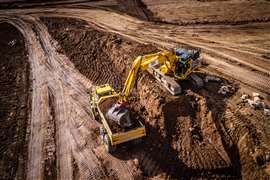 An excavator using Trimble Earthworks loads an ADT
When Barr joined UK contractor Ground Developments Ltd (GDL) around 20 years ago, digital construction technology was far from commonplace.
Barr started as a joiner before becoming increasingly involved with surveying activities on site. Working alongside engineers using traditional theodolites provided an early glimpse into how technology could improve accuracy and efficiency.
That interest would eventually lead GDL into a digital transformation that mirrors the wider evolution of the earthmoving sector.
The catalyst came in 2011.
“One of our guys was reading an earthworks magazine and saw a company based in Newcastle that had acquired some GPS equipment for a dozer,” says Barr.
Curious about the technology, GDL’s team travelled to see it in operation.
“They were constructing a section of road, without any profiling whatsoever, not a single piece of timber on site.”
What Barr and his colleagues saw convinced them that machine control represented the future of earthmoving.
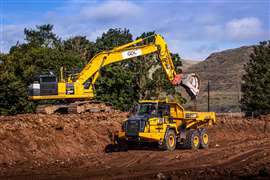 Trimble Earthworks is able to automate position tracking, calculate exact payload weights and optimize bucket placement to maximize cycle efficiency
“We had a sense that this was where construction was going to go and this is what we needed to do to give us a competitive edge and become a leader in the market.”
The company invested in GPS systems for two dozers, marking the beginning of a technology journey that continues today.
Beyond machine control
For many contractors, the initial attraction of machine control is improved grading accuracy and reduced surveying requirements. But GDL quickly discovered that the technology’s value extended beyond the machines themselves.
“Obviously, the design and technology that needed to go alongside the equipment was where we spent a lot of our time and effort, creating models that our teams on site could use,” says Barr.
After two years operating GPS-equipped dozers, the company expanded the technology to excavators and have continued to upgrade equipment as new generations became available.
Today, GDL operates the latest Trimble Earthworks system across its fleet, supported by Trimble Business Center for model creation, survey processing and project data management.
Barr says, “This technology is now a significant part of our business strategy. Our production, our efficiencies, our quality control are all part of the technology we’re using.”
Eliminating information delays
One of the less visible challenges facing contractors is ensuring that design updates reach every machine on site quickly and accurately.
“It was only three or four years ago we were running around sites with USB sticks, to load data onto each machine,” says Barr.
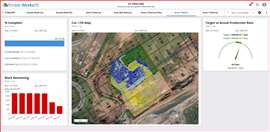 A Trimble WorksOS screen shows precise cut and fill positions on a GDL jobsite
“Imagine you’ve got eight machines on site and you have to upload data to all of them, then the design changes the next day and you have to go through that process again.”
As well as the time involved, there was always a risk that machines might be working from outdated information, increasing the potential for rework.
Today, GDL uses Trimble WorksManager as the central hub for distributing project information. Designs created and processed in Trimble Business Center can be sent directly to connected machines across the site.
“We take all this data and, in two minutes, we can add the latest version to the machines on site.”
The ability to confirm which machines are working with the current design also provides an additional layer of control.
“When I’m in the office and I look at all the machines on the site, I can see that they’re green, which means they’re all using the latest design. If they were using an incorrect design, they’d be orange.”
For project teams, that means greater confidence that work is being completed correctly the first time.
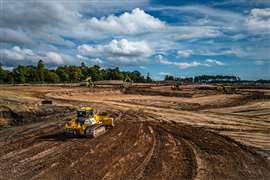 An engineered fill being placed by a dozer using Trimble Earthworks
Turning production data into operational intelligence
While machine control improves execution in the field, GDL believes some of the most significant gains now come from real-time production monitoring.
The company uses Trimble WorksOS to monitor earthmoving volumes, track progress and support planning decisions.
According to Barr, the platform provides updates approximately every 10 minutes, allowing project teams to compare actual progress against planned targets.
“We’re able to pick up mistakes or incorrect work at a very early stage and we can go back and rectify it before it becomes a bigger problem,” he says.
On a recent project, GDL had estimated a cut volume of 111,000 cubic metres and budgeted for an average daily production rate of 1,800 cubic metres.
However, real-time monitoring revealed actual production averaging 2,105 cubic metres per day – approximately 17% ahead of target.
For management teams, this information provides immediate visibility into likely completion dates, resource requirements and future workload planning.
“If we’re ahead of programme, we know we’re going to finish slightly earlier than anticipated, which means we can look for additional work, or we can plan accordingly regarding the resources we need,” says Barr.
Scaling up with confidence
Perhaps the most striking outcome of GDL’s digital transformation has been its ability to take on increasingly larger projects with confidence.
A decade ago, Barr says, a 40,000 cubic metre earthworks project would have been considered a major undertaking for the business. Today, that scale is viewed very differently.
“We recently worked on a 120,000 cubic metre cut-to-fill job and that’s now a standard-sized project for us.”
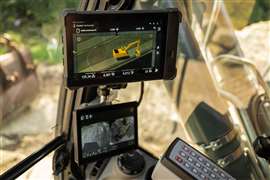 Earthworks’ real-time blade and bucket guidance can improve operator efficiency
The company is also preparing to start a project involving approximately 500,000 cubic metres of earthmoving, with completion planned within four to five months.
And looking further ahead, projects involving up to three million cubic metres are now considered realistic opportunities for GDL.
Barr attributes this growth to understanding productivity more accurately.
“We’re a company that doesn’t over-resource on a project,” he says, “because we know that more plant doesn’t mean more volume; more volume comes from better execution.”
Data meets experience
Barr acknowledges the expertise of long-serving operators who have spent decades moving earth, but he believes digital tools can provide performance data that was previously unavailable.
As an example, GDL recently introduced monitoring systems to analyse excavator loading cycles. One veteran operator with more than 30 years’ experience became part of a programme aimed at reducing truck loading times and improving site productivity.
“We put in a system to monitor his loading time on an articulated dump truck, to see if we can get it down and maximise the amount of loads per hour.”
The results contributed to increasing average daily production from 1,800 cubic metres to more than 2,100 cubic metres while reducing loading cycles to under two minutes per truck.
Rather than replacing operator skill, the technology provided new insights that allowed experienced personnel to refine their performance further.
The next stage of earthmoving
 Wayne Barr of Ground Development Limited (GDL)
For GDL, the evolution from GPS-equipped dozers to fully connected digital operations has fundamentally changed how projects are planned, executed and measured.
The company now relies on integrated workflows that connect design teams, surveyors, operators, site managers and commercial staff through a shared data environment.
“Being able to monitor the team’s performance in real time has given us the confidence to take our business to the next level,” says Barr.
For contractors evaluating their own digital strategies, GDL’s experience offers a useful insight: the greatest gains may not come from individual technologies alone, but from connecting design, machines, production and decision-making into a single operational workflow.
--------
This article was produced by KHL Content Studio, in collaboration with experts from GDL and Trimble.
--------
All images courtesy of GDL and Trimble
--------