How a modular test system overcame a genset bottleneck
Partner Content produced by KHL Content Studio
16 March 2026
When diesel generator set (genset) production momentum outruns testing capacity, manufacturers find themselves facing strong order books on the one hand, but potentially delayed shipments and deferred revenue on the other.
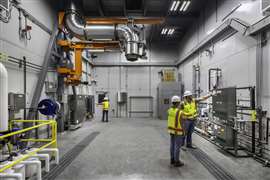 An interior view of the genset test cell featuring a diesel fuel skid, localised control panels, and an adjustable engine exhaust arm
In the case of one global heavy equipment manufacturer, that tension became acute as genset output surged beyond the limits of its end-of-line testing infrastructure.
The solution was not a stopgap in the traditional sense, but a carefully engineered modular intervention that delivered immediate capacity, while aligning with the company’s long-term expansion plans.
At the centre of the project was ACS, a long-standing partner to the manufacturer with more than two decades of shared operational history.
Already engaged on a major campus expansion that would add permanent test cells the following year, ACS was asked to help more immediately by adding meaningful testing throughput at very short notice.
Bob Roth, Director of Project Delivery with ACS, says, “We discussed options to solve the problem, with an understanding that the priority was not to compromise safety, data integrity or future flexibility. At the same time, it had to be in place quickly.”
And crucially, the solution needed to be commissioned with no disruption to current production.
A backlog with consequences
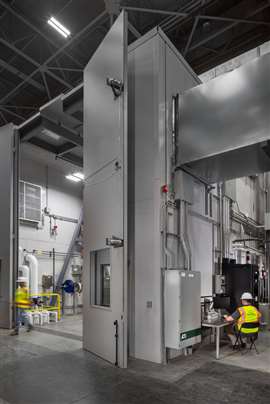 The main control desk is equipped with a PLC panel and high-speed DAQ rack for real-time engine diagnostics
With the company’s existing test cells fully utilised, untested generators were beginning to accumulate, which was inevitably tying up working capital, delaying deliveries to customers and putting pressure on sales teams trying to balance promise with reality.
While the long-term facility expansion would ultimately resolve the issue, its delivery timeline did not match the market’s urgency and ACS’ task was to design, fabricate and install an interim solution that could be deployed rapidly, operate at industrial scale, and integrate seamlessly with established processes.
Modular thinking
Rather than treat the brief as a short-term workaround, ACS approached it as a fully-fledged engineering project with modularity at its core.
“As a team, we never considered the solution to be a temporary ‘fix’” says Roth. “The challenge was to create something that would solve the immediate issue, but still have value once the permanent infrastructure is in place?”
The ACS team developed a self-contained genset test cell capable of handling engines from 1,300 to 5,300 horsepower. The system was fabricated largely off-site and installed quickly at a secondary facility located around two hours from the main campus.
This location choice was strategic. “It gave us space, crane access and logistical flexibility, without pulling testing too far away from production,” explains Roth.
The modular system was also designed to sit within the reach of the site’s existing 35-ton overhead crane, allowing safe and efficient handling of units under test without the need for new heavy lifting infrastructure.
Inside the cell, critical systems were engineered to ensure optimal throughput and repeatability. Modular skidded equipment for diesel fuel supply, engine jacket water and aftercooler water systems were preassembled to minimise on-site installation time.
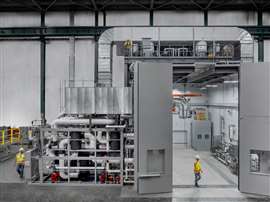 A wide view of the genset test cell showing the integrated mezzanine and the jacket water system used for thermal management
“Every hour saved on site mattered,” says Roth. “Prefabrication allowed us to control quality and maintain the schedule without increasing risk.”
An acoustically insulated enclosure managed noise emissions, while integrated chilled water, ventilation and temperature control systems ensured consistent test conditions across a wide range of genset configurations. An articulating exhaust system added further flexibility.
Building at speed, without disruption
The compressed timeline placed a premium on construction management. While prefabrication reduced on-site work, precise coordination was essential once modules began to arrive.
According to Roth, “There was only one access route for large deliveries, so sequencing was critical. We basically had to keep production moving while building a test facility alongside it.”
To maintain momentum, ACS scheduled weekend shifts and coordinated multiple trades working in parallel.
External works, including the installation of a new dual-wall diesel storage tank and repaving of access roadways, were executed alongside internal integration activities.
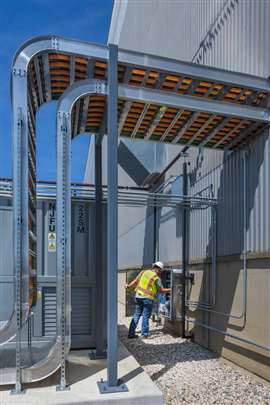 A technician monitors the Battery Energy Storage System (BESS). The facility uses precise control logic to ensure a seamless handoff between stored energy and the plant grid
Even procurement challenges associated with long-lead equipment were mitigated through early planning and close supplier coordination, ensuring commissioning targets were met.
The result was a complex test cell brought online with minimal disruption – an outcome that reflected both the ACS team’s technical preparation and an intimate understanding of the client’s operating rhythms.
Data, automation and operator confidence
Throughput alone would not have solved the manufacturer’s problem if testing became more complex or error-prone. Process control and data acquisition therefore played a decisive role.
The modular test system is driven by ACS’ open-source control software, Acselerant™, providing a single operator interface for all genset variants.
“In a high-mix environment, automation is essential,” Roth explains. “The system removes ambiguity and ensures every unit is precisely tested.”
Once a unit is connected, operators enter its identification number and the system automatically retrieves the correct test parameters from the client’s database. This eliminates manual cross-checking and reduces the risk of configuration errors.
During each test run, performance data is continuously monitored against defined pass/fail criteria and displayed in real time across a dual-screen setup.
On completion, results are uploaded automatically to the manufacturer’s remote database.
“For the operators, the experience is consistent and intuitive,” says Roth, “and for management, they can be confident that a higher throughput doesn’t mean lower data quality.”
An interim solution with lasting value
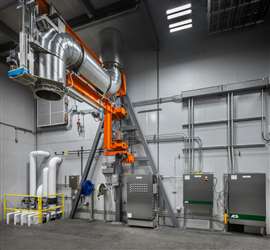 This setup includes a dedicated PLC panel and RIO exhaust panel. The overhead exhaust arm is designed to handle high thermal loads during full-load testing
With the modular test cell commissioned, the manufacturer gained the immediate capacity needed to clear its backlog of untested gensets.
As shipments accelerated and customer commitments were met, the pressure on production planning was eased.
Because the system is modular and largely self-contained, it retains the option of being relocated or redeployed as permanent test cells come online.
From ACS’ perspective, the project reinforces the value of long-term partnerships. Familiarity with operational constraints, safety standards and data systems allowed decisions to be made quickly and confidently.
Lessons for the wider industry
As manufacturers across the heavy equipment and power generation sectors navigate volatile demand patterns, the case illustrates a broader shift in thinking about capacity.
Modular, prefabricated systems are no longer viewed solely as temporary fixes. When engineered correctly, they offer speed without sacrificing robustness, and flexibility without compromising integration.
The modular genset test cell bought the manufacturer time – but it also demonstrated how interim solutions can protect revenue, strengthen customer relationships and support long-term growth strategies.
In an environment where bottlenecks can quickly erode the benefits of strong demand, that value is hard to ignore.
--------
This article was produced by KHL’s Content Studio, in collaboration with experts from ACS
--------
All images courtesy of ACS
--------