

How installation determines alignment success in rotating machinery
Partner Content produced by KHL Content Studio
30 June 2026
Many heavy industry professionals assume that misalignment of rotating machinery develops only during operation.
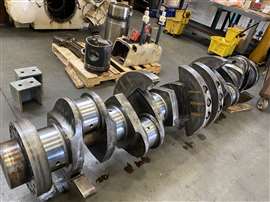 The standards for installation already exist. The problem is when people decide they do not need to follow them
They believe the machine is installed, aligned and commissioned, and that it gradually drifts out of that specified alignment through use.
As a result, alignment corrections are often viewed as little more than routine maintenance.
Installation is the critical moment
However, Roman Megela, Senior Reliability Engineer at Easy-Laser, believes that view overlooks a more fundamental – and common – reality.
“The installation phase is where everything happens,” he says. “If you build a house and the carpenter installs the front door crooked, it will be crooked forever and it will never work properly.
“It is the same with rotating machinery. Flatness, levels, soft foot, shaft alignment – all of that must be done before the machine comes into operation. Installation establishes the condition of the machine and that condition follows it throughout its life.”
So, when vibration, heat, noise, fatigue and premature wear appear earlier or more severely than expected, Megela argues that the root cause often lies in the installation itself.
Reliability, in other words, starts long before a machine even enters service.
Assumptions kill reliability
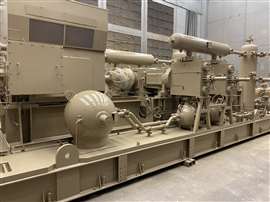 According to Megela, the sheer size of the equipment creates a false sense of robustness
For Megela, the biggest threat to reliability is not a technical problem at all. It is assumptions.
Modern industrial projects involve long chains of stakeholders. Customers, engineers, manufacturers, transport providers, installation contractors and operators all play a role in delivering a machine from design to operation.
“The most common mistake I see is misconceptions during design, fabrication, transport and installation,” he reveals.
“There is always an assumption that somebody else knows what we need. The customer assumes the engineering office knows. The engineering office assumes the manufacturer knows. The manufacturer assumes the transport company knows.
“But the chain is so long that those connections break. Most of the time they break. There is a lot of assumption in this industry, and assumption kills reliability.”
Once assumptions replace clearly defined requirements, mistakes become embedded into the project and are often discovered only after equipment enters service.
Foundations: where integrity begins
One area where those mistakes commonly occur is foundation preparation.
While alignment discussions often focus on shafts, couplings and rotating components, Megela argues that true alignment begins beneath the machine itself.
“The equipment must sit on a very flat and stable foundation. That is the basic,” he says. “Foundations are designed to hold the equipment and dissipate dynamic forces from the process and the machine.
“If the foundation is not flat, the equipment is moving and twisting. Once you twist that machine, everything changes. And one of the worst enemies of rotating equipment is casing distortion.”
According to Megela, the sheer size of the equipment creates a false sense of robustness.
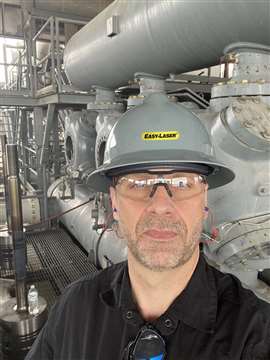 Roman Megela, Senior Reliability Engineer at Easy-Laser
From the oil and gas and renewables sectors right through to the manufacturing and process industries, “many people think that 10-tonne machines are like battleships. But they are not.”
Despite their size, compressors and other rotating assets are complex machines that operate with extremely tight internal clearances. They are intrinsically delicate and even relatively small distortions can affect reliability and energy-efficiency.
And their delicate nature is not only subject to the mercy of properly levelled foundations, but also to transport.
Protecting integrity from the outset
“A lot of issues come up during transportation,” says Megela. “After factory testing and calibration, the machinery is dismantled and shipped in multiple units.”
During that journey, equipment will be subjected to vibration, repeated lifting operations and handling by contractors who may have little knowledge or experience of the specific machinery. So, components that left the factory within specification can arrive on site with hidden damage or distortion already present.
The challenge does not end there. Once delivered, the machine must be manoeuvred into its final operating position before being reassembled.
As Megela explains, this often takes place under conditions vastly different from those in the factory where the machine was built, forcing installation teams to adapt on the fly to the practicalities of the site.
“The equipment arrives on site, and everything is new,” says Megela. “You do not have the same space, the same people or the same tools. Then it becomes: we cannot lift it, so we will just push it. Use the forklift and push it.”
For Megela, every handover creates another opportunity for assumptions to replace verification.
Specification matters
Avoiding those assumptions begins with specification. Unlike factory testing, installation must account for the conditions in which the machine will operate.
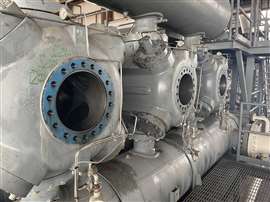 Cylinders are checked at overhaul
A compressor installed in Texas faces different challenges to one operating in northern Canada. As Megela puts it: “All those things must be specified. Precisely specified.”
That is why, he argues, installation cannot be reduced to a generic checklist.
The customer, engineering company, manufacturer, transport contractor and installation team must all be working to the same clearly defined requirements from the outset.
Only then is there a meaningful baseline against which commissioning can verify the installation.
Commissioning as verification
Megela believes commissioning should be evidence-based rather than assumption-based.
“You must require all the alignment and flatness reports from the factory,” he states.
Those reports provide a baseline against which site conditions can be compared. Foundation flatness, soft foot conditions, shaft alignment and pipe strain should then be verified before equipment enters operation.
Pipe strain is particularly important because it can introduce new forces into the machine after alignment has already been completed. In Megela’s view, a machine can be aligned correctly and still develop problems if additional stresses are introduced elsewhere in the system.
Reliable records are equally important. Megela recalls reviewing incomplete commissioning documentation.
“The installation team installed the compressors and they did the alignment, etc. Then I got their report and it said, ‘Was the soft foot verified?’ And someone had written, ‘Yes.’ And that’s it.”
The example highlights a wider problem. Poor tick-box documentation practices do not provide the evidence needed to verify measurement, recorded values or achieve tolerances.
Commissioning, therefore, is not simply a paperwork exercise. It is the process of proving that every stage leading up to operation has been completed correctly.
Looking at the whole system
Communication remains the thread connecting all these issues.
“There must be specification from the customer side,” says Megela. “The customer must define the standards required for that environment, and then everybody else must work to those same standards. The design company, the manufacturer, the installation team – everybody must be on the same boat.”
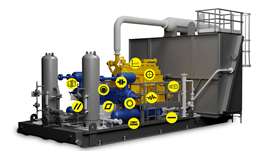 An illustration showing the many elements of rotating machinery that must be perfectly aligned at installation
He adds, “It is always a communication problem. Always. Somebody says, ‘We forgot to specify that,’ or ‘We assumed you knew.’ Reliability depends on making sure that information flows all the way through the project.”
Megela also points to communication problems between engineering teams and purchasing departments.
“The engineering office says we need this compressor because it is proven, reliable and suitable for the application. The purchasing department says we will buy a cheaper one because it fits the budget. Same company, different departments, different mindset, different philosophy,” he states.
“The problem is that nobody is looking at the whole picture. They are not seeing how those decisions affect reliability, uptime, efficiency and sustainability.”
Integrity as standard
Alignment is not simply a maintenance activity or a task completed during installation. It is the result of decisions made throughout the project lifecycle.
“The manufacturer specifies how equipment should be installed, aligned and maintained. The standards already exist. The manuals already exist.”
“The problem is that people decide they do not need to follow them because they have been doing it for twenty-five years. Then when the equipment fails, everybody is surprised,” Megela says wryly.
At the heart of that argument is a concept that Megela returns to repeatedly: integrity.
“Integrity is when you do what you say you are going to do. Even if nobody is watching,” he says, adapting the famous C.S. Lewis quote.
Heavy industry does not lack standards or proven installation practices. What it does often lack, however, is the discipline to apply, verify and document them consistently throughout the project lifecycle.
From initial machine designs to foundation flatness to installation and commissioning, reliability depends on ensuring that what was specified was delivered and can be verified.
Only then can reliability, energy-efficiency and sustainability become achievable outcomes rather than hopeful assumptions.
--------
This article was produced by KHL Content Studio, in collaboration with experts from Easy-Laser
--------
All images courtesy of Easy-Laser
--------