How less can be more: Rethinking cooling system design for modern heavy equipment
Partner Content produced by KHL Content Studio
28 May 2026
As heavy equipment becomes more capable, the cooling system is no longer a secondary design consideration. For OEMs, it is increasingly central to machine efficiency, operating cost and uptime.
 Left/right images demonstrate the visible difference a Cleanfix self-cleaning fan can make for cooling packages
That shift is driven by a simple reality: thermal loads are rising, but space in the engine bay is not. At the same time, engineers are under pressure to reduce weight, simplify system architecture, cut noise and lower lifetime operating costs.
Michael Hogan, Key Accounts Manager with reversible fans manufacturer Cleanfix, says cooling has moved from being a secondary consideration to one of the starting points in machine design.
“In off-highway equipment, there are limited opportunities to gain efficiency through aerodynamics or other external factors,” he says, adding, “Cooling is one of the major factors that can be worked on in terms of improving efficiency.”
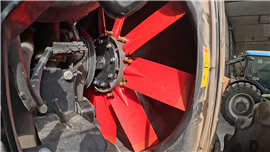 Cleanfix Fans allow OEMs to use the already available engine fan drive to reduce overall engine cooling complexity
So how do OEMs balance the demand for greater performance against often very tight packaging constraints?
Performance, packaging and noise
Hogan believes the answer lies in rethinking what good cooling design looks like and points to the mix of challenges now facing OEMs, including stricter emissions requirements, space allowance and growing attention to noise.
Basically, customers want the full package, says Hogan. “They’re looking for efficiency. They’re looking for size reduction. They’re looking for reversing capability, all while working around other components, as well as anticipating additional benefits, such as noise reduction.”
Cleanfix’ Applications Engineering Lead, Lee Armstrong, agrees, saying, “We’re starting to see that a lot more on the application engineering side – with customers enquiring about noise rating and whether we can improve it.”
For the engineers, that means testing changes in blade angle, lower fan speeds and making other design refinements that can reduce noise without sacrificing cooling performance.
This is a particularly challenging task for smaller and mid-sized OEMs, with engineering teams that may be stretched across multiple systems, as opposed to specializing in cooling.
 Michael Hogan, Lead Key Accounts Manager with Cleanfix
As Hogan observes, many of these teams will be working outside of their core competencies. “They sometimes lack the experience, but they almost always lack the time, even though they understand how important cooling can be in terms of efficiency and performance.”
Why less can be more
Armstrong feels it’s important to challenge the assumption that better cooling means more system complexity.
He says some OEMs have shifted toward hydraulically-driven fans to reduce space requirements, control fan speed, or enable reversing, but he believes there is a simpler route.
“We’d like to push them back towards a more conventional pulley drive system, because it’s a lot simpler,” he says. “Rather than adding another hydraulic circuit, OEMs can use the engine drive they already have and gain efficiency by actively varying blade angle using our variable pitch technology.”
In this way, smarter airflow control can deliver the same functional benefits as variable speed, but with fewer parts and lower system complexity.
“It’s all contained in one fan system, rather than having an additional hydraulic system,” says Armstrong.
Smarter airflow
Asked whether cooling is now less about size and more about efficiency, Armstrong says, “Both matter, but intelligent design opens up more options in a smaller package.
“Blade angle, blade tip design and shroud geometry all affect airflow. If you move from a simple box shroud to a bell shroud, you get significantly better airflow.”
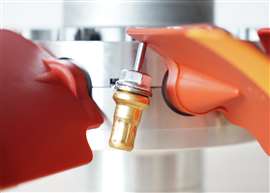 The Cleanfix variable pitch system increases efficiency by actively varying the blade angle. This is fully contained in the fan, decreasing the overall system complexity
Hogan adds, “People are not looking to have the biggest cooling system on the block. They’re really just looking to have a cooling system that’s as big as they need.
“The goal is to size for sufficient cooling capacity and optimize efficiency and packaging within that constraint.”
A key part of that efficiency story is maintaining a clean cooler.
Explaining the link between clogged radiators and poor performance, Armstrong says, “When you have a pile of dirt on your radiator, it’s like putting a heat-insulating blanket on it. The dirt not only blocks heat transfer at the fins, but also restricts airflow through the core.”
Hogan further describes the “dual effect”, saying, “Debris covers the conductive surfaces designed to shed heat. Then, as buildup worsens, airflow is reduced. The moment there’s dirt there, there’s a detrimental effect on cooling efficiency.”
Operators may only notice this when overheating begins, but long before that point the fan is working harder and consuming more energy to compensate.
Automating for efficient systems
That, says Hogan, is why automatic cleaning cycles matter. Rather than relying on operators to wait for rising temperatures or stop for manual cleaning, timed reversing cycles keep performance more consistent.
Armstrong says Cleanfix typically sets timers at 30-minute intervals as a starting point, though they can be adjusted to suit the application.
“The customer can tailor it to their needs,” he says, with intervals going as low as five minutes, when working in particularly dusty environments.
 Cleanfix’ Application Engineering Lead, Lee Armstrong
The result is not just lower risk of overheating, but less downtime and less manual intervention. In some applications, Armstrong says, operators may otherwise need to stop several times a day to clean out radiators with compressed air.
Automatic cleaning can eliminate those interruptions. Hogan adds that even in less severe applications, where manual cleaning might only be needed every few days, “scheduled cleaning still reduces fuel use and takes care of another maintenance task for the operator”.
Pivoting towards performance
He adds that a fan with variable pitch blades adds another layer of control, which “allows the system to operate in real-life conditions, as opposed to what was theorized and designed as a worst-case scenario.”
That has significant implications for engineering margins. Traditional cooling systems have often been designed with generous headroom to ensure reliability under extreme conditions. But that can unnecessarily increase fan power demand, noise, belt wear and cost during normal operation.
With variable pitch, Hogan says, “machines can still have maximum cooling available when they need it, but that may not be that often.”
Armstrong also argues that blade-pivoting designs bring advantages over conventional reversible systems.
Traditional reversing fans typically slow down, then reverse rotational direction. That can create a temporary loss of cooling and may not clean as effectively.
A blade-pivoting approach reverses airflow by changing blade orientation.
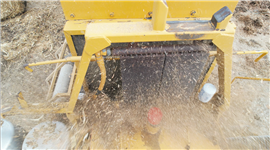 Automatic cooler package cleaning from Cleanfix helps keep performance consistent and eliminate equipment stoppages for cleaning and overheating
“When you flip the blades around, instead of changing the direction they’re spinning in,” Armstrong says, “you get a stronger cleaning blast and continued airflow during the reverse cycle.”
Why early collaboration matters
For OEMs, all of this points to the value of earlier collaboration with cooling specialists.
Hogan says involving Cleanfix sooner helps engineers understand the options available before locking in more complex solutions.
Armstrong agrees, saying early engagement is especially important with a blade-pivoting design, as the fan needs enough room to fully articulate.
An important message is that engine cooling uses a significant amount of machine power, regardless of the fact that it does no productive work.
As Hogan puts it, this is “wasted energy to manage waste heat. But it’s still critical, obviously – so the less of it you have to use, the better.”
Ultimately, in modern heavy equipment, better cooling is no longer about adding more fan or more radiator. It’s about using airflow more intelligently, keeping heat exchangers cleaner and designing systems that react to real operating conditions rather than permanent peak demand.
In that sense, less can absolutely be more: less complexity, less maintenance, less wasted energy – and more performance where it counts.
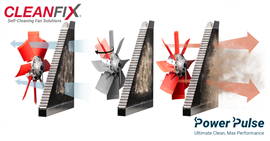 Cleanfix fans feature Power Pulse technology which allows the fan blades to reverse blade pitch at full speed to create a powerful cleaning burst, which dislodges debris from the cooling package without interrupting work
--------
This article was produced by KHL Content Studio, in collaboration with experts from Cleanfix
--------
All images courtesy of Cleanfix
--------