How microgrids are powering the data center boom
Partner Content produced by KHL Content Studio
03 December 2025
The notion of living and working without the internet, and now AI, is almost unthinkable, as is the very idea that these vital services could “go down.”
 An aerial view of a large data center. Image: Adobe Stock
That fact has led to the rapid growth of data centers, the largest of which can cover hundreds of thousands of square meters with computing power, storage drives and network hardware.
A hyperscale data center can consume hundreds of megawatts (MW) of power every day. This is often more power than a local grid can provide.
The result could be downtime, but that is stupendously expensive, with one recent study putting the average cost at more than US$14,000 per minute.
To mitigate the risk, an increasing number of businesses are installing microgrids, sources of power that can keep the data flowing.
Power uninterrupted
Frank Moyer is director of global sales with the power solutions provider ANA Inc. Much of his time is spent talking to the world’s largest data companies about their power needs, which increasingly involve microgrids.
Moyer describes a microgrid as a coordinated system of multiple power sources such as solar, batteries, utility feeds and diesel generators that work together to provide reliable 24-hour output.
By integrating multiple sources, the system can compensate instantly if one power stream dips or fails
Moyer explains that there are a number of different microgrid models, which can be either temporary or permanent.
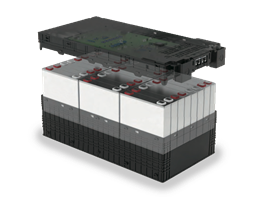 Battery Pack view, featuring the tray and containment for LTO (lithium titanium oxide) batteries
Temporary hybrid microgrids are commonly used to power construction sites when the utility can’t deliver enough electricity to support the load. In those situations, diesel generators, batteries and sometimes solar are brought in to fill the gap until the permanent grid connection is ready.
Permanent microgrids stay on site for the long haul and operate at a much larger scale. These systems can range from a few dozen megawatts to several hundred, and the largest data center campuses are now edging toward gigawatt-level clusters. Even during construction, a site may need 50 to 100 megawatts, and that demand rises sharply once the facility goes live.
Keep it safe, keep it green
Moyer notes that many data center operators continue using on-site microgrids even when the grid is available because they provide extra resilience and help meet tightening sustainability goals. The push toward hybrid systems is largely coming from end users who want lower emissions, better fuel savings and dependable performance.
In the right applications, hybrid microgrids can cut diesel use dramatically, often delivering 70 to 80 % savings on variable or temporary loads.
As the hybrid microgrid makes use of batteries, the clean, uninterrupted output from batteries is crucial, since even brief disruptions can damage servers or risk data loss.
On the subject of safety, Moyer notes that generators have a higher likelihood of thermal events than advanced battery chemistries such as LTO, which offer superior thermal stability.
So for owners, the three priorities are safety, savings and reliability.
The latest iterations of microgrid design take a lot from other mission-critical sectors, such as military bases, hospitals and even live broadcast operations like the Super Bowl or the FIFA World Cup, where power loss simply isn’t an option.
Those same principles of redundancy and reliability now underpin modern data center microgrids.
Also playing a key role in this ecosystem are rental companies.
 Frank Moyer, Director of Global Sales with ANA Inc
Moyer notes that large tech companies often prefer not to own generators or energy storage assets, instead relying on general contractors and rental providers to supply and maintain the required equipment
Demand has grown rapidly, and rental companies are increasingly investing in battery systems as end users request more sustainable and resilient options.
Micro evolution
And battery technology is evolving fast. As recently as five years ago, energy storage systems were primarily using lead-acid batteries which were heavy, inefficient and unsafe.
Then came lithium-ion-phosphate (LFP) batteries, popularized by Tesla.
The industry is now adopting lithium-titanium-oxide (LTO), a chemistry with no thermal runaway risk and a strong safety profile. ANA is among the only companies deploying LTO across both mobile and permanent systems
Moyer compares the shift from legacy chemistries to LTO to the technological leap from early smartphones to modern models, describing it as a clear next-generation advancement.
Other fast-moving technologies in microgrids include telemetry and remote control, which have become essential components of modern systems.
The controller has become the key differentiator among energy storage systems, serving as the intelligence layer that manages telemetry, predictive maintenance, scheduling and reporting
Telemetry enables fault detection, optimized charging strategies and the generation of verified CO2 and fuel savings data
For rental companies and contractors, this level of operational proof has become a key factor in winning major projects.
Compact power
Moyer notes that AI will also influence microgrid operations by optimizing charge and discharge cycles, forecasting demand and further automating system performance.
He adds that current applications represent only the early stages of what AI-enabled microgrids will eventually support. Moyer also believes engineering advances will reshape the physical design of microgrids
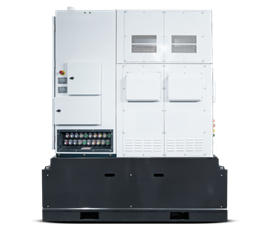 Battery modules help eliminate unnecessary power redundancy in a microgrid system
“Looking ahead, I see engineering advancements driving smaller footprints and higher density for microgrids. For example, we’ll compress what now fits in a 40-foot container into one of maybe 20 feet, and we’ll be stacking systems vertically to save space on data center campuses.
Whatever advances are made, Moyer believes that only microgrids can currently meet the demands of the data center rollout.
“Every major data center project today depends on microgrids,” he says, “particularly in regions like Northern Virginia, where 80% of the world’s data traffic passes.
“You simply can’t run these sites without hybrid systems combining grid, generator and battery power.
Next gen supply
On a global scale, growth is impressive, but in the US, the data center market has simply exploded.
He notes that the U.S. data center market, valued at roughly US$18 billion in 2024, is forecast to reach US$30 billion by 2027, and adds that Europe is following a similar trend, although European sites tend to be smaller and integrate higher levels of wind power.
Moyer says nuclear is back on the radar as operators look for new ways to keep up with the huge power demands of AI. Small modular reactors and microreactors are getting a lot of attention, but they are still a few years away from being used at scale.
Moyer also anticipates that nuclear assets may eventually complement microgrids, with hybrid systems helping balance and support nuclear-based generation. Solar is valuable, but it isn’t currently efficient enough for most temporary microgrids.
That said, for the next five to ten years, diesel and battery hybrid systems will remain king until turbines and small modular reactors become more commercially viable.
Whichever power option is chosen comes at a cost. Latest estimates put the average cost of installing a battery system at between $1,000 and $1,500 per kWh in installed CAPEX cost for high-safety chemistries such as LTO and LFP.
What’s more, for a large site, a multi-million-dollar system could be required.
Nevertheless, the data center market is currently booming, and these costs are being easily absorbed in the pursuit of uninterrupted power.
And while there may be uncertainty about future power sources, a pause in the expansion of data centers is currently not an option.
--------
This article was produced by KHL Content Studio, in collaboration with experts from ANA Inc.
--------
All images courtesy of ANA Inc.
--------