How smart equipment is improving jobsite productivity
Partner Content produced by KHL Content Studio
27 August 2026
Today’s contractor faces high material costs, the challenge of finding experienced operators and often very tight project margins.
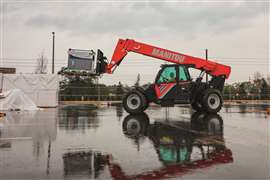 Versatile and productive equipment is a commercial win on any jobsite
Against that backdrop, productivity has gone from being an operational objective to a strategic priority.
This also changes the focus for OEMs, as buyers are now looking less at machine specifications and purchase price and more at how equipment contributes to profitability over its entire working life.
“Input costs are rising and margin protection is really important for contractors,” says Shawn Elliott, Managing Director of Manitou North America. “Productivity is the way in which you can maximize margin and also offset some of those higher input costs. Productivity continues to be very much about efficiency and ensuring the margin is realized.”
Steve Kiskunas, Manitou America’s Product Manager for telescopic handlers, agrees that the commercial pressure is becoming increasingly evident on jobsites.
 Shawn Elliott, Managing Director of Manitou North America
“Productivity directly affects the bottom line and the ability to get the project done quickly and efficiently,” he says. “As budgets become tighter and there’s less money available, it becomes even more important.”
He compares today’s construction industry with the manufacturing sector’s adoption of Just-in-Time principles decades ago.
“That same process is occurring on jobsites,” he says. “When material arrives, it needs to be staged and ready for use so the project can be completed as quickly and efficiently as possible.”
Looking beyond purchase price
As contractors become more focused on profitability, the criteria used to evaluate equipment are changing.
The emphasis is shifting towards total cost of ownership, machine utilization and lifecycle performance, rather than just acquisition cost.
“When you look at total cost of ownership,” Elliott says, “it’s about maximizing the machine, making sure it’s productive, that uptime is high and running costs are as low as possible for as long as possible.”
But, according to Elliott, that idea extends well beyond the machine itself.
“Customers are looking at machine data and how machines perform,” he says. “Reliability, downtime, parts availability, aftersales support and warranty all matter because if the machine’s down, that’s lost productivity and margin they can’t realize.”
Connected technologies have become an important part of that equation. Telematics systems not only monitor machine health but also allow contractors and dealers to manage assets more effectively throughout their working life.
Making machines easier to operate
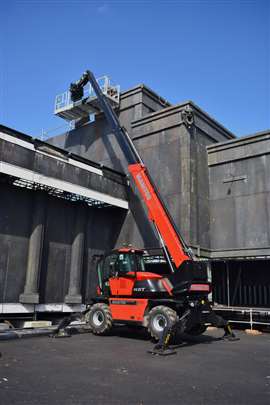 Machines with the multifunctional capabilities of a telehandler should be fully utilized on site
At the same time, equipment manufacturers are designing machines for an industry facing a shortage of experienced operators.
Rather than adding complexity, modern technology is increasingly focused on making equipment simpler and more intuitive to use.
“We’re moving into an era where labor is tight and there are fewer experienced operators out there,” says Elliott. “The push from an OEM perspective is to ensure that machines are simpler and easier to use.”
“It’s important that an operator can get on a machine and intuitively operate it and understand how to get the most out of its functionality.”
That philosophy influences everything from machine controls to software interfaces.
Kiskunas points to the evolution of modern construction telehandlers as an example.
“We’ve worked very hard to make it easier to operate our machines,” he says. “We’ve gone to a single joystick rather than multiple joysticks, and we’ve added software that guides operators with informational pop-ups that instruct them on the correct way to use the machine.”
Telematics also supports productivity away from the operator’s seat.
“The systems now on the machine make it very efficient for supporting that equipment,” Kiskunas explains. “They help locate the machine, make sure scheduled maintenance isn’t forgotten and ensure the asset is looked after correctly.”
Looking further ahead, Elliott believes automation will continue to play a growing role.
“The industry is moving towards automation, robotics and machine guidance,” he says. “If you can automate a machine, you don’t need as much labor, and that’s where investment is going in several areas of the business.”
Eliminating the hidden causes of downtime
While mechanical failure is a major cause of lost productivity, it’s far from the only cause. In reality, contractors lose valuable time through delayed maintenance, inefficient fleet allocation, poor visibility across multiple sites and avoidable accidents.
 Steve Kiskunas, Manitou America’s Product Manager for telescopic handlers
“Downtime is significant,” says Elliott. “Contractors need machines that are productive, reliable, have excellent uptime and can efficiently do the work that’s needed.”
Connected equipment is helping businesses tackle these bottlenecks that have tended to be somewhat under the radar in the past.
Kiskunas explains that telematics now enables dealers to diagnose problems remotely before a technician even leaves the workshop.
“The dealer can see the error code, understand what the problem is and send the technician with the correct parts rather than making two trips,” he says. “This technology is all about making the support for the machine more efficient.”
Fleet managers are also using telematics to optimize utilization across multiple projects.
“Some contractors are running several sites and sharing machines,” Kiskunas says. “Understanding where those machines are through telematics becomes a big piece of their inventory management.”
One machine, many jobs
Versatility has become another important productivity driver.
Modern telehandlers are increasingly expected to perform multiple roles throughout the working day, reducing the need for additional equipment and keeping projects moving.
Kiskunas says, “The fact that the machine can become a tool carrier and operate multiple attachments allows it to be utilized for more tasks.”
As work progresses from material delivery to site clearance, changing attachments, as opposed to changing machines, is one way to keep productivity high.
Equally important is choosing the correct attachment for the application.
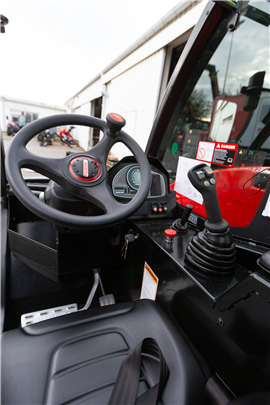 Ease-of-use technology and ergonomic controls are a welcome feature on the latest construction telehandlers
“It’s not just making sure the machine has forks,” Kiskunas says. “It’s making sure the carriage width and fork length are appropriate for what you’re trying to do.”
Engineering productivity
Many of the features that improve productivity are designed into the machine long before it reaches a construction site.
Hydraulic performance, cycle times, fuel efficiency, visibility, maneuverability and machine responsiveness all influence daily output.
Hydraulic performance, in particular, is a critical factor.
“It actually is a big differentiator for manufacturers who really understand how the product is being used,” says Kiskunas. “Cycle times are really important and, from our perspective, we know we have to either meet or exceed the industry standard to make sure we’re keeping up with contractors working on the jobsite.”
Fuel efficiency has also become a growing priority and Elliott points to Manitou’s stop-start technology as an example of where engineering can help.
“It provides efficiency, lowers the total cost of ownership and reduces fuel costs,” he says. “It’s a technology we’ve invested in because we know it makes a difference for end users.”
Machine design is equally important in increasingly congested urban projects.
“I’m constantly talking to contractors in New York City, Boston and the big metropolitan cities on the East Coast,” Elliott says. “I know that turning radius, compactness and visibility are really important to them.”
He believes these characteristics deliver both productivity and safety benefits, and adds that “You need visibility out to all four corners of the machine.
“From a productivity standpoint, you can maneuver the machine into a position that helps you get the work done. Maneuverability, tight turning, visibility and productivity are all tied together.”
Productivity begins with the right machine
As contractors continue searching for ways to protect margins, productivity is becoming less about asking operators to work harder and more about providing equipment that enables them to work smarter.
Advances in intuitive controls, connected telematics, hydraulic speed, attachment versatility and visibility are all helping contractors move more material, reduce delays and maximize the return on their machine investments.
That said, the most productive equipment is not necessarily the machine with the highest specification.
It is likely the one that consistently delivers the right performance, for the right application, with the fewest interruptions.
In an industry under increasing commercial pressure, choosing that machine is one of the smartest productivity decisions a contractor can make.
--------
This article was produced by KHL Content Studio, in collaboration with experts from Manitou
--------
All images courtesy of Manitou
--------