How smarter milling can boost productivity for Latin American road contractors
Partner Content produced by KHL Content Studio
30 July 2026
Across Latin America, road construction contractors are under mounting pressure to deliver rehabilitation projects faster and with tighter operational control than ever before.
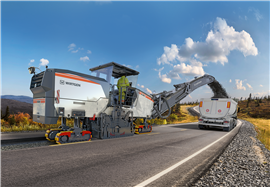 The W 200 F compact cold milling machine is designed for applications ranging from surface layer rehabilitation and complete pavement removal to fine milling
Ageing transport infrastructure, unpredictable fuel costs and growing demands for traceability on public projects are changing the way milling operations are planned and carried out.
At the same time, contractors are struggling with operator shortages and the challenge of maintaining consistent quality across diverse road conditions.
Against this backdrop, the industry is seeing increased interest in automation and digital jobsite management technologies – particularly in the cold milling segment, where machine efficiency can have a major impact on a project’s profitability.
Wirtgen’s W 200 F large milling machine is one example of how manufacturers are responding to these evolving requirements.
 The MILL ASSIST machine control system enables machine operation in automatic mode
Rather than focusing solely on cutting power or production capacity, newer machine concepts are increasingly being designed around reliability, operator support and data transparency.
Automation moves from ‘nice to have’ to operational necessity
According to Guilherme Rodrigues, Sales Director Latin America at Wirtgen, these priorities reflect the changing operational realities faced by contractors across the region.
“Many Latin American contractors are dealing with highly variable project environments,” he says. “You can have urban rehabilitation projects with restricted working hours one week, and large-scale highway rehabilitation in remote regions the next. Machines today need to adapt quickly without creating additional complexity for operators.”
One of the key areas of development has been automated machine control. Systems such as Wirtgen’s MILL ASSIST are designed to automatically adjust operating parameters – including engine speed, milling drum speed, water usage and advance rates – according to changing site conditions.
For contractors, the potential significance goes beyond productivity to benefit fuel efficiency, which remains a major concern across Latin America, particularly in markets where diesel costs fluctuate sharply or logistics chains make fuel supply expensive.
Automated systems that optimise engine performance can therefore have a direct influence on operating margins.
At the same time, contractors are increasingly focused on reducing dependence on highly specialised operators.
 Guilherme Rodrigues, Sales Director Latin America at Wirtgen
“The operator shortage is not unique to Latin America, but in many countries across the region it is becoming more acute,” explains Rodrigues. “Companies are looking for technologies that help standardise performance and reduce the burden on operators without removing their control over the process.”
Flexibility matters more than ever
Having flexible milling machines is also important in Latin American milling operations, particularly for contractors handling a broad mix of rehabilitation work.
Machine utilisation rates are critical to profitability, so rapid adaptation between applications is increasingly valuable. Systems that allow quick drum changes and multiple milling widths are attracting attention from contractors looking to maximise fleet versatility.
The W 200 F uses Wirtgen’s Multiple Cutting System (MCS), enabling relatively fast changes between different milling drum configurations and widths ranging from 2.0 m to 2.2 m.
This flexibility is particularly relevant in urban environments, where contractors often move between fine milling work, partial lane rehabilitation and deeper pavement removal within short project cycles.
Precision and emission targets drive technology adoption
As road agencies push for higher-quality pavement rehabilitation, contractors are under pressure to deliver tighter tolerances while maintaining productivity.
Integrated levelling and grade control systems are becoming more important in helping operators maintain consistency under difficult site conditions.
The W 200 F incorporates the LEVEL PRO ACTIVE system, developed specifically for cold milling applications, with automation functions intended to simplify operation and improve milling precision.
Alongside productivity and precision, sustainability considerations are becoming harder to ignore. Although emissions regulations vary significantly across Latin America, many international concessionaires and infrastructure investors are now embedding environmental targets into project requirements.
This is creating demand for technologies that can help reduce fuel consumption, lower noise emissions and improve efficiency, particularly in terms of resources.
For contractors, however, it’s not just about compliance, but the broader benefits of smarter operations.
“Sustainability discussions in Latin America are often closely connected to operational efficiency,” says Rodrigues. “Reducing fuel use, optimising water consumption and minimising wear are also directly linked to cost control and long-term competitiveness.”
A shift towards smarter milling operations
Ultimately, the evolution of milling technology reflects a wider shift taking place across the road construction sector.
Contractors no longer evaluate machines solely on peak production figures. Instead, purchasing decisions are now based on issues such as uptime, operational consistency, ease of use and the ability to adapt quickly to changing project demands.
In that sense, machines such as the W 200 F are less a standalone product story and more an indication of where the broader cold milling market is heading: towards smarter, more connected and more operationally resilient jobsite solutions.
--------
This article was produced by KHL Content Studio, in collaboration with experts from Wirtgen Group
--------
All images courtesy of Wirtgen Group
--------