Industrial Demolition
27 November 2019
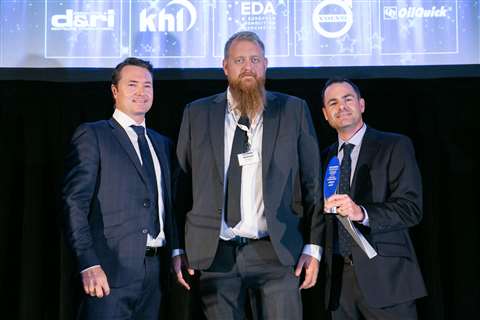
Winner
Liberty Industrial
Country
Australia
Project
Munmorah Power Station
Also shortlisted
Budget Demolition (Canada)
Despe (Italy, two entries)
Hughes and Salvidge (United Kingdom)
Summary
As the focus returned to contractor-based categories, Liberty’s demolition of the Munmorah Power Station meant that four continents had now supplied the winners of at least one award.
Australia and New Zealand have always strongly supported the event with both awards entries and delegates and this year Liberty followed companies such as Mainline Demolition and McMahon Industrial Services on to the winners’ platform.
The judges’ reaction was: “This was a big job, with 890 tonnes of asbestos removed, a 98% recycle rate, and good blast precautions.”
The Munmorah Power Station Removal project involved the demolition and removal of a 1,400 MW coal fired power station including four 350 MW steam driven turbo-alternators, two 155 m (508 ft) chimney stacks, four 60 m (196 ft) high boilers, coal handling plant and conveyors and 2.3 km (1.4 miles) of ash lines.
Three key explosive demolition events were carried out during the course of the power station’s removal by Liberty Industrial’s in-house explosives team, the first of which removed the twin 155 m high stacks, the second event to demolish boilers 3 and 4, and the final blast event to demolish boilers 1 and 2. The boilers are the largest demolished in Australia to date.