Inside Zoomlion’s Smart Factory: How digital manufacturing could rewrite the rules for heavy equipment
Partner Content produced by KHL Content Studio
23 January 2026
For decades, the manufacturing of heavy construction equipment has been defined by scale, rigid processes and compromise.
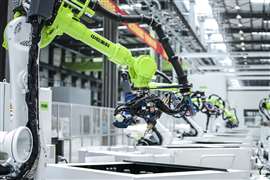 According to Zoomlion, the Smart Factory is not an automation project, but a full digital transformation
The world’s largest machine manufacturers have tended to build the largest factories, generally designed to produced long runs of standardised machines.
Unfortunately, these factories are not designed to respond rapidly to demand swings, and their manual or semi-automated processes also struggle to cope with machine variations.
At Zoomlion’s new Earthmoving Machinery Manufacturing Smart Factory, which is located in Zoomlion Smart City in Changsha, China, that model has been deliberately dismantled and rebuilt from the ground up
The result is a facility that can produce an excavator every six minutes. It can also shift instantly between different models without stopping the line.
The smart factory signals a shift in the way we are set to view manufacturing in what is increasingly becoming a high-mix, low-volume industry.
From automation to digitalisation
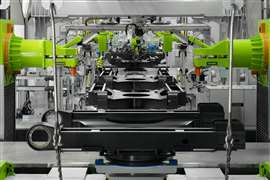 Automation and AI play key roles in the Earthmoving Machinery Manufacturing Smart Factory
Zoomlion’s leadership describes the factory not as an automation project, but as a full digital transformation. “The smart manufacturing philosophy builds from a highly automated production line to achieve end-to-end digital transformation of the manufacturing process, extending out to the supply chain,” says Mr Shi Heng, assistant to the general manager of Zoomlion Zvally Co Ltd.
That philosophy has two dimensions: Horizontally, digital systems connect research and development, production, supply, sales and service, improving material readiness and responsiveness. Vertically, data flows from individual machines and workstations up through production lines, workshops and management systems, accelerating decision-making and production changeovers.
“The goal,” says Shi, “is to create a flexible production and supply line system, so we can achieve production and operation targets, including quality improvement, cost reduction, efficiency enhancement and a reduced inventory.”
This emphasis on flexibility reflects the realities of modern construction machinery markets. Excavators in particular combine high mechanical, electrical and hydraulic integration with volatile demand and growing customer expectations for customisation.
Why excavators came first
Choosing excavators as the starting point was not the easy option. With thousands of parts, complex assembly processes and demanding quality standards, they are among the most challenging machines to manufacture. However, Zoomlion saw this complexity not as a risk, but as an opportunity to put the smart factory to the ultimate test.
“We believe ‘excavators are the jewel in the crown of construction machinery’,” says Shi. “They have the most advanced electronic integration technology and the highest operation frequency.”
Furthermore, says Shi, Zoomlion recognised at an early stage of the factory’s development that incremental change would not be enough. “We couldn’t just digitize the old process; we had to redesign the entire manufacturing system,” he explains, highlighting pressures in the market such as growing product variety, fluctuating cycles, shorter delivery expectations and stricter quality requirements.
In fact, Zoomlion spent three years, between 2020 to 2022, developing the facility.
Shared mixed-flow manufacturing
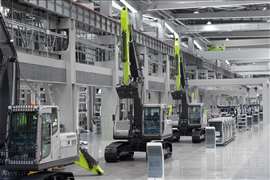 The Smart Factory is able to produce an excavator every six minutes
At the heart of the factory is what Zoomlion calls ‘shared mixed-flow manufacturing’.
Traditional factories rely on dedicated lines for specific models; this system works well in terms of volume production but is poor at handling variation.
Zoomlion has replaced this with a system capable of building more than 100 excavator models on the same line.
Shi explains that “Shared mixed-flow manufacturing means the production line has to switch automatically and quickly. We might be making one excavator model with a specific process and over 6,000 parts in the first ten minutes, then switch to another model, with a different process and 6,000 parts in the next ten minutes.”
To make that possible, Zoomlion designed 21 sets of flexible workstations equipped with artificial intelligence (AI), force control and multi-modal sensing. Adaptive welding, flexible machining and advanced tightening processes also allow machines to self-adjust rather than wait for manual reconfiguration.
Behind the scenes, an AI-driven scheduling engine manages thousands of components, balancing resources and responding to anomalies in real time.
Shi says, “By doing this, we are able to roll out one excavator every six minutes with zero changeover time. From cutting the steel to completing the machine assembly and fit-out takes just 6.5 days.”
Logistics as a production system
One of the less visible but critical innovations is in the field of logistics. Shared mixed-flow production demands precision in material delivery and Zoomlion has replaced traditional storage-heavy approaches with a system it describes as “transport replacing storage”.
Heavy-duty three-dimensional logistics systems move components through the factory via integrated air and ground transport, guided by AI forecasting models. Zoomlion says this has had the effect of reducing structural parts in production inventory by around 70%.
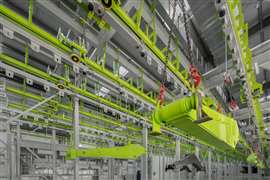 Continual motion is a feature of the structural workshop at Zoomlion’s Smart Factory
This is what the company calls the “vital artery” of the factory, enabling continuous flow irrespective of product diversity.
A single blueprint, multiple factories
The Changsha excavator plant is designed as the lead facility within a wider “one blueprint” manufacturing strategy that spans multiple factories and product lines.
Excavators, cranes, concrete pumps and aerial work platforms are all set to be covered under a unified framework, with common manufacturing centres for steel processing and stamping to be shared across plants.
This “one lead factory, three satellite factories” model is expected to deliver material utilisation rates above 90% and reduce construction costs by around 15%, according to Zoomlion.
More than 20 smart factories and 200 smart production lines globally have already followed this blueprint.
Quality engineered into the process
In the smart factory, says Zoomlion, every component is digitally coded and tracked, enabling full traceability from steel plate to finished machine.
Over 30 AI-based inspection technologies operate throughout the plant, including automatic weld seam inspection and on-machine measurement.
Combined with digital twins and process simulation, this allows defects to be identified and addressed in real time.
Shi says, “Through full-process smart quality control and defect analysis, the factory is able to achieve zero product defects.”
From make-to-stock to make-to-order
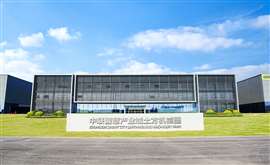 More than 20 smart factories have already been commissioned to follow the ‘one blueprint’ strategy
Perhaps the most visible impact of the smart factory is on Zoomlion’s business model. Historically, excavators were produced on a make-to-stock model, with large numbers of standard machines shipped to distributors and sold over a three- to four-month cycle.
“Now we make-to-order,” says Shi. “Customers tell us their needs and we can start from raw materials to the completion and delivery of the exact model they want within just two weeks in the domestic market.”
This shift reduces inventory, mitigates the effects of market cycles and aligns production directly with customer demand.
Extending beyond the factory walls
Under the new system, Zoomlion’s suppliers are able to access the same digital platforms, and are able to see design changes, production plans and quality data in real time.
Shi says, “Sharing our process and intelligent algorithm platforms with our suppliers helps us get rid of the information gaps and allows the entire supply chain to organise and collaborate independently.”
Qualified parts can move directly into stock without additional inspection, while Zoomlion monitors supplier capacity and logistics through what it describes as a supply chain “control tower”. The company describes measurable gains, including a 16% improvement in on-time supply and a 42% increase in collaboration efficiency.
People, skills and leadership
The transformation has also reshaped roles within the organisation. Shi says new digital skills were required on the shopfloor and in management, while executives are expected to operate with greater system-level oversight.
“Our team definitely had to pick up some new skills and this is an ongoing process,” he says.
“We are shifting from basic digital training to a focus on innovation, industrial software and big data analysis. Introducing new talent is how we aim to guarantee that we drive improvement across the organisation.”
According to Shi, managers are also increasingly trained in the use of AI-driven tools that integrate operational and financial data, blending physical and digital decision-making.
A model with global implications
Zoomlion is not alone in exploring smart manufacturing, but the scale and depth of its implementation set it apart.
“The smart factory has shown us a way to build a new agile and collaborative manufacturing ecosystem,” Shi concludes.
“We have been discussing the system with organisations in industries including new energy and shipbuilding and I believe it won’t be long before we see many more manufacturers adopting these processes.”
--------
This article was produced by KHL Content Studio, in collaboration with experts from Zoomlion
--------
All images courtesy of Zoomlion
--------