Is total cost of ownership now the real measure of equipment value?
Partner Content produced by KHL Content Studio
13 January 2026
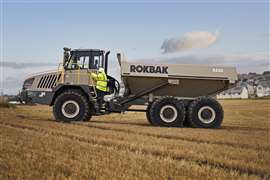
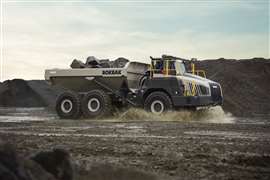 A Rokbak RA40 articulated dump truck - at home navigating quarry haul roads
For a contractor, the factors that must be considered to ensure a solid bottom line have never been more complex.
To the balance of profit, risk and long-term value, we now have to add the need for more sustainable operations, as well as an increasing reliance on technology to improve productivity.
Today, equipment can account for 10% or more of a project’s costs and its effectiveness over time has also become a significant piece of the profit and loss equation.
With this in mind, businesses are now focusing on the TCO (total cost of ownership) of a machine, as opposed to its initial cost, to ensure it is of greatest long-term benefit to the company.
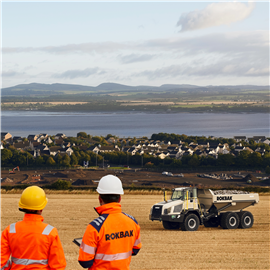 Rokbak’s RA30 hauler undergoes testing with a heavy load
Scott Pollock, senior product manager with Scotland-based hauler manufacturer Rokbak, has definitely seen attitudes to TCO change during his 37 years with the company.
“I do think there’s more of a focus on how a machine can affect the bottom line,” he says.
“Previously, TCO was viewed more in terms of maintenance costs – how much is it going to cost to maintain this machine and how frequently do I need to maintain it?
Machine performance
“Of course, within that scope there would be numerous associated labour and parts costs, but there’s now more of a bigger-picture mentality, which includes gathering data on productivity, revenue and margins and the balance of what the machine can do for the owner over time against purchase cost and these calculations will include the cost of associated tax and insurance.
“Technology can also push up the purchase price of equipment, but a lot of tech development has been focused on the performance of the machine, which results in improved productivity. It’s certainly a complicated calculation.
“There are also the controls you have now to safeguard the machine against operational abuse, protect the operator, reduce fuel consumption and extend service – and maintenance intervals have become another important part of the equation.”
TCO and environmental impact
To complicate matters further, Pollock believes you need to look at TCO on an even more granular level, introducing elements such as the cost of purchasing and of recycling fluid and filtration products.
“Everyone is now more aware of how their operations impact the environment,” he says, “which is why the refurbishment of both machines and components is increasingly important to our customers.”
As well as reducing environmental impact – including a reduction in material waste – the ability to extend the life of a machine clearly has a beneficial effect on TCO.
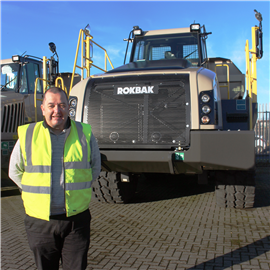 Scott Pollock, senior product manager with Rokbak
The bottom line is always a part of the equation and, as Pollock says, “Fuel consumption is an environmental concern, but also one of the biggest costs for a machine owner.
“In terms of TCO, there’s much more to it than the manufacturer’s data on fuel usage; it includes the way operators use and take care of the machine. This aspect of the calculation has become more important in recent years as the ability to analyse the data has improved.”
Of course, there are many levels of sophistication when calculating TCO, and some smaller businesses might rely on the machine manufacturer to help them understand the data. Most larger organisations however have a good understanding of both the calculations that can and should be made and the elements that need the closest scrutiny.
Designing for uptime
From a manufacturer’s perspective, knowing that equipment is going to be judged over the long term, there is a growing imperative to build not just durable machines, but machines that will continue to show high productivity with low maintenance needs, year after year.
Pollock believes component selection plays a crucial role here, saying, “The major lifecycle components, such as engines, transmissions, drives, axles, pumps and structural elements, will have an effect on uptime, which is one of the key elements of TCO.
“These major components also have a larger cost when they need to be repaired or replaced,” he says.
“We have this in mind, even at the drawing-board design phase of a new or updated hauler. At the same time, you can’t have your focus solely on the bigger elements; if you do that without ensuring the switches and widgets are durable and robust, you’re letting your customers down.
“These small components may have a smaller replacement cost, but if they come loose or stop working, that again means downtime that adds to project cost.”
Protecting the machine
This may sound like common sense, but Pollock points out that a new component – even one that operates optimally – has the potential to have a detrimental effect on another part of the machine. Testing, he says, starts at the very beginning of a new project and must continue through prototyping, bench testing and pilot stages.
“This is where collaboration through the supply chain is key and a free flow of information at every stage of development,” he says.
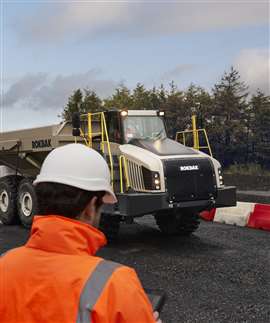 Comprehensive on-site testing ensures machine components are functioning at optimum levels
According to Pollock, a lot of focus during development now goes into ensuring the machine is protected against adverse on-site conditions and out-of-scope operations – and here technology and advanced engineering both have a role to play.
Rokbak’s RA30 and RA40 haulers both have adaptive shifting and traction control, features which basically remove the operator from the equation.
Ensuring optimal grounding for the articulated machines, traction control improves safety for the operator, but also protects the drivetrain and axles from overspinning, subsequently increasing their lifespan.
Equally, adaptive shifting ensures shifts are perfectly timed and smooth, reducing shock loads on the transmission and driveline, easing brake strain and minimising component wear.
All of this must be factored in to get the full TCO picture of a machine.
Parts choice and long-term risk
Of course, some businesses may well be including the cheaper cost of third-party components in their calculations, based on the fact that they are certainly a closer match to the originals than was the case in the past.
Pollock urges against the temptation to cut corners, saying, “Verified parts may cost a little more, but a hauler, like most construction equipment, is an expensive piece of kit and hauler components are tested and retested to work in perfect harmony with adjacent elements within the machine.
“Third-party parts are likely to be inferior in terms of material and machining. If that is the case, you could be reducing the lifespan of your equipment and can also expect more downtime, again increasing the total cost of ownership.”
Pollock gives the example of transmission fluids: Rokbak moved from a mineral fluid to a more expensive synthetic fluid and in doing so increased service intervals from 2,000 to 4,000 hours.
“Because that move gave us twice the interval,” he says, “the actual operational cost was less than it would have been had we continued using mineral fluid.”
Telematics today – alternative power tomorrow
The advent and rapid development of telematics has clearly helped machine owners gain a better understanding of TCO.
 Sophisticated on-board telematics systems have the potential to significantly reduce unplanned downtime
Both customers and their dealers can monitor a machine’s performance remotely, getting a clear picture of when some aspect of its operation is out of calibration.
With this powerful tool flagging issues, back office staff can quickly send messages to the field, notifying operators that a maintenance intervention is required, before a problem escalates to a potentially catastrophic failure.
Less dramatically, telematics keeps track of machine position and operational hours, ensuring better planning of maintenance across a fleet than ever before.
While Pollock agrees technology is making TCO easier to calculate, he also highlights another complicating factor, alternative power.
The onset of hybrid and full-electric propulsion for an increasing range of machine types will, he says, make the TCO calculation more challenging, at least in the short term.
“While some of the electronic components that will be used in the future won’t necessarily need to be overhauled in the same way, they will have a life cycle,” he says.
“Buyers will want to know how long the battery will last, whether there’s a battery swap-out scheme and how it works, the cost of replacing motors, etc.
“Clearly, there are many benefits to alternative power, but OEMs will need to be cautious when they consider increasing the purchase price of a machine that moves material from point A to point B.
“The total cost of ownership calculation is a key factor, but businesses also need to trust that they are buying machines that will operate productively and cost-effectively over the long term.”
--------
This article was produced by KHL Content Studio, in collaboration with experts from Rokbak
--------
All images courtesy of Rokbak
--------