Joint venture steams off with $446.5m Mumbai high-speed rail station deal

17 March 2023
A joint venture between two Indian construction companies has won a deal to build a station for a high-speed rail line in Mumbai.
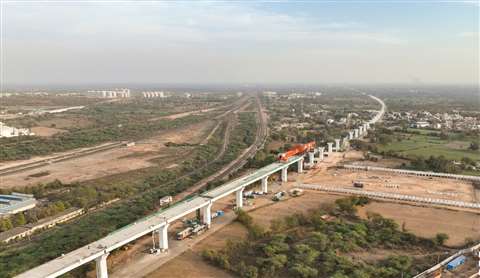 Construction of a viaduct for the high-speed rail line in Ahmedabad district, Gujarat, India (Image: National High Speed Rail Coroporation)
Hindustan Construction Company (HCC) and Megha Engineering & Infrastructures will build the station for the National High-Speed Rail Corporation, in a contract worth Rs 3,681 crore (US$446.5 million).
The Bandra Kurla Complex (BKC) bullet train station will serve as a terminal for the 508.2km-long Mumbai-Ahmedabad high-speed line.
It will have six 414m-long platforms, each sufficient to accommodate a 16-coach bullet train.
The station will also connect with the metro and road transport and will be the only underground station on the Mumbai-Ahmedabad High-Speed Rail corridor.
The joint venture will build the three-floor station around 24m below ground, over a total floor area of 2 million sq m.
The station will house waiting areas, a business-class lounge, a nursery, restrooms, smoking rooms, and information kiosks.
The contract also includes building a retrieval shaft on the eastern end for the removal of the tunnel boring machine (TBM), architectural finishing, all MEP works, and testing and commissioning.
Infrastructure specialist HCC claims to have built 26% of India’s hydro power generation and 60% of of its nuclear generation capacities, as well as over 4,036 lane km of roads, and 395 Bridges.