

Less effort, better compaction
Partner Content produced by KHL Content Studio
05 October 2026
Rolf af Klinteberg of Caterpillar considers how better information can help contractors make compaction more efficient, consistent and predictable…
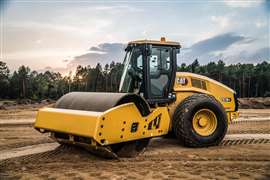 Cat’s CS10GC vibratory soil compactor is primarily designed to tackle granular soil applications
Compaction is a key element of the performance of roads and other infrastructure, but simply increasing the number of compaction passes doesn’t guarantee a better result.
In fact, unnecessary passes can mean additional fuel consumption, plus wasted machine hours and machine wear, without improving the ground.
For me, this highlights one of the biggest opportunities we have in compaction today, which is to be better at knowing where, when and how much compaction is required.
The problem with ‘just in case’
 Cat Paving’s Rolf af Klinteberg
Traditionally, operators have relied heavily on experience, specified pass counts and then testing to determine whether an area has been properly compacted.
Experienced operators can be extremely good at this. They learn to read subtle changes in machine behaviour, surface movement and soil response. But there is always going to be an element of uncertainty.
That can encourage operators to make additional passes “just in case”.
Also, if moisture conditions are unsuitable or the material isn’t responding as you expect, a machine can continue putting energy into the ground without achieving the required improvement.
This is what I think of as misaligned effort: we’re doing the work, consuming fuel and accumulating machine hours, but we don’t necessarily know whether that effort is adding value.
It also works in the opposite direction. A fixed number of passes might be sufficient across most of an area but leave isolated weak zones requiring more attention.
The objective should not be a certain number of passes – it should be achieving the required result as efficiently and consistently as possible.
Finding problems before they become expensive
One of the unusual characteristics of soil compaction is that problems can remain hidden for a long time.
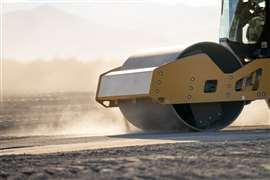 Machine Drive Power technology on board a compactor will flag where there are weak spots below the surface
Once another layer has been placed, you may have very little indication that an area beneath it has not been compacted correctly.
Problems can emerge much later as settlement, rutting, cracking, drainage issues or failures around utilities and trenches.
And by then, the cost of putting them right can be dramatically higher.
Traditional spot testing is an important part of quality assurance, but it inevitably provides information about selected locations.
The question contractors really need to answer is what happened between those test points.
This is where measurement and mapping can change the process.
With real-time information, operators can see how the material is responding while there is still an opportunity to do something about it.
In this way, weak areas can be targeted, while areas that have reached the required condition can be left alone.
At Caterpillar, this is an important principle behind the way we approach compaction technology. It’s why we developed Machine Drive Power, which reads soil stiffness from the machine’s own rolling resistance rather than from an accelerometer-based system – measuring at a depth that is comparable to typical lift thickness, and it works on smooth drum or padfoot machines, cohesive as well as granular material.
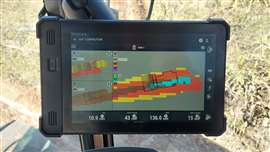 On the compactor’s mapping screen, MDP highlights soil stiffness, which it reads from the machine’s own rolling resistance
It will also flag areas where there are weak spots below the surface, so the operator knows when there is an issue in the material rather than the effort.
The objective isn’t to create data for its own sake, it’s to give the operator useful information at the point when it can make a difference to the outcome.
Making every pass count
I think this is an important distinction when we talk about productivity.
Traditionally, productivity might be associated with working faster or completing more passes within a shift. But if some of those passes aren’t improving the material, they’re not really productive.
A better measure is how efficiently the machine achieves the required compaction across the whole working area.
Mapping can help an operator understand coverage and identify where additional attention is required.
And here there are several potential efficiency gains: operators can stop when additional passes cease to add value, concentrate effort on weak zones and identify poor conditions before significant time is wasted trying to compact unsuitable material.
The result should be fewer unnecessary passes, lower fuel consumption and reduced machine wear.
From machine efficiency to project efficiency
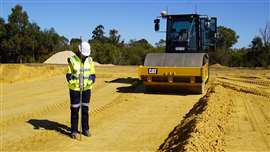 There is no requirement to exit the cab to test soil stiffness with MDP technology on board
The next step is to look beyond the individual compactor.
Compaction information must be part of a connected workflow – alongside grading, paving, design models and quality assurance.
When that happens, information generated during construction can improve decision-making elsewhere on the project – and produce a better record of what actually happened on site.
That can be very valuable for contractors, as it can support quality assurance, help resolve questions later and give asset owners confidence in the work beneath the finished surface.
Construction will always involve variability, and soil certainly doesn’t behave identically from one metre to the next.
But if we can see more of that variability while we’re working, we can respond intelligently.
Ultimately, that’s what efficient compaction should mean: applying the right effort, in the right place, at the right time.
--------
This article was produced by Cat Paving, in collaboration with KHL Content Studio
--------
All images courtesy of Cat Paving
--------