Meeting the data center power challenge… with batteries
Partner Content produced by KHL Content Studio
18 August 2026
As artificial intelligence changes the digital landscape, data centers are entering a new phase of growth.
The increasing computational requirements of AI training and inference workloads are driving an unprecedented demand for power and putting pressure on electricity networks that were not designed to cope with the rapid expansion.
Against this backdrop, battery energy storage systems (BESS) are emerging as a critical component of modern energy infrastructure.
Previously seen largely as backup power, BESS installations are increasingly being integrated into sophisticated power systems architecture.
Understanding BESS
A battery energy storage system basically combines electrochemical battery cells, power conversion equipment, thermal management systems, safety systems and advanced control software.
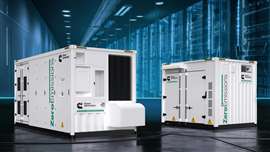 Cummins Power Generation’s battery energy storage system (BESS) solutions
While the battery hardware stores and delivers energy, the software layer is increasingly where the value is created.
Modern energy management systems (EMS) continuously monitor load profiles, grid conditions, electricity prices and, in some cases, renewable generation forecasts.
This allows operators to optimize how and when energy is stored, discharged or exchanged with other power assets.
According to Cummins Business Development and Marketing Manager, Dinesh Balaji Ramaraj, “The EMS is the brain – it’s what turns a collection of disconnected assets into an optimized power plant.
“It forecasts load, prices and weather, and works in parallel with the grid, coordinating onsite BESS and prime power to minimize cost and emissions, while guaranteeing operational reliability and managing grid constraints.”
 Dinesh Balaji Ramaraj, Business Development and Marketing Manager, Cummins Power Generation
This level of coordination is becoming increasingly important as data center operators look to balance reliability requirements and sustainability goals.
The need for more – and more – power
For many operators, obtaining sufficient power has become one of the biggest obstacles to expansion.
The rapid growth of AI infrastructure combines with challenges to utility connections to create a bottleneck for developers, who are also under pressure to reduce emissions and improve energy efficiency.
Furthermore, in many regions, grid upgrades can take years to complete, compounding the problem.
“Speed-to-power is the number one constraint,” says Dinesh. “Utility interconnection queues now stretch for years, while compute demand can’t wait.”
As a result, operators are increasingly looking beyond traditional grid connections and adopting more diversified energy strategies involving storage, onsite generation and microgrid controls.
Why AI workloads change the equation
Traditional data centers typically exhibit relatively predictable power consumption patterns.
AI facilities, particularly those dedicated to model training, behave differently.
“Traditional data centers carry relatively steady loads; AI training is the opposite, synchronized GPU [graphics processing unit] clusters ramp from idle to 100% load in milliseconds, creating sharp power swings,” says Dinesh.
These rapid fluctuations create challenges for transformers, switchgear, generators and utility connections.
 Adobe Stock
BESS installations are increasingly being deployed as a buffer between volatile computing loads and the wider electrical system.
BESS as shock absorber
One of the most significant roles of BESS in modern data centers is oscillation mitigation (or load stabilization).
Rather than allowing sudden AI-driven load changes to propagate through the entire electrical system, batteries can smooth out fluctuations before they affect the upstream infrastructure.
Dinesh describes the technology’s role, saying, “BESS is becoming the shock absorber of the power architecture. Its primary role is decoupling the impact of volatile compute loads on the grid and generation assets.”
The response time is a key advantage. Whereas conventional generators require time to ramp output, modern inverter-based battery systems can respond within milliseconds. This makes them particularly effective for handling transient events, voltage disturbances and sudden changes in demand.
Integrating grid power, generators and storage
In most large-load facilities, BESS forms part of a broader power ecosystem that may include utility supply, standby generators, renewable energy assets and uninterruptible power systems (UPS).
In this system, the battery provides the critical buffer power for sustained periods, to support the stable operations of both the onsite prime assets and overall grid resiliency.
Grid connections deliver bulk energy, generators provide longer-term onsite capability, and the battery manages short-term fluctuations.
The result is an efficient and resilient system. Rather than continually responding to transient load changes, generators can operate closer to their optimum efficiency points, reducing wear and improving fuel usage.
Increasingly, storage systems are also being used to provide continuity if grid power is interrupted.
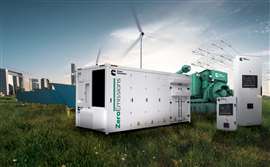 Cummins fully-integrated power system
Accelerating data center deployment
Another potential benefit of BESS is in accelerating project delivery.
Because battery systems can temporarily supply power during peak demand periods, facilities may be able to operate with a smaller grid connection than would otherwise be needed.
Where this is the case, development could proceed while utilities address longer-term network upgrades.
Dinesh says, “We’ve seen how BESS systems can help sites come online years ahead of a substation upgrade, then right-size the grid tie once the utility catches up.”
For operators facing intense pressure to bring capacity online quickly, this flexibility can be of significant value.
Supporting renewables integration
Increasingly, renewable energy is playing a role in data center sustainability strategies. However, solar and wind energy generation is inherently variable, creating challenges for facilities that require continuous and reliable power.
Battery storage helps bridge this gap by capturing renewable energy when it is available and delivering it when demand exceeds generation.
This capability allows operators to make better use of onsite solar installations or renewable power purchased through dedicated energy agreements. It also supports emerging approaches to carbon reduction that focus on matching electricity consumption with cleaner generation on an hourly basis rather than simply purchasing annual renewable energy certificates.
As Dinesh says, “BESS is a key enabler of Scope 2 reduction because it lets a facility actually use the renewable energy it procures, storing clean generation and discharging it when the grid is dirtiest.”
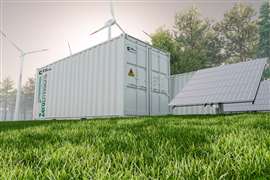 BESS integrated with the renewable energy sources of wind and solar
Peak shaving and energy cost management
While resilience remains a primary driver, economics are becoming increasingly important in the business case for energy storage. Many industrial and commercial electricity tariffs include significant demand charges based on a facility’s highest short-term power draw. BESS can reduce these charges by supplying power during peak demand periods, reducing the facility’s overall grid requirement.
Storage can also be used for energy arbitrage, charging when electricity prices are low and discharging during more expensive periods. In regions with volatile electricity markets, these capabilities can substantially improve operational economics while reducing strain on the grid.
Scaling to multi-megawatt applications
Being modular, modern battery systems allow operators to expand capacity incrementally as computing requirements grow. This scalability aligns well with the phased development approach commonly used in data center construction. That said, creating multi-megawatt storage installations means more than adding batteries.
Dinesh says, “Get the system controls, grounding, and protection right and scaling becomes largely repeatable.”
This modular approach also creates opportunities for future expansion without requiring major redesigns of the underlying electrical infrastructure.
Looking beyond batteries
Looking ahead, many industry observers expect to see increasingly sophisticated hybrid systems that combine storage, conventional generation, renewable energy and emerging low-carbon technologies such as hydrogen-powered engines and fuel cells.
In these environments, intelligent control systems will determine which energy source should operate at any given moment based on cost, availability, emissions and reliability requirements.
“We expect the lines between generation, storage, and backup to keep blurring into integrated microgrids that self-optimize in real time,” explains Dinesh.
For manufacturers such as Cummins, which are developing technologies across multiple power domains, this trend reinforces the importance of integrated energy solutions rather than isolated products.
Maintenance, monitoring and lifecycle
As with any critical infrastructure, ongoing maintenance remains important. However, much of today’s asset management can be performed remotely through advanced monitoring platforms that continuously analyze battery health, thermal performance and operational data.
This predictive approach allows operators to identify potential issues before they affect availability, improving reliability while reducing maintenance costs.
Looking further ahead, the industry is also increasingly focused on lifecycle sustainability.
Second-life battery applications, material recovery and recycling programs are becoming more important as the BESS market grows.
When evaluating total cost of ownership, these factors must be considered alongside capital costs, operational savings and other benefits.
For many applications, the most effective solution is not an either-or choice between batteries and generators, but a carefully engineered combination of technologies.
--------
This article was produced by KHL Content Studio, in collaboration with experts from Cummins
--------
All uncredited images courtesy of Cummins
--------