Nicolas in Royal Transport
14 May 2015
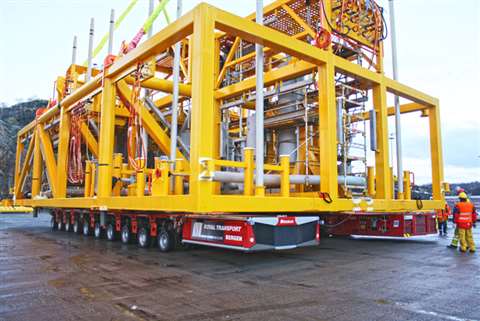
Transport company, Royal Transport, based in Straume, Norway, transported pumping station components in the town of Bergen.
The pumping station weighed 420 tonnes and was transported using two self propelled platform trailers. The trailers sued in the move included a second-generation Nicolas (G2) MHD SPE and a first-generation Nicolas (G1) MHD SP. Royal Transport owned the MHD G2 SPE and rented the MHD G1 SP.
Sébastien Porteu, Nicolas managing director, said, “The idea was to combine an electronically-steered vehicle with a mechanically-steered one in a loose coupling mode. This is unusual but it functioned perfectly with vehicles from Nicolas following a careful planning process. Thereby, the two PowerPacks used were configured to run in a master and, or, slave mode. Once again, this is a good example of the technical innovative strength that lies behind our vehicles - they offer solutions instead of problems.”
The bogie units of the Nicolas MHD G2 are available with either mechanical or electronic multi-directional steering. The trailers are specially designed to carry extremely concentrated loads, the manufacturer said. For road transport assignments, the MHD G2 can be used as a trailer or semi-trailer combination as well as being coupled side-by-side as a 3 or 4-file combination, a spokesperson from TII Group, of which Nicolas is a part, added.