Parked in plane sight: Why GSE fleets rely on large spark-ignited engines
Partner Content produced by KHL Content Studio
07 September 2026
This is a dynamic time for the on- and off-highway equipment industries. It wasn’t all that long ago that fleet buyers could pick any energy source they wanted so long as it ran on diesel fuel.
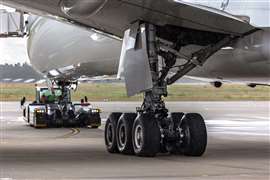 A ground support vehicle undertakes pushback operations on a wide-bodied aircraft. Image: Adobe Stock
Today, thanks to a much wider selection of power sources, it is finally possible to pick the powertrain that best fits a particular application.
Choosing the correct path into the future can still be an overwhelming task: should engineering stick with the tried-and-true or bet everything on the latest technology?
However, there’s a proven power source that already offers low tailpipe emissions, one that has virtually been kept secret for a long time. It has been parked in plain sight of anyone who’s spent time waiting on a jet plane.
Airport ground support equipment (GSE) has depended on large spark-ignited engines for decades.
When equipment availability is critical
Consider the application: An airport operates like a small city. Out on the tarmac and under the terminal, thousands of moving assets work together for a single goal: to get each aircraft turned and back into the air as quickly and as safely as possible around 2,600 times a day (in the case of Chicago O’Hare International Airport).
From regional runways to major international hubs, airport ground support is a complex operation that demands operational efficiency and equipment uptime.
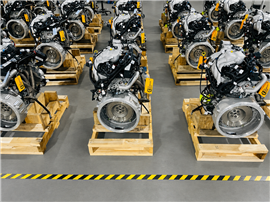 Fully assembled Ford MSG425 2.5L engines
Ground crews must think in terms of equipment availability. Fleet managers work to ensure each machine offers airport personnel similar user experiences for ease of operation.
Each mobile machine, such as baggage tractors, belt loaders and those heavy aircraft pushback tractors, moves through work cycles that are closely orchestrated to ensure on-time departures occur throughout multiple shifts every day.
Adding to the complexity is the fact that large airports are typically landlocked, making it difficult for transportation authorities to expand their footprint or for fleets to add equipment when air traffic increases.
If additional flights are required, airlines must use the tools they have to reduce the time needed to turn a plane and make room at the gate for the next flight.
“Ground support equipment is like emergency vehicles – it needs to be available when it’s needed,” says Glenn Cummins III, vice president for Engine Distributors Inc. (EDI) in Blackwood, N.J. “If they’re not, it’s a disaster. The pilots will time out and then hundreds of passengers will take off three or four hours late.
“The delay will cause a ripple effect because now that plane’s late getting to the next destination. It is a very demanding market. Any delay is huge for these airlines from a cost standpoint. Time is money.”
A long-established powertrain choice
A third-generation family-owned engine distributor, EDI is led by brothers Glenn Cummins III and Jaime Cummins.
The company started at a Camden, N.J., Ford Motor Company dealership in 1958, when it was launched as a division of the dealership to sell Ford’s automobile and truck engines into construction, marine and agricultural applications.
By the end of the 1970s, the company had moved out from under the umbrella of the dealership to operate as an independent enterprise managed by Glenn Cummins Jr. and, later, his sons.
The company is the global supplier of Ford engines for the industrial off highway market. Ford’s industrial engines have been the leader in the GSE space since the 1960s, starting with the Ford 300 engine [a 4.9 L inline six-cylinder unit offered from 1965 to ‘96]. Most everything was gasoline back then,” says Cummins.
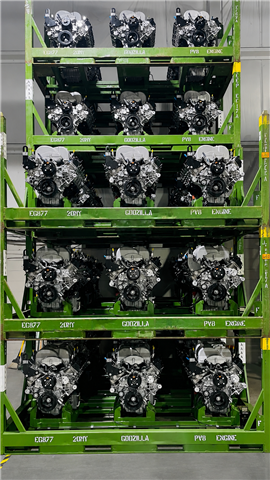 Ford WSG873 7.3L “Godzilla” engines racked at the pre-assembly stage
“Then, like just about any other industry, a lot of guys started using diesel engines because carbureted engines could be hard to start and the fuel consumption wasn’t as good as diesel.
“Once fuel injection came out, the major airlines and shipping companies went back to gasoline or filtered in LPG or CNG where they made sense. That’s where we are today.
“The Ford engine is even better now, because of fuel injection systems and because of the quality of their internal components. Fuel consumption and overall maintenance costs are still the key to success, and that is why GSE customers want those engines today.”
The economics of a power platform
Airports, cargo handlers and parcel delivery fleets stick with large spark-ignited (LSI) engines in part because the cost for replacement parts and entire engines is less than a comparable diesel engine.
In the case of Ford engines in particular, any machine downtime will be shorter on average because of the global availability of parts.
Ford Motor Company built 2,446,486 Ford and Lincoln vehicles in the United States in 2025, which included 537,030 examples of the Ford F-150 pickup and 380,126 units of its F-Series Super Duty trucks.
“We buy engines from the plants that produce those volumes,” says Glenn. “Industrial engine guys may produce well under that for the industrial market, and it’s hard to compete with those numbers when you look at cost and other factors.
“We use an automotive-based engine in the industrial market that has all of the benefits of an automotive platform: quality, technology, longevity and competitive pricing. Those are all benefits.
“These are positives that people within the ground support industry have recognized for a long time.”
“The acquisition cost of a Ford LSI engine is significantly less than an equivalent diesel,” says Jaime, “and the maintenance cycle is a lot less than a diesel engine.
“When it comes to cylinder heads and spark plug changes, our engines are an automobile-based product, designed by Ford engineers to go more than 125,000 miles.
“We can do the equivalent number of hours with off-highway equipment before technicians have to touch the spark plugs, for example. Plus, you never have to do any valve maintenance, which is an added cost with other engines.”
The relative simplicity of a gasoline engine is another selling point for ground support fleets, according to EDI.
“The emissions regulations for LSI engines haven’t changed since evaporative emissions standards of 2007,” says Glenn.
“That’s a benefit for our customers because we’re buying automotive-based engines and we already know that they’re clean and that they’re using current technology.
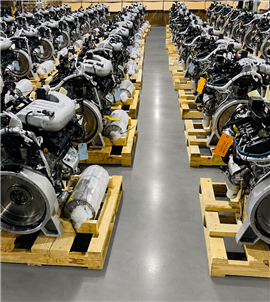 Fully assembled Ford LSG635 3.5L engines
“They’re the same engines running off the assembly line for Ford’s vehicles. By working with Ford, we benefit from always having current technology for fuel efficiency and quality. And we don’t have to make any internal engine modifications to run on alternative fuels like LPG and CNG.”
One platform, multiple fuel options
Today, it is most common to see a gasoline engine running a baggage cart tractor, for example. Engines running compressed natural gas (CNG) and liquefied petroleum gas (LPG) have their place, too.
The Denver International Airport recently completed several equipment repowers with EDI that will run CNG.
In Colorado, a regional abundance of the fuel and government incentives help CNG make financial sense.
Other airports, such as Charles de Gaulle or Los Angeles International Airport, prefer LPG for GSE because of the facility’s layout – in Paris, ground support crews spend a lot of time traveling to and from in tunnels.
Most GSE fleets work to stick with one engine platform to help ensure parts commonality and to simplify and accelerate diagnostics work when there is a problem.
“One of our major airline customers loves that they can buy one engine and have it configured to different applications based on their geographical location,” says Jaime.
Making room for a mixed-energy future
Battery-electric vehicles have earned a solid foothold in many off-highway equipment applications, including GSE.
While reducing emissions around congested airports is important, ground crews have learned to appreciate battery-operated machines for their lack of vibration, noise, reduced maintenance and fuel savings.
“The ground support market should be an easy place to do some electrification because the units are at the gate and it’s easy to charge them,” says Jaime.
“But a lot of airports have run into issues with the infrastructure investment needed to support all of the electric vehicles they wanted to add to their fleets.”
While the power profile that certain types of GSE need and their availability requirements may have slowed the adoption of battery-electric vehicles at certain airports, others have installed portable charging stations to run battery-electric GSE until the infrastructure can catch up.
For fleets that are ready to make the leap, Jaime says EDI also has access to the work Ford Motor Company has completed on battery and electric vehicle development. To that end, the automaker currently offers the F-150 Lightning and the E-Transit, an all-electric cargo van with a payload of more than 4,000 pounds.
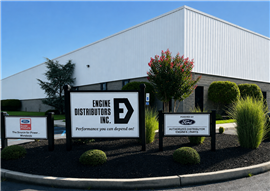 The headquarters of Engine Distributors Inc
“I think there’s going to be a mix of electric, gasoline, LPG and CNG in GSE equipment for a long time,” says Jaime.
“But every market could be 100% spark-ignited – up to whatever the horsepower and torque requirement is,” says Glenn.
Ford and EDI’s largest industrial engine is the naturally aspirated 7.3 L V-8 that was introduced in 2020 in the Ford Super Duty trucks.
The engine has a maximum power of 430 hp @ 5,500 rpm and a maximum torque of 475 lb.ft. @ 4,000 rpm.
While airport ground crews seem to have done a good job keeping their powertrain a secret – even while it was parked for all to see – EDI says the benefits of running LSI engines in equipment do not stop at the departure end of the runway. Other applications will see similar benefits, as well.
“A lot of customers we’ve talked with don’t realize they have options,” says Glenn. “If they’ve been buying a diesel for the last 30 years, they think they must continue buying a diesel for their material handling or other construction equipment.
“They don’t realize they have an alternative, one that the GSE market has proven for decades.”
--------
This article was produced by KHL Content Studio in collaboration with experts from Engine Distributors Inc.
--------
All uncredited images courtesy of Engine Distributors Inc.
--------