Powering through uncertainty: How engine choices can improve reliability
Partner Content produced by KHL Content Studio
25 June 2026
Across North America, operators are rethinking how power is sourced, deployed and maintained in the field.
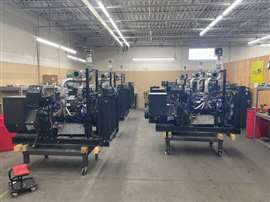 EPA Certified Reliable Horsepower engines in the production cell
With rising equipment costs, fuel price spikes and growing demands for uptime, industries from agriculture and oil & gas to power generation are being forced to take another look at their assumptions around engine strategy and operational reliability.
That’s driving a broader conversation around fuel diversification and a growing willingness to reconsider the traditional diesel-only approach.
Operators now have more focus on issues such as serviceability, fuel access, maintenance demands and long-term operational control. Many are moving away from one-size-fits-all solutions toward strategies that are more application-specific.
According to Jay Canada, VP of Sales & Engineering for IIS – an industrial engine OEM with their Reliable Horsepower engine line – the operational pressures facing engine and power-system professionals look very different from even five years ago.
 Jay Canada, VP of Sales & Engineering for IIS, owner of the Reliable Horsepower engine line
“Total cost of ownership is discussed much more closely than it used to be,” he says. “Customers are now asking what it’s going to cost over the life of the engine or system. And such evaluations include labor realities as well.”
For Blake Thompson, the company’s Engine Package Sales Lead, those same pressures are having a major effect on inventory strategy and long-term planning. He says, “Due to the upfront cost of diesel engines, a lot of dealers aren’t carrying that inventory anymore. They’re opting for spark-ignited or propane engines for the flexibility.”
He adds that operators are paying closer attention to ongoing cost, ease of care and serviceability, particularly when comparing diesel and spark-ignited systems.
Stable process
Canada agrees and notes that reliability today extends beyond uptime alone. “At some point, rotating equipment is going to break,” he says. “The question is whether you have the service support structure in place to get machines back up and running in a reasonable amount of time.
“At the same time, concerns around energy stability and domestic supply are becoming part of the equation. Given the world today, having a domestic source you can rely on is increasingly important, especially here in North America.”
That concern extends beyond pricing volatility into broader questions surrounding supply continuity and infrastructure resilience.
Canada says, “If oil and natural gas experience supply disruptions, what does that eventually do to diesel fuel or gasoline downstream? Propane, being a much more domestically sourced commodity, really has a leg up there.”
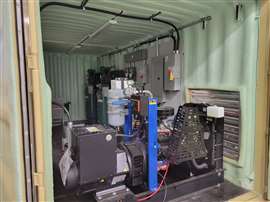 A Reliable Horsepower engine installed in a gen-set and ready for field deployement
In sectors where uptime is critical, those concerns are pushing operators to reconsider how power is sourced.
Canada continues, “Grid reliability concerns are also becoming more important. A lot of industrial applications are looking at more decentralized power supply options.”
Supply chain volatility is part of the conversation as well. Thompson notes that sourcing engines domestically has helped stabilize portions of the process.
“We try to forecast as far in advance as possible so we can produce what we need and keep products available for our customer base,” he says. “But at any point, things can change.”
For Canada, availability itself has become a major part of the value proposition. “Customers want suppliers that have proven availability across business cycles,” he says. “That’s true in good times, lean times, when there’s supply disruption, whatever it may be.”
Changing conversation
Those same pressures are reshaping how operators think about diesel and their long-term equipment strategies.
“There’s a significant upfront cost to keeping diesel inventory around,” Thompson says. “Dealers don’t know when it’s going to go out the door, so it becomes a major investment to stock and hope it moves.”
Instead, many operators are shifting toward spark-ignited platforms, driven by acquisition cost, maintenance demands and fuel volatility.
 Blake Thompson, Reliable Horsepower’s Engine Package Sales Lead
“We’ve seen far more spark-ignited engines going out the door than diesel lately,” says Thompson. “It’s the upfront cost, the ongoing cost and the maintenance piece too.”
Canada adds that many operators now view spark-ignited systems as a simpler, lower-maintenance alternative. “Diesel is jumping around quite a bit from a fuel-cost standpoint,” he says. “Propane has moved some too, but to nowhere near the same extent.”
At the same time, a lot of the assumptions around performance are beginning to shift.
“One of the misconceptions in the industry is that diesel is the only option for high-load or heavy-duty applications,” says Canada. “Today’s propane engines can do a lot of the same things. Diesel still makes sense in certain high-horsepower mobile applications, but the conversation has changed considerably for many stationary and portable operations.”
Thompson agrees. “We can still reach horsepower ranges in spark-ignited applications that compete with diesel,” he says. “Propane is right there with it in a lot of scenarios – and as far as infrastructure goes, you can place a propane tank anywhere you can place a diesel tank.”
Stronger focus
All told, says Canada, more operators are moving away from a diesel-only mindset. “They’re realizing there may not be a one-size-fits-all solution anymore. More and more are prioritizing flexibility and resilience over dependence on a single source.”
That flexibility can take different forms depending on the application – whether through propane portability, existing natural gas infrastructure or bi-fuel systems that allow operators to shift based on availability, economics or operational need.
Adding to that, Aaron Vancura, Technical and Engineering Support with Reliable Horsepower, is seeing a lot of operators overestimating how difficult those transitions actually are.
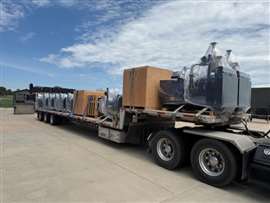 Engines from Reliable Horsepower, loaded up and ready for shipment
“The relative simplicity of some of these spark-ignited packages makes that transition easier than people expect,” he says. “With a lot of the turnkey packages we offer, you can set it in place, hook up fuel and go.”
Fuel availability has also become a key factor in long-term operational planning, particularly in remote or emergency-driven applications. “Without reliable access to fuel, the best equipment in the world is useless,” says Canada.
Such realities are especially important in agriculture, oil and gas and backup power generation, where downtime can have immediate consequences. As a result, operators are becoming far more intentional about fuel strategy itself.
“That includes a stronger focus on backup power, cost forecasting and long-term stability,” says Thompson. “Additionally, propane adoption has accelerated in many stationary agricultural applications, partly because operators can often lock in pricing and avoid the volatility associated with diesel.”
Canada points out that propane’s appeal also extends beyond cost. “It burns cleaner, emissions systems are simpler to maintain and the fuel itself is more stable than gasoline or diesel,” he says. “A decade ago, propane wasn’t even part of the conversation in many of these industries. Now it’s increasingly at or near the forefront.”
Defining priority
Looking ahead, then, are we seeing a true multi-fuel landscape emerging?
“I think every fuel is going to have its place,” says Thompson. “The real question is figuring out which option makes the most sense for a specific application.”
 Aaron Vancura, Technical and Engineering Support at Reliable Horsepower
That shift is becoming especially visible in stationary operations, where rising energy costs are forcing operators to reevaluate electrification strategies.
According to Thompson, “Not long ago, there was a major push toward electrification, and now we’re starting to see some pushback. In a lot of cases, propane is becoming the alternative people are gravitating toward.”
Canada describes the transition as part of a broader move toward operational flexibility. “It’s really an all-of-the-above approach,” he says. “It’s no longer one fuel for everything everywhere.”
From there, he explains, power strategy is becoming increasingly tech-driven. “One of the biggest shifts is the growing use of data and telematics,” he says.
Remote monitoring is playing a growing role as well, says Thompson, particularly in agriculture and oil and gas applications where equipment may operate far from maintenance teams.
“Operators can monitor systems from their phone,” he says. “They don’t have to send someone out every morning just to check on equipment.”
According to Vancura, “All of these systems are becoming more connected and more data-driven. The ability to collect information from multiple locations and have smart components communicating with each other is only going to become more valuable.”
Canada adds that flexibility in engine architecture looks set to drive future development. “The same core engine technology can work across propane, natural gas and even future hydrogen blends,” he says, “which allows us to tailor development around the fuel the customer actually needs.”
And he adds, “The data coming from units already in operation ultimately allows us to build better service manuals, maintenance schedules and support systems up front.”
As for future-proofing operations, it seems to come back to predictability for IIS and Reliable Horsepower – and Thompson believes that, “In fuel costs, equipment costs and long-term support, we see it as being about controlling the controllables.”
And Canada acknowledges that operators no longer have to choose between reliability and sustainability. “What we’re developing today,” he says, “are reliable, durable, long-life systems that are also sustainable from both an emissions and fuel-sourcing standpoint.”
The Reliable Horsepower team agrees that adaptability, rather than standardization, will be the priority moving forward.
“There’s no universal solution anymore,” Thompson concludes. “Every application is different, and the solution needs to reflect that.”
--------
This article was produced by KHL Content Studio, in collaboration with experts from Reliable Horsepower
--------
All images courtesy of IIS and Reliable Horsepower
--------