Rethinking compact equipment for space-constrained job sites
Partner Content produced by KHL Content Studio
04 May 2026
Urban construction in Europe is undergoing a significant shift.
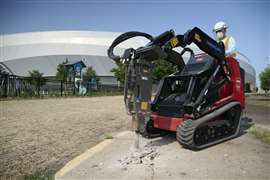 Toro’s Dingo TX-1000 Turbo with a powerful breaker attachment
As projects become more complex and experienced operators harder to find, contractors are being forced to reassess how they work and what equipment they bring on site.
Increasingly, the conversation is turning towards ultra compact, versatile equipment that can deliver productivity without the footprint of traditional machinery.
That’s certainly the view of Matt Coleman, UK & Ireland sales manager with the long-established equipment manufacturer Toro – a global brand with a diverse portfolio spanning turf care, grounds maintenance and specialised equipment, and known worldwide for its Dingo compact utility loaders.
He believes these pressures are reshaping job site priorities, creating opportunities for smaller, multi-functional machines.
“Access is most definitely an issue in some areas,” he says. “We had legislation changes in 2020, allowing for more infill work. Access there is often more challenging than on a large development where you tend to have more space.”
 Toro’s Matt Coleman
This rise in infill construction, alongside refurbishment and selective demolition, is fundamentally changing site dynamics. Tight urban plots, proximity to existing structures, and sensitivity to disruption all place new demands on equipment.
For contractors, this means balancing productivity with precision.
“You see a lot of contractors using mini excavators or bigger equipment on sites with tight narrow spaces…but a compact utility loader, which is really a multi-tool machine, has great mobility and is less likely to disrupt a neighbouring facility or building.”
The implication is clear: versatility is no longer a ‘nice-to-have’. It is becoming central to how contractors maintain efficiency under constraint.
Doing more with less
Beyond spatial challenges, labour challenges are also influencing equipment decisions. Across Europe, contractors are grappling with skills shortages, rising wages and the need to deliver projects faster.
This shift is also reflected in the growth of the rental sector, which increasingly favours equipment that can serve multiple applications.
Coleman says, “The rental market in Europe is increasing year on year, and small versatile stand-on machines like Toro’s TX1000 Turbo are becoming more valuable to that sector.”
The TX1000 Turbo is the newest member of the Dingo family of loaders and a recent update of Toro’s TX1000 loader, which came to market in 2015. The new machine has a turbo diesel engine, for greater torque and a 454kg lifting capacity.
Nevertheless, adoption of compact utility loaders in Europe lags well behind markets such as North America.
“It’s still a very young category for the European market,” says Toro’s international product marketing manager, Paul Johnson. “The growth we’re seeing in North America is phenomenal…now it’s important for more contractors and professionals in the European region to recognise what a valuable tool this is.”
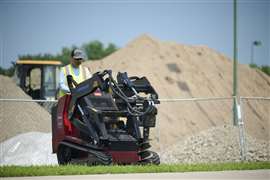 The Dingo TX-1000 Turbo working with an auger attachment
Part of this gap is cultural, but much of it comes down to awareness and education about the efficiency and productivity benefits of small but powerful stand-on machines.
“It’s only when you have a machine in a customer’s environment for the first time that they actually realise what it can do to their day-to-day activities,” Coleman explains.
Redefining ‘compact’ and ‘utility’
Even the terminology surrounding these machines remains fluid. Labels such as ‘ultra compact’ or ‘compact utility loader’ are still being discussed by many within the industry, even though Toro’s first Dingo loader was introduced to the market over 30 years ago.
“A lot of people are still trying to figure out the correct term for these machines,” says Johnson. “But for us they’ve always been compact utility loaders. What’s important, though, is that they have a lot of muscle for small machines.”
Johnson highlights a perception gap, with many people wrongly equating a compact footprint with limited capability. He sees this as one of the barriers to wider adoption.
“It’s strange,” he says. “You meet contractors who just can’t believe such a compact machine can get things done, but they have a surprising amount of power.
“In fact, they hit a sweet spot when you want a machine that’s large enough to cope with slightly bigger activities but compact enough for access.”
Transportability also plays a role in that equation. Machines that can be moved easily without specialist logistics offer a clear advantage for smaller contractors and urban projects.
As Coleman says, “You could drive a compact utility loader up into the back of a van; you don’t need a trailer or any other means of transport.”
Productivity in repetition
 Toro’s Paul Johnson
Where compact equipment often delivers its greatest value is in repetitive, labour-intensive tasks – particularly those involving the constant movement of materials.
“It definitely helps,” says Johnson. “A first-time operator can jump on it, not be in any way intimidated and be highly productive in a short amount of time.”
This ease of use is critical. Intuitive controls reduce training requirements and enable multiple operators to use the same machine effectively.
“Any operator could be on it for a matter of a few minutes and be very proficient,” Johnson adds.
The stand-on design of machines such as the TX1000 Turbo also offers visibility advantages that are particularly relevant in confined or complex environments.
“Operators have a 360-degree view with no obstructions,” says Coleman. “You can get a bird’s eye view in restricted areas and confined spaces.”
This improved situational awareness not only enhances productivity but also contributes to site safety – vital in the confined space of an urban construction site.
Adapting to the ground beneath
European job sites rarely offer uniform conditions. From paved urban surfaces to soft ground and demolition debris, machines must adapt quickly.
“With a track system, these machines really shine,” says Johnson. “The flotation of the tracks distributes the weight on uneven terrain, so travel is incredibly smooth.”
The ability to select a machine with a specific configuration, depending on the required application – narrow tracked for tight access or wider for increased stability – adds another layer of flexibility.
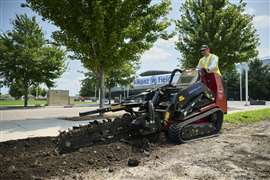 The TX-1000 Turbo has more than enough power for trenching work
Coleman adds that the tracks spreading that weight over a wider expanse keeps ground pressure to a minimum – particularly important where surface damage can carry significant cost and disruption.
The power of attachments
If compact loaders like the TX1000 Turbo are gaining traction, much of that appeal lies in their role as tool carriers rather than single-purpose machines.
From trenching and augering to material handling and surface preparation, the breadth of applications is extensive.
“At the most basic level, where you might have a labourer with a wheelbarrow and a shovel,” says Coleman, “these machines are taking that back-breaking work out of the equation.”
At the other extreme, Johnson highlights how this versatility can transform workflows, particularly in demolition.
“On a demolition job, you could put a hammer on the front of a mini excavator, but you still have all the damaged debris that you need to remove,” he explains. “A mini excavator is not efficient at moving debris. With a compact utility loader, one tool gets both jobs done very efficiently and quickly.”
Central to enabling this versatility, is hydraulic performance and, as Coleman notes, “A flow rate of up to about 50 litres per minute is very high for this size of machine. It’s capable of carrying out those heavy jobs you would expect a larger machine to cope with.”
A question of awareness
For contractors evaluating new equipment, the key considerations are still grounded in fundamentals.
“Return on investment is key,” says Coleman. “And time is precious. Having a product that’s going to do numerous jobs throughout the day, rather than one machine for a specific job is where these ultra compact loaders will really gain traction.”
Rental companies are arriving at similar conclusions.
“If a customer has a problem, it’s important for rental companies to have a ready answer,” Johnson says. “We’re making great progress in terms of growing awareness of the advantages of these products.”
As European construction continues to evolve, the pressures of space, labour, and efficiency are unlikely to ease.
In that context, compact, adaptable ultra-compact equipment is not simply a niche – it may increasingly become the norm.
--------
This article was produced by KHL Content Studio, in collaboration with experts from Toro
--------
All images courtesy of Toro