Sany delivers 3,000 tonne crawler crane

23 May 2022
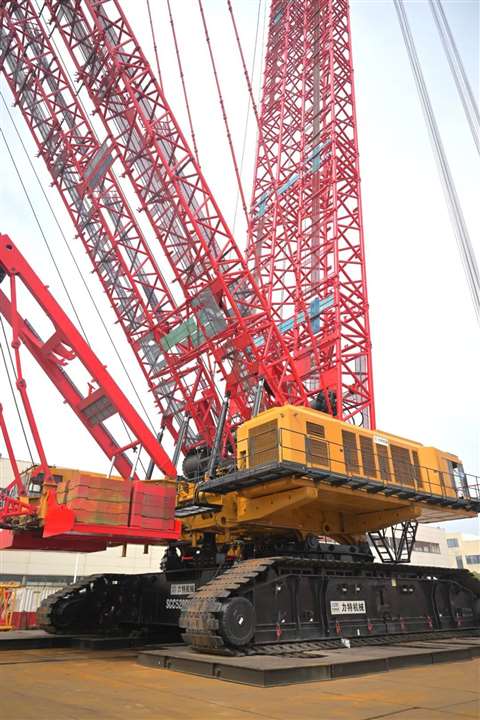 Sany SCC52000TM delivered for the Hualong One nuclear power station construction project. Photo: Sany
Chinese manufacturer Sany has delivered the first unit of its 3,000 tonne capacity crawler crane, the SCC52000TM, for a power project.
The manufacturer of cranes and general construction machinery handed over the double lattice boom giant on 28 April, having completed its programme of testing.
It will be used to lift the dome at Hualong One, a third-generation nuclear power plant construction project.
In addition to dome lifts and other big jobs at nuclear power plants, the crane will also be suitable for the large-scale hoisting of vessels in petrochemical plants, Sany said.
Two cranes in one
Sany said its SCC52000TM combines 2,000 tonne and 1,600 tonne capacity crawler cranes. It is tagged as the first “two-in-one” crawler crane to hit the market in China. In its highest capacity version it is configured with two parallel lattice main booms.
Zhou Hongwei, Sany engineer, said the SCC52000TM in “single-crane mode LJDB78+ 60” configuration lifts 278 tonnes on a 68 metre radius while in combined mode at the same radius, the lifting capacity is given as 581 tonnes – 2.1 times higher.
Higher utilisation
Being able to use it as two sizes of crane improves the utilisation rate of the equipment and maximises its value, said a spokesperson for the Hualong One power company that bought the crane.
Check back for more details as they become available.
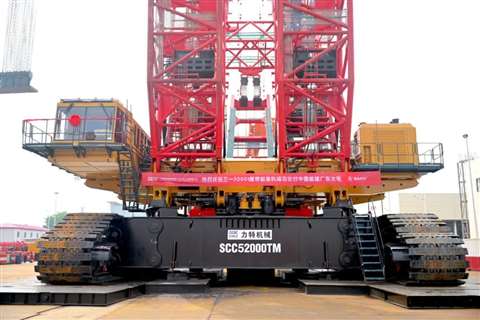 Front view of Sany SCC52000TM showing the double booms. Photo: Sany