Smart lifting: How to balance cost and safety
Partner Content produced by KHL Content Studio
03 December 2025
Across North America, contractors continue to feel the squeeze.
 LGH supplied trolly hoists to ensure this historic plane lift went without a hitch
Material prices remain volatile, tariffs shift without warning, and budgets are tightening in ways that make the cost of a mistake far heavier than in years past.
At the same time, project timelines are stretching or collapsing depending on funding cycles, supply availability and design changes.
Through it all, lifting operations remain central to moving work forward – yet they are increasingly difficult to plan with confidence.
For LGH Regional Rental Manager Aaron Orsak, who oversees LGH’s South Central region, those pressures have reshaped the conversations he’s having with contractors every day. “The increase in raw material costs is really pushing people to rental,” he says.
“Maintenance, replacement costs, certification costs – all those things are on us when they rent, not on them.”
Orsak emphasizes that many contractors are reacting to both financial pressure and the need to eliminate downtime. “They can’t have a down day – or a lost day. The bidding is so competitive now that when equipment goes down or something’s amiss, a whole day really eats at their profit.”
 Versatility, in terms of the length and capacity of lift, is key to the growing popularity of multimodular spreader beams
In the Northeast, LGH’s Regional Rental Manager Jason Rios sees similar patterns and notes that cost pressure has shifted how many contractors approach investment decisions.
“Contractors are realizing that tying up capital in infrequently used rigging or lifting assets doesn’t make sense when material and labor costs are already inflated,” he says.
“Instead, many are moving toward a rental-first mindset that allows them to keep cash flexible while still accessing specialized lifting gear.”
According to Orsak, such economic conditions also influence how jobs are sequenced. “Tariffs, in particular, create a strange dual effect,” he says.
“Sometimes, if contractors are about to move on a job and the tariffs are coming up – they’re going to move quick to avoid that.
“The flip side is they push the job, hoping the tariffs come down, hoping the raw materials are not as much.” In either case, he indicates, lift planning becomes more challenging.
Rios, agrees, adding that extended timelines, phased work and fluctuating funding are now routine.
“On major infrastructure jobs, we’ve seen lift plans that need to remain flexible for months at a time,” he says. “Customers increasingly rely on LGH to scale equipment packages up or down as scopes change.”
Meanwhile, supply-chain issues – once a dominant constraint – have largely normalized.
“I think everyone’s caught up for the most part,” Orsak says. “Which was not the case two years ago.”
Operational complexity
Even in strong markets, the demands on lift operations are becoming more intricate.
Rios points out that one of the most common oversights is underestimating the engineering or rigging complexity required for today’s modular and prefabricated assemblies.
“In dense urban markets like Philadelphia, New York, and Boston, space and timing constraints mean every lift must be precisely modeled and executed,” he says.
“Too often, lift planning is treated as an afterthought rather than a core safety and efficiency function.”
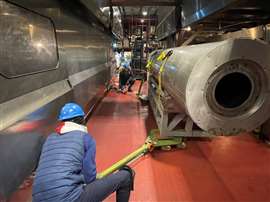 Pulling power…skates can be used to transport heavy machinery safely and smoothly
Orsak echoes the concern from a different vantage point. “Often the biggest thing is a lack of pre-planning. They’ll get a drawing from the manufacturer of what the load is supposed to be, and then it arrives onsite, and it’s different.
“Once additional piping, skid modifications or weight changes appear, crews can quickly find themselves with the wrong crane, the wrong rigging, or an outdated plan.”
In response, many contractors have begun requesting photos in advance rather than relying solely on engineered drawings.
“A drawing is great – but send me a picture to confirm it looks like the drawing,” adds Orsak.
Both managers also point to the consequences of underestimating the size or capacity of required gear – something that’s still surprisingly common.
Rios notes that customers frequently request spreader bars or beams without accounting for slings, shackles or leveling components.
“The consequences are delayed mobilizations, or worse, rework and rescheduling costs,” he says. “Even a day or two delay can cause thousands of dollars in costs.”
Orsak sees this a lot with bull rigging rather than crane work. “Inside a building, moving machinery with hydraulics and skates, they might underestimate how much it weighs because of sediment and grease buildup,” he says. “It’s a different animal.”
The rise of self-performing work adds another layer of risk. “The equipment is only going to do what you tell it to do,” says Orsak.
“This comes down to personnel and experience. My advice is to do a mock move before you show up on the jobsite and try to use it there for the first time.”
He adds that many compliance lapses are often rooted, not in the equipment, but in the lack of experienced hands guiding the lift.
 The Hydra-Slide system could be the answer when the use of a crane is not practical for a heavy lift
Rios also points to human factors and planning gaps as drivers for many incidents. “Crew substitutions, night work and last-minute changes all increase risk,” he says. “Which is why we emphasize pre-lift meetings and digital documentation tools to keep everyone aligned.”
To that end, he says, LGH frequently joins pre-critical lift meetings or even visits sites on lift day to advise.
Smarter strategy
Despite the challenges, both managers see clear paths toward safer, more predictable outcomes, with rental playing a central role in many of them.
As contractors reconsider equipment ownership, Orsak says the decision often comes down to repetition.
“Ownership makes sense if it’s the same single job over and over again,” he says. “But as soon as a company wants to expand beyond its core lifts, rental becomes the more strategic option.
“They want to go bid on larger jobs without the capital expenditure of having all the equipment. Rental lets them do that.”
He also recognizes the stability rental brings to job costing: “When you have a rental quote and you’re going to bid a job, that quote should not change. Your fixed cost is rental.”
Rios approaches the question similarly, emphasizing utilization analysis.
“Renting makes the most sense when project scopes vary, equipment utilization is unpredictable, or the gear required is specialized,” he says.
“Hidden costs like recertification, storage, repairs, transportation, can often shift the financial equation more than contractors realize.”
 LGH sheave blocks being used to reduce the force required to lift a digester tank for a biogas plant
Both men highlight the role they can play in offering guidance during that decision-making process. “If you’ve got the equipment, that’s great,” Orsak says. “But if you get in a bind and need to supplement, that’s where we come in.
“Our goal is to help customers make data-driven decisions that maximize efficiency and minimize liability,” adds Rios.
With that in mind, strategic planning also requires earlier collaboration. “The earlier lift planning is introduced, the better,” says Rios. “Revisited plans during preconstruction and mobilization tend to lead to smoother lifts and fewer surprises.”
Technology – from CAD-based lift plans to real-time load monitoring – has accelerated that collaborative potential.
Orsak notes the impact of digital twins and VR modeling on critical lifts, while Rios points to modern load links, cube jacks and robotic skates as part of the next wave of jobsite capability.
Still, Orsak believes the greatest value comes from clarity. “Visual aids are so helpful,” he says. “It’s like having a picture of the puzzle you’re putting together.
“When people are efficient, they’re safe. Less chaos equals more safety.”
And Rios agrees, saying, “All the more reason to treat lift planning as a strategic investment and not an afterthought.”
--------
This article was produced by KHL Content Studio, in collaboration with experts from LGH
--------
All images courtesy of LGH
--------