How smarter hydraulic reservoir design can improve system performance
Partner Content produced by KHL Content Studio
07 October 2026
As construction equipment gains more sophisticated cabs, emissions systems, electronics and safety technology, the space available for traditional hydraulic hardware is increasingly contested.
At the same time, manufacturers are keen to keep machine weight down, reduce their consumption of resources and simplify maintenance without compromising productivity.

The hydraulic reservoir is an obvious target, but reducing its volume is no easy task – it’s not just a matter of creating a smaller tank design.
The reservoir has historically performed several jobs, and removing oil volume without understanding those functions can introduce a host of problems.
Why reservoirs became large
Conventional reservoir-sizing guidance reflects three primary needs: thermal management, contamination settling and natural deaeration.
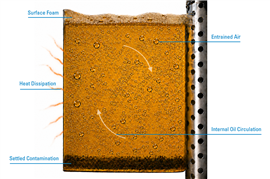 Multiple factors affect hydraulic oil quality
With that in mind, a traditional rule of thumb has been to hold oil volume equivalent to two or three times the pump flow rate, giving time for heat, particles and air to leave the circulating fluid.
That equation is changing, with new options for oil temperature management and high-efficiency filtration dealing with contamination more directly.
This leaves aeration as one of the most important constraints on further downsizing.
Jared Flanigan, Senior Hydraulic Product Manager with Donaldson, says, “Most modern hydraulic systems use oil coolers to manage oil temperature, eliminating the need for the reservoir to take on this responsibility.
“Filtration and aeration management allow OEMs to optimise reservoir size based on the system’s true needs.”
The hidden cost of air
Air can enter hydraulic oil during filling and maintenance, through leaks or seal wear, and can be difficult to separate when short reservoir dwell times exist. Some is visible as foam or bubbles; some remains dissolved or entrained in the fluid, invisible to the naked eye but hiding in plain sight.
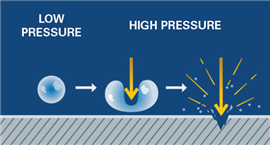 Bubble implosion under high pressure causes cavitation damage to hydraulic component
When that air reaches areas of low pressure, bubbles can form and then collapse as they move into higher-pressure zones.
The resulting cavitation can damage pumps and affect performance of valves and other components.
Even before a failure occurs, aerated oil can reduce pump efficiency, increase noise and vibration, and impair the precise, stable movement expected from modern machines.
The design challenge is therefore not only to remove visible bubbles, but also to control air throughout its journey through the system and prevent it from returning to critical components.
From dissolved air to removable bubble
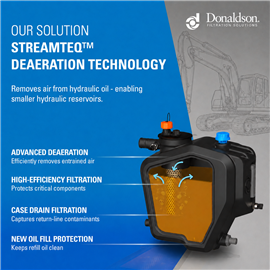
Flanigan describes Donaldson’s STREAMTEQ technology, which was developed through extensive research into how air interacts with hydraulic oils, behaves under pressure and responds when passing through porous filter media.
He says, “The technology can be broken down into three distinct phases: nucleation, coalescence and growth, and capture.
“It focuses on the air you can’t see, so nucleation is the first step in getting air to come out of solution – essentially changing its state from entrained to free.
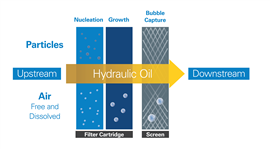 STREAMTEQ™ two-stage air removal process
“Small bubbles then join to form larger bubbles. Once they’re larger, it’s important to capture and direct them out of the oil and prevent them from going where you don’t want them to go – which is the pump.”
And that task is managed through the use of a dual-stage filter. The first stage uses multi-layer synthetic media to remove contamination at high efficiency and initiate the nucleation stage as the air-oil mixture moves from a high-to-low-pressure zone.
The second stage manages the air, capturing and directing bubbles towards the fluid level of the reservoir, where the free air can escape.
In this way, filtration and deaeration become coordinated system functions rather than separate responses to separate problems.
Protection for more complex circuits
Reservoir optimisation is only part of the opportunity. Mobile hydraulic circuits have moved from predominantly mechanical systems towards electrohydraulic systems operating at higher pressures and with tighter clearances.
Valves, pumps, and motors are now more sensitive to contamination, increasing the value of high-efficiency filtration to keep these components operating efficiently over time.
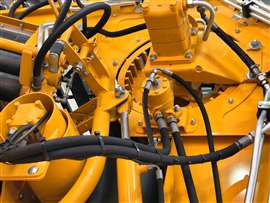 Donaldson solutions support complex hydraulic circuits. Image: Shutterstock
If a pump or motor experiences internal damage due to wear or contamination, any corresponding debris that is generated can be recirculated through the case drain line; returning harmful contaminants back to the reservoir, and back through the system.
This makes case drain lines a particular concern when it comes to contamination, yet they often go unfiltered due to sensitivity to backpressure and risk of damaging seals on the pump or motor.
A dual-stage in-tank filter, like that used in Donaldson’s STREAMTEQ technology, can be utilized to offer additional protection for the system by combining the main implement return and case-drain flows while also integrating new-oil fill, bypass and breather protection.
Fewer standalone components can mean a smarter, simpler reservoir design, fewer potential leak points and a less complicated manufacturing and service process.
The filter is no longer an accessory selected after the reservoir has been designed, but rather a critical design feature that influences the size, shape and performance of the reservoir.
Case study: A smaller tank for compact equipment
Recently, a leading construction equipment manufacturer faced a packaging challenge on a compact and skid-steer loader platform.
A redesigned cab required more space, while the hydraulic reservoir occupied valuable volume.
The manufacturer wanted to reduce the reservoir footprint and increase the hydraulic system protection with an additional in-tank return filter.
Laboratory testing indicated that the reservoir could potentially be reduced by as much as 44% when utilizing STEAMTEQ deaeration technology.
The production design team decided on a slightly more cautious but still ambitious approach. They introduced a Donaldson HKK multifunction in-tank filter, incorporating STREAMTEQ deaeration technology, which allowed the original 36-litre reservoir to be reduced by 10 litres, or 28%.
The result was better system protection, more packaging freedom and 10 litres less hydraulic oil in every machine.
The addition of the in-tank return filtration helped double the existing charge-filter service interval from 500 to 1,000 hours, extending the maintenance period and improving the end user experience.
In fact, the additional protection proved valuable even during the development stage. Debris from a failed pump or motor returned through the case-drain lines, but the second stage of the filter captured it before it could circulate and cause further damage.
“The case-drain function helped prevent a potentially catastrophic failure of the hydraulic system,” says Donaldson’s Jared Flanigan. “The previous filtration solution did not include case-drain filtration, so this demonstrated the value of the enhanced protection.”
At production scale, modest per-machine savings become substantial. Data from the project indicates annual oil savings equivalent to around 1,400 drums, while Donaldson calculated lifecycle emissions savings of approximately 10,000 tonnes of CO2e across ten years of production.*
These figures depend on production volumes and operating assumptions, but they illustrate the cumulative effect of reducing both initial fill and service consumption.
Looking for a quick overview?
Lower lifecycle cost, not just lower oil volume
Hydraulic oil is an important engineering resource, but also a recurring operating cost.
 A mechanic services a machine’s hydraulic system. Image: Shutterstock
A smaller initial fill reduces the material required at manufacture, the weight carried by the machine and the volume eventually handled during maintenance.
Longer filter intervals can also reduce service interventions and associated downtime.
“Replacing hydraulic oil at regularly scheduled intervals is a significant driver of maintenance costs,” Flanigan says. “Costs should not be the reason an end user delays maintenance. Saving oil in the system helps reduce the overall maintenance costs, and improve an end user’s experience.”
The gains must nevertheless be assessed at system level. The benefits of reservoir downsizing should be measured against real duty cycles, flow conditions, air-release characteristics, contamination targets, cooling capacity and service requirements.
The end game is not to achieve the smallest possible reservoir, but the smallest reservoir that offers a reliable machine, without impacting productivity and with more manageable maintenance.
Designing filtration in from the start
OEM engineering teams are tasked with making many decisions that impact machine design, from performance to packaging and production assembly; but filtration is still an important factor in that decision-making process.
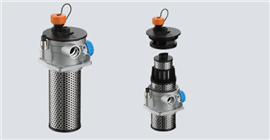 The Donaldson HKK multifunction in-tank filter
For them, treating the reservoir, filter, deaeration strategy and hydraulic circuit as an integrated design problem creates options that component-by-component development can miss.
“The filter should never be an afterthought in reservoir design,” Flanigan says.
“An in-tank filter is an important part of the hydraulic system. It protects critical components and can enable reservoir optimisation while adding functionality and system-level protection.
“Designing around the filter can achieve results you did not know were possible.”
As equipment platforms become more compact and technically demanding, this systems approach is likely to become more important.
It’s now clear that effective air and contamination management can enable greater design flexibility and system protection.
Effective air and contamination management not only enables greater design flexibility and system protection, but can also help meet the efficiency, reliability and sustainability goals of the next generation of construction machinery.
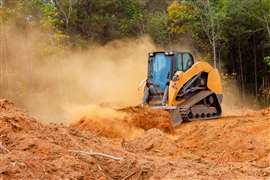 Image: Shutterstock
*Based on reference emissions factors, expected project size and manufacturer recommendations.
--------
This article was produced by KHL Content Studio, in collaboration with experts from Donaldson
--------
All uncredited images courtesy of Donaldson
--------