The changing role of compact excavators on modern jobsites
Partner Content produced by KHL Content Studio
06 February 2026
Compact excavators have long been associated with domestic construction, landscaping, and small-scale urban work. Increasingly, however, they are playing a broader and more strategic role across the construction sector.
 The power and performance offered by modern mini excavators opens up applications that would previously have been reserved for bigger machines
In the UK and across Europe, contractors of all sizes are rethinking the potential value of having mini excavators on site and how they might fit into their fleets.
This change in attitude reflects wider changes in construction, with space on jobsites often at a premium and work needing to be more sensitive to surrounding infrastructure.
In response, contractors are turning to compact excavators not simply because they are smaller, but because they are often better suited to the realities of today’s work.
 A machine that is easily transportable has clear advantages for contractors operating multiple sites
“Customers and operators increasingly want features and functionality on smaller machines that they used to only expect on bigger excavators,” says Miroslav Konas, who oversees compact excavator product strategy at Bobcat.
That expectation is reshaping the compact excavator segment.
Space and access on modern jobsites
As with much of Europe, compact equipment has long been a feature of the UK construction market, primarily due to access restrictions, transport considerations and a strong rental culture.
Construction activity is increasingly taking place in urban centres, confined areas and within existing structures – locations where larger machines can be inefficient or impractical.
“The main reason people buy and work with small excavators is space,” says Konas. “Where there are space constraints, they’ll often need to use a smaller machine.”
This applies not only to small contractors but also to larger organisations. On complex projects, compact excavators are frequently used for finishing operations, interior work or tasks close to live utilities and structures, where control and precision are more important than outright power.
As a result, compact excavators are increasingly viewed as complementary assets within mixed fleets, rather than niche tools reserved for small jobs.
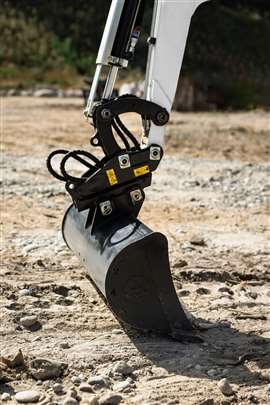 Having a choice of attachments and quick coupling options is becoming more important in the mini excavator market
Rethinking performance expectations
Despite their growing role, compact excavators are still sometimes underestimated, particularly by contractors more familiar with heavier equipment.
“Operators coming from heavier equipment are often surprised by the power and performance of these compact machines,” says Konas.
“With the advances made in hydraulics, control systems and machine balance, the latest mini excavator models deliver much better performance levels, when you compare them with previous generations.”
Of course, a 2-tonne excavator is not designed to replace a machine in the 7 to 10 tonne class, but it is certainly capable of handling a wider range of tasks than ever before – particularly where access, control and surface impact are critical considerations.
This is important for contractors as project risk is increasingly concentrated close to existing services, within finished structures or in restricted environments. In these areas, compact excavators can often work more efficiently and with lower risk than larger machines.
Small machine, big features
One of the defining trends in the compact excavator market is the gradual migration of features from larger machines onto smaller platforms.
Contractors now expect mini excavators to offer predictable hydraulics, smooth multi-function operation, and compatibility with a growing range of attachments.
Konas describes this as a “cascade” effect, driven by changing operator expectations rather than by technology alone.
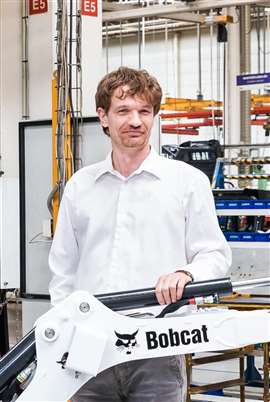 Miroslav Konas, product line manager for Doosan Bobcat EMEA
As an example, he offers the high-performance SmartFlow hydraulic system. Now available on Bobcat’s R2 Series mini excavators, the system uses a load-sensing pump, bundled with a closed centre/flow-sharing main control valve to provide the sort of power on demand generally seen in larger excavators.
Konas says it is features like this we will see more of in mini excavators moving forward, which ensure continuously available power that can help improve both precision and efficiency.
“Predictability is increasingly important,” he says. “The machine needs to do exactly what the operator wants. Operators are disappointed, for example, if the machine can’t do two or three movements simultaneously when they need it.”
This expectation is influencing design priorities across the market. Machines such as Bobcat’s E16 mini excavator reflect this shift, combining compact dimensions with operating characteristics traditionally associated with larger equipment.
The emphasis is possibly less on headline power figures and more on controllability, responsiveness and consistency.
For small contractors, or those working with less experienced operators, these technology features can make learning curves less steep and maintain good productivity.
For larger organisations, they allow compact machines to integrate more effectively into professional workflows.
Operator availability and the influence of comfort
Labour availability continues to shape equipment decisions across the industry. With experienced operators in short supply, their preferences now carry greater weight in purchasing decisions.
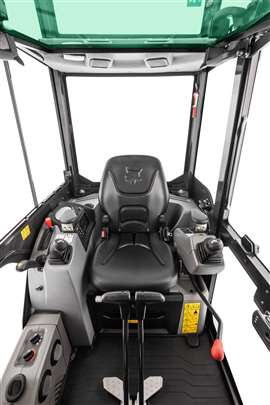 Ergonomic controls and in-cab comfort offer clear benefits for operators, as well as potentially enhancing performance levels
“When companies manage to find operators with experience across different machines, those operators will tend to be more involved in the purchase decision-making,” says Konas. “Compared to 15 or 20 years ago, we’ve seen a big change.”
As a result, operator comfort and ease of use have now become important considerations. Noise levels, control layout, visibility and overall ergonomics will influence not only productivity, but also fatigue levels – regardless of the size of the machine.
“Operators don’t want to be exposed to high levels of noise, perhaps even more so when they’re working on a small machine,” Konas adds.
For contractors, this reinforces the idea that compact excavators should be assessed using the same criteria as larger machines, particularly where operator retention and utilisation are concerned.
Uptime, durability, and changing maintenance expectations
Maintenance expectations have also evolved. Many smaller contractors lack dedicated servicing staff, while larger organisations face pressure to maximise machine availability with minimal intervention. At the same time, fewer operators have the skills or inclination to carry out mechanical repairs.
“We’ve really come away from the model where a lot of operators were able to service and even repair machines themselves. That is disappearing,” says Konas.
This places greater emphasis on machines that promise durability, accessible service points and onboard diagnostics. In the compact class, robust construction and clear fault communication can have a significant impact on uptime, particularly for businesses operating lean fleets.
Konas says, “Design choices like steel body panels, protected components and telematics-based monitoring are valued more and more by customers, and not as premium features, but as what they consider to be practical tools for reducing disruption and controlling costs.”
Transport considerations and flexibility
Transport remains a critical factor in compact excavator selection in many EU states and in the UK. Contractors often move machines between multiple sites in a single day and increasingly want to transport attachments alongside the excavator.
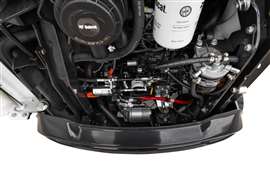 High-quality mini excavators promise not only durability and performance, but also accessible service and maintenance points
According to Konas, two trends are converging: a growing reliance on attachments and increased scrutiny of real transport weight. Enforcement across Europe is becoming more stringent, prompting contractors to pay closer attention to total loaded weight rather than nominal ratings.
These pressures make machine weight, trailer compatibility and attachment handling central to purchasing decisions. Compact excavators that can be transported easily (and legally), along with the required tools, offer a clear operational advantage.
Attachments and quick couplers move into the mini class
The potential to operate with a number of different attachments is now a key strength of many compact excavators, with expectations around attachment handling rising accordingly.
Hydraulic quick couplers, once the preserve of heavier machines, are becoming more common in smaller weight classes.
“It’s another example of technology cascading down – and it’s important because it means the operator can remain inside the cab when switching attachments, which increases both productivity and safety,” Konas says.
Powertrain choices and the pace of electrification
Electrification continues to attract attention, but adoption rates remain relatively low for now.
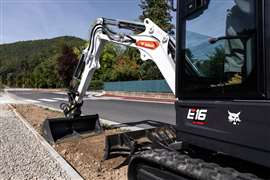 Mini excavators are increasingly being utilised on urban sites and sensitive utilities projects
Konas notes that, “Battery-electric machines have advantages in low-noise and zero-emission applications, but the main challenges are purchase price and daily usage planning.”
Electric compact excavators are increasingly being utilised in environments such as indoor work, sensitive urban areas, and renovation projects, but diesel remains the default for general-purpose excavation.
Regulatory pressure may accelerate change over time, but most contractors currently favour a pragmatic, application-led approach.
A changing role for compact excavators
Compact excavators can now help small contractors gain access to higher-value work, such as urban projects, interior operations and specialised tasks without increasing transport complexity or fleet size.
For larger contractors, compact machines are increasingly essential for precision work at the sensitive end of projects where control, access and risk management are paramount.
Across the market, compact excavators such as Bobcat’s E16 are no longer viewed as secondary machines; they’re becoming strategic assets, designed to fit into tight spaces, but also to operate effectively within the tighter constraints of modern construction.
Mini excavators in action
A video highlighting the features of Bobcat’s new generation of 1-2 tonne mini excavators can be viewed here.
In 90 seconds, the video demonstrates just how adaptive these machines can be; their capacity to undertake rugged applications, utilise numerous different attachments and deliver precise manoeuvrability in confined and sensitive spaces.
--------
This article was produced by KHL Content Studio, in collaboration with experts from Bobcat
--------
All images courtesy of Bobcat
--------