The changing role of power units in off-highway equipment
Partner Content produced by KHL Content Studio
02 July 2026
In off-highway equipment, engines will often dominate the discussion. Yet for many OEMs (original equipment manufacturers), the greatest technical risk and cost exposure lies as much in what surrounds the engine as in the engine itself.
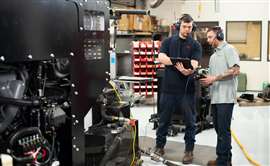 Isuzu Motors America’s technical facility at Wixom, Michigan
Cooling performance, aftertreatment integration, wiring, urea lines, vibration behavior and packaging constraints are often where programs slow down, particularly for specialized or low-volume machines.
This is the context in which Isuzu Motors America has developed its power unit program.
Rather than only supplying engines, the company designs and validates power units and modular accessory systems at its technical facility in Wixom, Michigan.
The objective is not to replace OEM engineering, but to absorb a portion of the integration and validation work that frequently delays product launches and increases downstream risk.
Cody Garcelon, executive director for Engineering, Service and Aftermarket with Isuzu Motors America, sees the approach as a practical response to how equipment is actually developed.
“For me, the whole conversation evolves around the value added that we’re providing by pre-validating power units, accessory kits and everything from wiring harnesses & control panels to basic systems like cooling packages, air cleaners and engine mounts,” he says.
Integration as the limiting factor
For many equipment manufacturers, integration is the most resource-intensive stage of machine development.
Even when an engine platform is well understood, the surrounding systems must be engineered, sourced, packaged, and validated within the constraints of the host machine.
For smaller organizations that don’t have large in-house test facilities, this work often relies on prototyping and field testing.
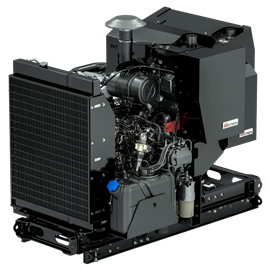 A 4J pre-validated genset-ready power unit from Isuzu
Garcelon states that Isuzu’s approach is structured in a way that aims to reduce that additional and/or repetitious work.
“We have many ship loose components and an engine that aren’t directly integrated when delivered” he says, adding that avoiding pre-fixed layouts means Isuzu can configure systems for many different applications before they reach the customer.
The practical consequence of pre-designed accessory kits is that OEMs are not required to design common subsystems from scratch. As Garcelon says, “For example, OEMS don’t have to design wiring harnesses, air filter mounts, oil & fuel filter mounts and/or exhaust tail pipes.”
While these components are rarely headline features, they are often where last-minute changes occur and have an adverse impact on schedules.
Garcelon says this approach can benefit the largest global OEMs but is especially beneficial to manufacturers operating in smaller volumes.
“Most people think of an OEM as a Caterpillar or a John Deere,” he says. “We’re talking now about customers buying 100 to 500 engines a year.” Many of these companies build technically demanding machines but lack the scale to justify dedicated integration and validation infrastructure.
Validation based on measured performance
A central element of the program is controlled validation of equipment throughout the full range of engine operation, from idle to full load, and Garcelon draws a clear distinction between being confident in theory and having actual measured data.
“There’s no theory, there’s no extrapolation,” he says. “We are collecting real-world data with all key systems installed.”
As an example, Garcelon says, “If you have a hydraulic pump in a machine that only requires 50 horsepower and the engine is rated for 70, you can’t run the engine and associated systems at full load.”
As a result, OEMs may have limited data on thermal margins or aftertreatment behavior at rated power.
 Cody Garcelon, executive director for Engineering, Service and Aftermarket with Isuzu Motors America
“At our Wixom facility,” he says, “we can test a complete power unit at full output or anywhere in the power and speed range of the engine.”
This full range of validation work for all power unit systems can be substantial. Garcelon says a longer testing time may be required for some packages equipped with SCR (selective catalytic reduction).
For OEMs producing tens (or even hundreds) rather than thousands of units, replicating that level of controlled testing internally is rarely viable.
Modular systems rather than fixed packages
The power unit strategy at Isuzu Motors America is not limited to turnkey assemblies. The program is structured around modular, validated systems that can be adopted individually. Cooling packages, intake systems, exhaust configurations, wiring harnesses and mounts are offered as discrete kits.
“Once we’ve released the power unit for commercial sales, you can go online and see every kit,” Garcelon says. “You can look at any individual kit and check its compatibility, bill of material and visuals.”
For OEMs, the value lies as much in compatibility information as in the hardware itself. Engineering teams under pressure to meet schedules can adopt proven systems rather than extending design cycles late in development.
Garcelon says this potential headache can often be reduced from “days and weeks of design and validation” to “a few hours”.
He does, however, acknowledge that not all risks can be eliminated before installation. “It’s impossible to validate vibration, for example, without everything in the system, including the machine side” he says.
However, pre-validation narrows the uncertainty, leaving fewer variables to resolve once the engine is installed in the host machine.
Responsiveness at lower volumes
Another differentiator is responsiveness. Garcelon says the approach of Isuzu Motors America differs from suppliers focused primarily on large-volume customers.
The organization’s distributor network often supports numerous customers with relatively small annual volumes, which changes the economics of engineering support.
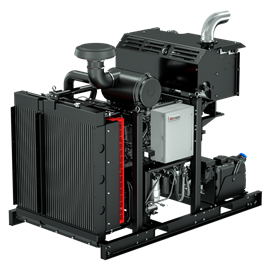 A 6H pre-validated genset-ready power unit from Isuzu
As an example, Garcelon describes an installation review where a minor packaging conflict was identified late in the process.
Rather than initiating a lengthy redesign cycle, the engineering team constructed a revised component the same day.
“We shipped out the new component the next day, and turnaround times of a week or less are the norm, not the exception” he said.
For OEMs with limited prototype capacity, that ability to resolve small issues quickly can prevent minor integration problems from becoming launch delays.
What ‘pre-validated’ means in practice
For end users, the technical detail behind validation is largely invisible. Garcelon puts it simply:
“From the end-user standpoint, the pre-validation means that Isuzu stands behind the work we do because we’re doing everything to meet strict criteria – to make sure the products meet both emissions and durability standards.”
For fleet operators and rental companies, this translates into confidence that the package has been tested to meet criteria for the full range of operating conditions.
“They know they’re getting something that’s been validated in the real world,” he says.
This aligns with broader trends in the construction and rental sectors, where total cost of ownership and uptime increasingly outweigh initial purchase price considerations.
Variable-speed applications drive complexity
While generators remain an important segment, Garcelon notes that growth and technical complexity are increasingly concentrated in variable-speed applications such as pumps and hydraulic power packs.
“Gensets are relatively simple machines,” he says. “Fixed speed, 1,800 rpm, and you generally run them for long periods of time.”
Variable-speed equipment operates across wider speed and load ranges, placing greater demands on cooling, aftertreatment and vibration control.
According to Garcelon, recent growth in the PowerTrain Division of Isuzu Motors America has been largely in the variable speed segment.
Although validation requirements remain consistent and the basics are covered in the testing, additional time is typically required for vibration testing in the actual machine.
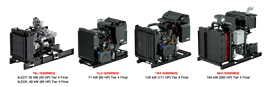 Isuzu Motors America's range of genset-ready power units
Beyond engineering, the approach adopted by the PowerTrain Division also supports supplier consolidation and parts standardization.
Garcelon says using common power unit and accessory kit components across multiple applications is beneficial, with targeted modifications rather than unique designs.
“Consolidating suppliers is a big advantage for distributors buying small volumes,” he says.
In an environment where supply chain volatility remains a concern, reducing part variation can also improve availability and simplify service support.
A redistribution of engineering effort
Isuzu Motors America’s power unit program reflects a redistribution of responsibility rather than a fundamental shift in engine technology.
By moving more integration and validation work upstream, the company aims to shorten OEM development cycles and reduce late-stage risk, particularly for low-volume and specialized equipment.
For OEMs, the value of the validation work undertaken at the Wixom facility largely lies in time saved and uncertainty reduced.
For end users, the value lies in knowing that a complete system has been tested under controlled conditions and supported to a consistent standard.
For Garcelon, the objective is straightforward: “We accelerate time-to-market for our OEM customers while delivering consistent, high-quality products.”
In a sector where technical complexity continues to rise while engineering resources remain limited, that kind of acceleration – grounded in measured performance rather than theory and assumption – may prove increasingly relevant.
--------
This article was produced by KHL Content Studio, in collaboration with experts from Isuzu Motors America
--------
All images courtesy of Isuzu Motors America
--------