The evolution of construction site safety: Why smart machines matter
Partner Content produced by KHL Content Studio
01 September 2026
Construction equipment safety has traditionally depended on three connected elements: machine design, operator competence and disciplined site behaviour.
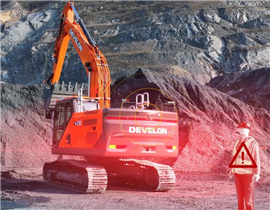 Here, AI-based detection activates an exclamation point icon when a person approaches the machine
Today these essentials are being tested to their limits by increasing levels of jobsite complexity.
Pedestrian interaction is among the most serious risks. Excavators and other heavy machines routinely work near ground personnel, other equipment and temporary structures, often with restricted space and changing traffic patterns.
The consequences of a collision can be severe, which makes prevention a human priority before it becomes a commercial one.
“Collisions with pedestrians are generally the most dangerous accidents,” says Stephane Dieu, Product Manager for Develon Excavators in Europe.
“Given the size and weight of these machines, the consequences are often critical and can be fatal. For me, this is probably the biggest safety issue.”
Safety performance is also uneven across the industry. Large contractors commonly operate detailed procedures and exclusion zones, while smaller businesses may have fewer resources and older fleets.
Rules reduce exposure, but cannot remove every unpredictable movement.
The limits of visibility
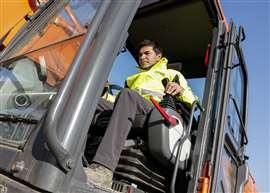 Stephane Dieu, Product Manager for Develon Excavators in Europe
Physical machine design presents some visibility challenges that cannot be avoided. Cab improvements have helped, but it’s not possible for direct visibility to cover every angle around a large, moving machine.
“The behaviour of people around the machine is a major part of the problem,” says Dieu. “If nobody entered the working area, many accidents would not happen. But the operator cannot see everything on the right-hand side of an excavator, for example.
“Cameras help – although rain, winter conditions or dust mean you cannot rely on a camera image alone in every situation.”
The issue is whether one person can operate the machine, monitor several information sources and anticipate everyone nearby throughout a shift. Fatigue, poor weather and distraction is likely to narrow that margin of safety.
Additional sensing technology is potentially the answer; a 360-degree view combining several camera feeds, with artificial intelligence able to identify people within them.
Together with radar adding distance information, these technologies can provide information that mirrors, windows or a conventional reversing camera simply can’t.
From warning to intervention
For years, a lot of construction safety technology has been passive – it presents a picture, sounds an alarm or supplies information, leaving the operator to interpret the risk and respond.
While that is valuable, the direction of travel is now towards systems capable of supporting the response itself.
“There is a strong influence from the automotive industry,” Dieu says. “Cars can detect another vehicle in a blind spot and, in some circumstances, stop automatically. Those technologies are progressively coming to construction equipment.
“There is real demand for systems that support the operator, because even the best operator cannot be fully concentrated for eight hours every day.”
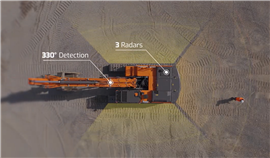 Develon’s E-Stop system combines cameras, radar and AI technology for next-level hazard detection
An alert can be missed or delivered too late. Active intervention adds protection when a hazard reaches a defined threshold.
This should not replace operator judgement or site controls, but it does offer a final opportunity to interrupt the chain that could lead to an incident.
That principle can be seen in Develon’s E-Stop system, now offered on its Series 9 crawler excavators.
Six high-definition cameras create a combined all-round image, with software distinguishing people from other objects.
Three radar sensors provide precise distance measurement across 330 degrees around the machine, covering the principal blind-spot areas.
Selective action in the danger zone
Effective intervention depends on more than the ability to stop. On a live jobsite, a system that reacts indiscriminately to spoil piles, structures or nearby machines could interrupt normal work so often that operators lose confidence in it.
Selectivity is therefore central to both safety and continued productivity.
“The system can detect a tree, a large stone or another machine, so the operator remains aware of those objects,” explains Dieu.
“But automatic E-Stop intervention is focused on people. The software analyses the image, recognises a pedestrian and combines that information with the distance measured by radar.
“At six metres, the machine first slows down; at four metres, swing and reverse movements are stopped.”
This staged response creates time to resolve a hazard before a full stop. In the outer zone, visual and audible alerts include an external warning; if the person moves away, work continues.
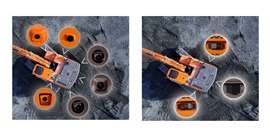 An array of six cameras and three radar sensors, combined with artificial intelligence, can give operators a superb view around the machine
The system intervenes fully only if the risk enters the inner zone.
The technology addresses defined movements rather than presenting itself as a universal answer. Its automated function concentrates on swing and reverse movements, where blind spots are significant.
The technology is designed to be part of a broader safety system – not a reason to relax exclusion zones, communication or supervision.
Safety without the productivity penalty
The credibility of any new safety system will depend on how it behaves in the field. Frequent false alerts and unnecessary stops can disrupt cycles, frustrate operators and encourage workarounds.
A technology may be technically capable yet fail in practice if it does not fit the workflow.
Dieu describes Develon’s testing of E-Stop with contractors and operators in France. The most encouraging feedback, he says, was not that the system dominated the operator’s attention, but that it receded into the background during normal operation.
“After a week, the operator told us, ‘I don’t even think about it because it doesn’t disturb the way I work. I can work as usual, but I know the machine is watching and will help me if necessary,’” he says.
“That gives the operator more confidence and allows greater focus on the task, while still remaining responsible for safety.”
A useful behavioural effect is also apparent outside the cab, as the external warning sound makes an otherwise invisible boundary very real.
The wider business case
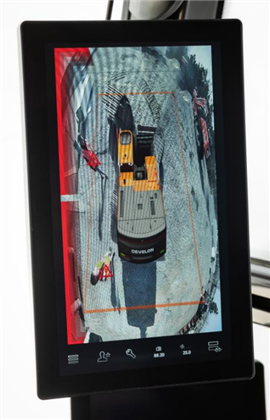 Develon’s SAVM (smart all-round viewing monitor) displays a 360° view of the environment using 6 cameras and AI assistance
Preventing injury is sufficient justification for improving safety. Nevertheless, the operational consequences of an incident explain why safety is increasingly treated as a measure of business performance.
A serious accident can stop a project, damage equipment, trigger investigation and increase insurance exposure.
On the flip side, a strong safety record can support prequalification and help contractors demonstrate that they can manage complex work responsibly.
“Protecting people comes first, but the cost of a severe accident is also enormous,” says Dieu. “If a system prevents even one serious incident, the avoided cost can outweigh the investment across many machines. Safety technology has a real economic value as well as a human one.”
The case for adoption will, of course, vary with fleet size, application and pedestrian exposure.
Rental companies and large contractors may lead by standardising requirements across fleets.
Technology as part of safety culture
The move towards intelligent intervention is being shaped as much by contractors as by manufacturers. Major equipment users increasingly participate in trials, set technology requirements and share evidence about how systems perform in real conditions.
In France, industry-led testing of anti-collision systems has helped turn an ambition into a very practical discussion about recognition accuracy, stopping behaviour and operator acceptance.
And machine specifications are now beginning to reflect that shift.
Develon has made its Smart All-Around View Monitoring system, including people recognition, standard on its Series 9 excavators, while E-Stop remains an option requiring additional radar sensors and software.
The distinction illustrates a likely path for the wider market: advanced visibility and detection first become expected, followed by broader adoption of intervention as confidence and demand grow.
“My own view is that anti-collision systems will become a standard jobsite requirement within the next five to ten years,” says Dieu. “Just as some projects now specify 3D machine control, they may specify an anti-collision system.
“The initial interest will come from large contractors and rental companies, but with greater volume the cost will fall and the technology will become integrated into more machines.”
No technology can credibly promise a zero-accident site. The realistic goal is to reduce the occasions on which one missed sightline or moment of inattention leads directly to harm.
That is why smart machines matter. And as prevention becomes more connected and intelligent, serious incidents can be treated less as an unavoidable feature of heavy construction – and more as events the industry has the tools and the duty to prevent.
--------
This article was produced by KHL Content Studio, in collaboration with experts from Develon
--------
All images courtesy of Develon
--------