The evolution of electromobility in construction
Partner Content produced by KHL Content Studio
30 July 2026
It’s no surprise to see electric rollers, pavers and compactors working on active projects throughout Europe.
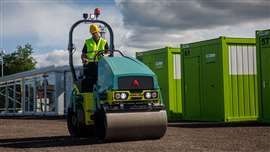 Ammann’s eARX_26-2 Light Tandem Roller
Battery-electric compact equipment can help contractors meet increasingly demanding environmental targets while maintaining the productivity levels required by modern infrastructure projects.
Yet despite the growing visibility of electric machines, adoption remains relatively limited.
Contractors are still asking difficult questions about battery autonomy, charging infrastructure, utilisation rates and return on investment.
Also, while sustainability remains important, it’s no longer the only driver. Contractors are looking to electric equipment to bring efficiency gains, workforce wellbeing and long-term business resilience.
From sustainability initiative to business strategy
As regulations continue to tighten across many markets, particularly in Europe, contractors are increasingly examining total cost of ownership, maintenance requirements and operational flexibility alongside emissions performance.
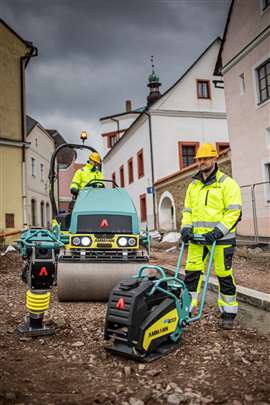 A range of Ammann eDrive equipment on an urban jobsite
“Five years ago, most conversations started with carbon reduction targets,” says Philipp Bramer, Head of the e-Paver development team with construction equipment manufacturer Ammann. “Today, customers still care about emissions, but they are just as likely to ask about energy consumption, operating costs, uptime and how electric equipment fits into their broader business strategy.”
This shift reflects wider industry pressures, such as volatile fuel prices and the need for greater transparency around environmental performance.
In this context, electrification is beginning to be viewed as a tool for managing risk.
Electric drivetrains are inherently more efficient than combustion engines. They contain fewer moving parts, require less maintenance and can provide more predictable operating costs over time. For contractors managing large fleets, those advantages are becoming increasingly important.
Adoption challenges are real
Despite growing interest, the market remains in an early phase of development.
Demand for electric equipment is still concentrated in a relatively small number of countries – particularly Germany, France, Sweden and the Netherlands – where regulations, sustainability requirements and customer readiness are currently making the transition to electromobility somewhat easier.
It should also be said that many purchases are also linked to pilot projects, sustainability-focused contracts or programmes supported by government incentives.
Ultimately, the construction industry is built on productivity, reliability and tight margins, and any new technology must prove itself under demanding conditions before achieving widespread adoption.
“Contractors are naturally pragmatic,” says Thiago Santos, Head of Commercial Management with Ammann’s Light Equipment division. “They don’t buy equipment because it is new. They buy equipment because it helps them deliver projects safely, efficiently and profitably. Electric machines have reached the point where they can demonstrate those benefits, but customers still want proof.”
Across Europe, electric paving and compaction equipment has been deployed on infrastructure projects where performance requirements leave little room for compromise.
The results suggest the industry’s long-standing concerns about power and productivity are beginning to fade.
Turning technology into a practical solution
For manufacturers such as Ammann, the challenge has never been simply replacing a diesel engine with a battery. Electric equipment is only likely to be accepted by construction businesses if it solves real operational problems.
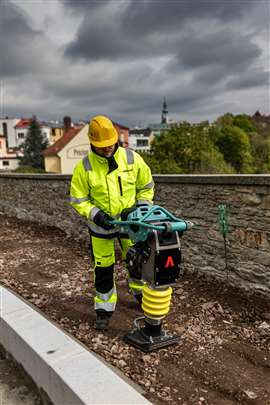 An eATR 68 Rammer
That thinking has shaped the development of the company’s e-drive range, which now includes electric pavers, rollers, plates and rammers.
Across the portfolio, the emphasis has been on maintaining familiar performance levels while taking advantage of the characteristics unique to electric drivetrains, such as instant torque, lower maintenance requirements and reduced noise.
“The goal is not to ask contractors to compromise,” says Santos. “but to remove those barriers to adoption. If an electric machine can deliver the same compaction force and the same paving quality, or the same daily output and at the same time reduce emissions and operating costs, then that completely changes the conversation.”
Performance without compromise
Historically, one of the biggest concerns surrounding electric equipment was whether it could match the output of conventional combustion engines.
But electric drivetrains provide instant torque delivery and high operating efficiency, characteristics that can be advantageous in many construction applications.
Data collected from dozens of active projects has shown electric paving equipment delivering consistent performance across a wide range of conditions.
One notable example involved the deployment of an electric paver from Ammann on a major UK road resurfacing project which focused on low-carbon construction.
Operating under demanding production requirements, Bramer says, “The machine paved widths of up to 6.5m and delivered daily outputs of up to 1,200 tonnes – and in doing that, it reduced carbon emissions by 70%, compared with conventional alternatives.”
Moreover, the site manager reported that the paver typically began a shift with around 95% charge and finished with around 0%, despite the high production demands of the project.
For contractors, examples like this are important because they shift the conversation from theoretical capability to real-world performance.
According to Bramer, “The key psychological shift happening in the market is that customers are now moving from asking whether electric machines can perform to asking how they can deploy them most effectively.”
That distinction matters as, once productivity concerns are addressed, attention naturally shifts towards operational planning and optimisation.
Charging as part of the workflow
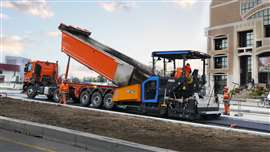 Ammann’s eABG 4820 ePaver
Charging infrastructure is one of the most frequently discussed aspects of electromobility. Unlike refuelling, charging requires planning to be successfully integrated into project workflows.
However, experience from active projects suggests the challenge may be more manageable than contractors have assumed.
For one thing, many electric machines are deployed on urban infrastructure projects or major worksites where power is readily available.
“Energy is becoming a managed resource in the same way that materials, labour and logistics are managed,” says Santos. “The most successful electric equipment users are the ones who make sure the charging strategy is part of their project planning from day one.”
And technology is supporting this shift, with an increase in fast-charging systems exceeding 100 kW, which reduce downtime and improve utilisation rates.
At the same time, battery technology continues to improve and smarter energy management systems mean operators can monitor consumption in real time.
The connected electric worksite
A few years ago, few would have expected to hear the phrase ‘data-driven decision-making’ used in relation to construction, but its relevance to electric machines is clear.
Electrically-powered equipment can generate detailed operational data relating to energy consumption, battery health, utilisation and efficiency.
That information becomes particularly valuable when integrated into connected worksite platforms.
As construction companies increasingly embrace digital workflows, electrification and connectivity are becoming mutually reinforcing trends.
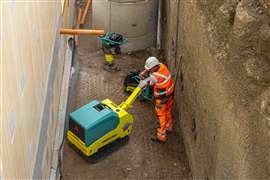 An Ammann eAPH vibratory plate at work in a confined space
Connected worksites can provide visibility across the entire construction process, from material production and logistics to paving and compaction.
Machine data can be used to monitor performance, optimise scheduling and support predictive maintenance strategies.
For fleet managers, new metrics such as kilowatt-hours per tonne, charging efficiency and battery utilisation are becoming as important as traditional measures like operating hours.
“The future jobsite won’t just be electric,” says Vlastimil Medek, Head Commercial Manager with Ammann‘s Heavy Compaction division. “It will be connected. Electrification can provide a lot of operational data, and that data creates opportunities to improve efficiency throughout the project lifecycle.”
Better for operators and communities
In terms of human benefits of electric equipment, operators often cite reduced noise levels as one of the most noticeable differences.
Lower noise improves communication between crew members, contributes to safer working environments and makes electric machines particularly attractive for urban projects where noise restrictions are becoming more common.
The absence of exhaust emissions also creates obvious advantages when working in confined spaces, tunnels and densely populated areas.
Importantly, these advantages do not require a trade-off with productivity.
As contractors gain experience with electric machines, many are discovering that sustainability and performance can actually go hand-in-hand.
An inevitable evolution
For the foreseeable future, electric and combustion-powered equipment will coexist. However, the direction of travel is becoming clearer.
Battery technology is improving and charging networks are expanding. Connected worksite technologies are also becoming more sophisticated. Meanwhile, clients and regulators are placing greater emphasis on sustainability performance throughout the construction value chain.
According to Medek, The most successful companies may not be those that attempt a rapid wholesale transition. He says, “I think initially businesses have to identify suitable applications and build some internal expertise. When you have a clear understanding of how the equipment can add value to your operations, that’s when the shift to electric gathers momentum.”
For manufacturers such as Ammann, the challenge of building electric machines is largely in the past. The new challenge is helping customers through this power transition – and demonstrating that electric power can deliver measurable business benefits.
How Ammann is preparing contractors for the electric future
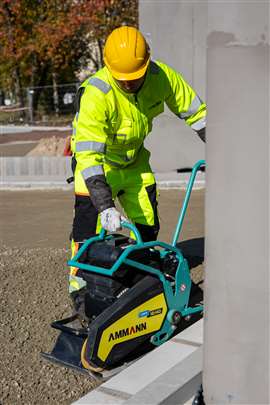 The eAPF 1240 Vibratory Plate
The transition to electric construction equipment is still in its early stages, but manufacturers are increasingly recognising that contractors need more than a single demonstration machine. They need a practical pathway into electrification that allows them to introduce battery-powered equipment where it makes the most operational sense.
For Ammann, that has meant steadily expanding its eDrive range from light compaction equipment through to heavy asphalt paving and compaction machines – allowing contractors to gain experience with electric technology across a variety of applications.
“Electrification isn’t about replacing every diesel machine overnight,” says Ammann’s Vlastimil Medek.
“Our customers are looking for solutions that fit their business today while preparing them for the future. The key is offering electric equipment that delivers the productivity they expect while making the transition as straightforward as possible.”
The Ammann portfolio now spans multiple product categories:
Light compaction
For smaller jobs and confined working environments, Ammann offers the eATR 68 rammer alongside a range of electric vibratory plates, including the eAPF 12/40, eAPH 15/40 and eAPF 2040.
Available with either Honda or DeWalt battery systems, the machines are designed to provide familiar compaction performance while offering the benefits of zero local emissions, reduced maintenance and lower noise levels.
The eAPH 70/95 hydrostatic vibratory plate extends those benefits into heavier-duty applications, bringing electric power to a 750 kg class machine suitable for earthworks, trenching, paving and civil engineering projects.
Heavy compaction
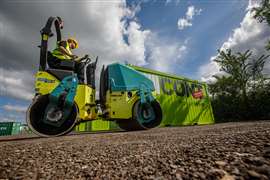 Ammann’s eARX 26-2 Tandem Roller
For asphalt compaction, the eARX 26-2 light tandem roller demonstrates how battery-electric technology can be applied to larger machines without compromising productivity.
The roller has already been deployed on major infrastructure projects and offers strong battery performance alongside quieter operation and reduced emissions.
Electric paving
At the top end of the range sits the eABG 4820 electric paver, developed for medium-sized paving applications where contractors increasingly face restrictions on emissions and noise.
With paving widths of up to 6.5 m and production capability of up to 1,200 tonnes per day, the machine illustrates how electric equipment is moving beyond pilot projects into demanding commercial applications.
“As customers become more familiar with electric equipment, the conversation is changing,” says Medek. “Contractors want to know how electric machines can fit into their operations, how they integrate with connected worksites and how they can deliver long-term business value. That’s where we see the future of electromobility.”
--------
This article was produced by KHL Content Studio, in collaboration with experts from Ammann
--------
All images courtesy of Ammann
--------