The right tire for the right application
Partner Content produced by KHL Content Studio
20 October 2026
Two identical haul trucks can require different tires.
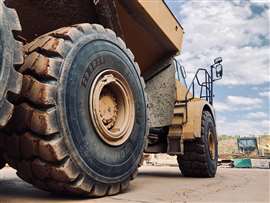 Is enough consideration being given to the point of contact between off-road equipment and the earth beneath them?
At an iron ore mine in Australia’s Pilbara region, heat may be the principal concern. Put the same truck to work at a high-altitude copper mine in Chile and sharp rock may make cuts and chipping the greater threat.
“Same truck, same tire size, but totally different conditions need different tire designs,” says Tech Wang, founder and chairman of Techking Tires, a company with a focus on tire solutions for mining and construction equipment.
It is an observation that challenges a common starting point for tire selection: finding a product that fits the machine.
Fit matters, but so does the material being moved, the surface beneath the wheels and the way the machine works throughout a shift.
For Wang, understanding those conditions is the basis of application-specific development.
The answer is in the field
“I often tell our team the answer is in the field,” Wang says. “Application-specific development means matching the tire to the machine and the real working conditions.”
Those conditions extend well beyond whether a site is classified as a quarry, mine or construction project.
Wang identifies five factors that carry particular weight for both tire selection and product design:
- ground conditions, including surface evenness, sharpness and abrasiveness;
- payload and the type and density of the material being carried;
- temperature – particularly in extremes;
- haul distance per cycle;
- operating speed.
Together, they influence the balance a tire must strike between traction, load capacity, wear resistance, cut resistance and heat management.
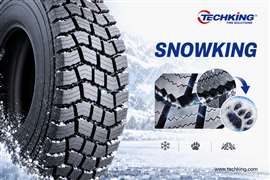 Inspired by polar bear paws, SNOWKING’s biomimetic tread design enhances grip and traction
A visit to Canada provided Techking with a particularly visible example.
Wang says its engineers saw operators cutting additional grooves into snow tires by hand. They wanted more grip, while retaining protection against stones.
After finding a similar need in northern Europe, Techking worked with a customer in Norway on a tread design that Wang says was inspired by the paws of polar bears.
“We designed a zigzag tread pattern,” he says. “It improved grip while keeping the tread blocks strong and durable.”
Techking named the design SNOWKING.
The lesson, Wang argues, extends beyond one product. “What we learn in the field cannot stay with one engineer or one project.
“We turn those experiences into design rules, simulation models and test methods that the whole team can use and improve.”
What a mismatch can cost
Tire specification has consequences for more than replacement intervals. Wang says a poorly matched tire can increase the risk of failure, while irregular wear, chunking and premature damage can shorten its service life.
Rolling resistance can also affect a machine’s fuel or power consumption.
In a mine operating as a continuous production system, a tire-related stoppage can introduce a cost that extends beyond the damaged tire.
The machine is out of service, so the work it was due to perform and the resources needed to recover it all become part of the cost calculation.
“The real cost of a tire is never its purchase price, but its total cost of ownership,” Wang says.
That makes tire selection a fleet decision as well as a straightforward purchasing decision.
A design that performs well in one application may deliver a different result when the surface, load or journey changes.
Equally, selecting a more robust tire in isolation does not establish that it is the best choice for every duty cycle.
The useful question is what combination of properties the operation requires.
From site visit to specification
Techking’s development process begins with engineers observing the operation and speaking to equipment operators, maintenance teams and mine operators.
 Tech Wang, founder and chairman of Techking Tires
They gather information about the machine, load, speed and haul distance, and inspect tires already in service, including those that have been removed.
Product and technical teams then compare those findings with existing data and previous experience.
An established tire may already meet the need. Where it does not, Techking assesses whether a new development project should be initiated.
Once a project is approved, Wang says the team translates field observations into engineering parameters, including axle-load distribution, heat generation and tire contact stress.
Designers can then model the tire’s structure, steel-belt layout, rubber compound and tread pattern, and use simulation to assess possible designs.
This translation from site evidence into a useful specification is, in Wang’s view, a crucial step.
A description such as “the tread is chipping” identifies a problem, but engineers still need to understand the operating conditions and the mechanism behind the damage before deciding what to change.
“Our ability to translate site information into clear tire specifications is a core competitive advantage of our application-specific development system,” he says.
Service as a source of insight
Much of the tire’s performance will still depend on how it is used and maintained after installation.
Wang points to inflation pressure, inspections and rotation as areas where local support can help customers manage tire life.
Techking uses different service arrangements according to the operation: technical service centres in mining regions, on-site service stations at some large mines, and service engineers who visit dispersed construction sites.
Their work also provides a continuing view of how tires perform outside the development process.
“Field service is part of research and development,” Wang says.
Engineers record damage and investigate possible causes; product teams compare what they find with simulation predictions.
That can expose gaps in a model and inform changes to designs or compounds.
The same information can help an operator decide when to replace or rotate a tire, or whether pressure needs adjusting as loads or seasons change.
In this sense, the relationship between manufacturer and fleet does not end when a tire is fitted.
Each period in service offers evidence about whether the original application match was right.
New demands on the tire
Wang sees further challenges emerging as machines grow larger and electrification and automation develop.
Higher payloads increase demands on load capacity and heat management.
As more electric powertrains come into use, torque response and rolling resistance become more significant considerations, raising the question of how to balance durability with energy efficiency.
Autonomous operation creates another requirement: the ability to understand tire condition without relying solely on a person inspecting the machine.
“In an automated mine, no one touches the tire to feel its temperature or check its tread,” Wang says. “The tire’s condition must be tracked by data.”
Techking is developing digital systems intended to connect tire information with the machine, operating conditions and site.
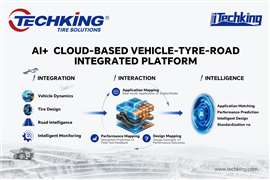 iTechking, AI+ cloud-based vehicle-tire-road integrated platform
“Ultimately, the tire and the heavy equipment need to work together,” he says. “With this in mind, we developed the iTechking platform, which connects the machine, the tire and the road through the cloud.”
The aim is to put tire readings into their operating context. An unusually high tire temperature, for example, needs to be considered alongside load, speed and road conditions to understand what is happening.
“We can use real-time data to analyse this, together with simulation models, to assess performance and update tire design,” Wang says.
Bringing application data together could help improve the match between machine, tire and working conditions, while feeding operational experience into future development.
“Tire data needs to support operating decisions, helping to identify potential problems early and reduce unplanned downtime,” he says.
A wider role for the manufacturer
Wang expects to see closer collaboration between tire manufacturers, equipment makers and fleet operators as machines become more connected.
Early involvement could help define tire requirements while a new machine is still being developed.
During operation, shared data could help fleets identify problems sooner and manage performance over the tire’s working life.
“We are moving from being a tire supplier to a joint development and operation partner,” he says.
That ambition begins with a straightforward principle: the tire, machine and site influence one another.
As the Australian and Chilean examples show, a suitable tire cannot be determined by machine model and size alone.
It has to be chosen for the work the machine will actually do.
--------
This article was produced by KHL Content Studio, in collaboration with experts from Techking
--------
All images courtesy of Techking
--------