

Why crawler AWPs are becoming essential to modern mining and tunnelling
Partner Content produced by KHL Content Studio
29 July 2026
When we think about mining and tunnelling equipment, we naturally picture tunnel boring machines (TBMs), drilling rigs, loaders, haul trucks and crushers, and other mining-specific machinery.
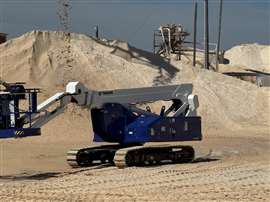 A crawler AWP can travel easily across the challenging terrain of a jobsite
These machines drive production in the mine. They are excavating rock, moving material and keeping some of the world’s most demanding projects operating.
Yet every mine and tunnel also relies on an extensive network of supporting infrastructure. Processing plants, conveyors, ventilation systems, electrical installations, workshops, water management facilities and maintenance areas all require construction, inspection and ongoing upkeep.
Increasingly, aerial work platforms (AWPs) are proving their value in these environments.
Crawler AWPs are particularly well suited to both surface and underground applications, thanks to their ability to operate on the uneven terrain that characterizes many mining and tunnelling projects.
 Erik Elzinga
As Erik Elzinga, Tadano Pan-America vice president of AWP business development, explains, understanding the role of crawler AWPs is key.
“ Crawler booms are access equipment that support mining tools and infrastructure,” he says. “We are not promoting AWPs as direct mining equipment”
That distinction is driving growing interest among contractors, rental companies and mine operators looking for safer and more versatile ways to work at height.
Looking beyond the tunnel
While tunnelling often dominates discussions around underground access, Tadano believes the opportunity extends across the wider mining sector.
Open-pit mines, aggregate operations, sand and gravel quarries, processing facilities and transportation tunnels all share one challenge: difficult ground conditions.
Sites evolve constantly as material is excavated, stockpiled and moved, leaving uneven terrain that can prove challenging for conventional wheeled equipment.
“You’ve got construction work there just like you do anywhere else,” says Elzinga. “It’s just that the context is in a mining, moving-dirt environment, where crawlers are perfectly suited.”
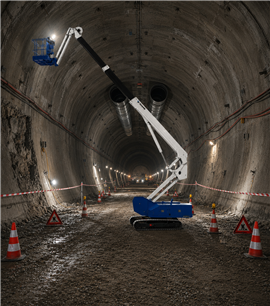 This crawler AWP, with a maximum working height of almost 58 feet, is ideally suited to operate in under-construction tunnels
Crawler AWPs are designed for precisely these conditions, offering mobility across mud, gravel, steep slopes and uneven ground.
The same applies to major tunnelling projects, where portal areas and staging yards require extensive temporary infrastructure.
Elzinga recalls driving through a large mountain road tunnel project and seeing many examples of gravel yards with supporting infrastructure under construction or removal, all in support of the tunneling beyond sight under the mountain.
“Every tunnel has a giant laydown yard outside,” he says. “It’s a giant gravel pit, and there’s construction of buildings and water management systems. Why is a crawler useful in that context? Because it’s just sloping gravel and dirt all the time.”
Technology expands capability
Advances in crawler technology have significantly broadened the applications for tracked access platforms.
Among the most important developments is reduced ground pressure. As Tyler Brown, Tadano Pan America’s AWP national business manager, explains, crawler AWPs can exert ground pressures as low as 6 psi.
Conventional wheeled boom lifts typically operate between 70 and 95 psi, while many competing crawler designs are closer to 30 psi.
For mining sites where saturated or unstable ground is common, that difference can determine whether equipment can reach the work area at all.
“It defines accessibility,” stresses Bernie Duque, product manager for Tadano Pan America AWP.
Improved gradeability also allows crawler platforms to negotiate incredibly steep inclines, with gradients of up to 57% being described.
 Tyler Brown
At the same time, more durable non-marking rubber tracks enable machines to move between rough terrain and prepared surfaces without causing damage, making crawler AWPs practical across a wide range of construction and maintenance tasks.
Challenging outdated assumptions
Despite these advances, Brown admits that some contractors remain to be convinced about the capabilities of access platforms.
“The biggest misconception as it applies to AWPs is that they can’t access the terrain that some of these mines operate in,” he says.
He then describes a project at a sand-and-gravel operation in Georgia, USA, where conventional wheeled machines became bogged down in deep mud and burned up the wheel-drive motors, while a crawler AWP simply continued operating.
The example actually highlights the size of the opportunity in this space for AWPs. Sand, gravel and aggregate extraction represent a huge proportion of global mining activity, supporting industries such as concrete production.
“The rental opportunity is there to put a crawler boom into a mine and make it more efficient,” says Elzinga.
Another misconception is that AWPs are unsuitable for tunnel environments because of limited space.
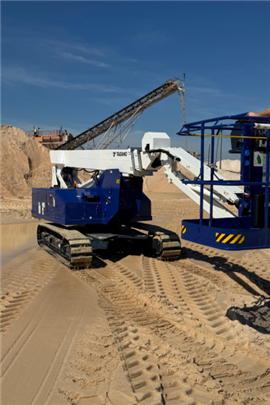 AWPs are increasingly being used in open-pit mines, for maintenance, inspections and repairs
Tadano argues that compact dimensions, high maneuverability and zero-turn-radius capability allow crawler platforms to operate effectively in confined areas where repositioning larger equipment can be difficult.
Supporting mining operations
Crawler AWPs are not intended to replace specialist mining equipment. Their role is to provide safe, efficient access for personnel carrying out work at height.
Applications include installing electrical systems, maintaining processing equipment, inspecting tunnel infrastructure, repairing buildings and supporting work around major machinery.
“Any task that necessitates working at height is the perfect underground task for an AWP,” emphasizes Brown.
And the opportunity extends well beyond new construction. Mines, quarries and tunnels typically spend decades in operation, with maintenance becoming increasingly important as infrastructure ages.
Duque believes this aspect is often underestimated.
“A lot of companies will spend a lot of time on new buildings, but maybe are less focused on maintaining them,” he says.
Inspection, refurbishment and repair work across ageing transport tunnels, processing facilities and aggregate plants continue to create demand for reliable access equipment.
A safer approach to working at height
Safety is a very strong argument for utilizing purpose-built access equipment.
Today, personnel are sometimes elevated using modified cages attached to loaders, forklifts or other machinery.
While such methods may satisfy local requirements, Tadano argues that dedicated AWPs provide a purpose-engineered solution designed specifically for working at height.
“AWPs are always the better way to pick people up and take them to a work site,” says Elzinga.
Modern platforms also incorporate technologies including load-sensing systems, increased platform capacities and anti-crush protection to improve operator safety.
“AWPs are generally extremely safe machines,” Elzinga stresses. “It’s very important for the industry to understand that and understand that they can take on access tasks in very challenging environments.”
Built for demanding environments
Mining presents one of the harshest operating environments for any machine.
Dust, debris, moisture and falling material all contribute to accelerated wear, making durability a major purchasing consideration.
Tadano highlights several features intended to improve long-term reliability, including protective bellows covering hydraulic cylinders, boom wipers that prevent contamination entering telescopic sections, internal cable tracks and robust steel construction.
“There is always the risk of objects falling,” notes Duque when discussing underground conditions.
While these design features may attract less attention than headline performance figures, they play an important role in reducing maintenance requirements and maximizing uptime.
Support beyond the machine
Technology alone is not enough to ensure productivity. Operator training and after-sales support remain critical.
“Training and familiarization with the equipment is key,” says Brown.
Manufacturers, dealers, rental companies and end users all have responsibilities in ensuring operators receive appropriate training and understand safe working practices.
Service support is equally important, particularly for remote mining and tunnelling projects where downtime can be costly.
“Sales sells the first machine; service sells the rest,” Brown summarizes.
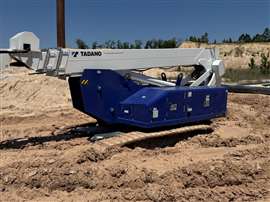 The crawler AWPs powerful tracks allow it to navigate the unstable terrain commonly found in mines and tunnels
Tadano believes its established crane support infrastructure provides an advantage, with parts warehouses, trained distributors, field service technicians and digital support resources already in place to assist customers.
Growing awareness
Looking ahead, Tadano expects crawler AWPs to play a larger role across mining and tunnelling applications.
Part of that growth will be driven by continued investment in aggregates, critical minerals and infrastructure. However, the company believes the biggest opportunity lies in replacing conventional wheeled access equipment with tracked machines better suited to difficult terrain.
Brown estimates the market could grow by more than 10% over the coming decade, although he notes the figure reflects industry experience rather than formal forecasting.
For Elzinga, the wider opportunity is increasing awareness of what crawler technology can achieve.
As more contractors, rental companies and mine operators recognize the operational advantages of tracked access equipment, crawler AWPs are likely to become a more familiar sight across mines, quarries and tunnelling projects.
For an industry that depends on keeping people and equipment working safely in some of the world’s most challenging environments, that evolution seems not only logical, but inevitable.
--------
This article was produced by KHL Content Studio, in collaboration with experts from Tadano
--------
All images courtesy of Tadano
--------