Why rugged electronics are becoming mission-critical for off-road OEMs
Partner Content produced by KHL Content Studio
02 June 2026
Today’s off-road equipment is more dependent on electronics than ever before.
 Technicians analyze circuitry at John Deere’s Product Verification Lab
New machines increasingly feature the sort of advanced displays previously reserved for the automotive industry, as well as telematics, smart controllers, electrified power systems and autonomous functions.
But while a lot of conversation focuses on new features, a more fundamental issue for OEMs is whether the electronic systems at the root of those features are built to survive.
That matters because, in heavy-duty applications, electronics are increasingly central to uptime, machine value and brand credibility.
Jason Weishaar, head of OEM sales and business development at John Deere, says, “The biggest change I’ve seen over the past 10 years is the increase in the use of electronics to enable advanced features on industrial machines.”
In particular, he points to autonomy, saying, “really the only way that happens is with advanced compute electronics.”
 Jason Weishaar
At the same time, however, expectations around the operator environment have also shifted. Dan Dougherty, John Deere’s director of electronics manufacturing and OEM sales, says the sector has steadily borrowed cues from automotive design, from larger interfaces to in-cab digital features.
“You’re seeing larger displays and more car-like infotainment packages,” he says, as OEMs respond to customer expectations shaped well beyond traditional off-highway markets.
While the combination of advanced functionality and rising user expectations is increasing the amount of electronics on board, it is also raising the consequences when those systems underperform.
Harsh environments, higher stakes
For OEMs, the technical challenge is not simply adding more electronics. It is ensuring those electronics can cope with unforgiving environments.
Dougherty identifies the major threats of “dust, dirt, liquid ingress, extreme temperature swings and “vibration.”
Weishaar adds another: “Shock. The sudden impact loads that come when, for example, a loader drives into a rock pile”.
In those moments, electronics are exposed not just to steady operating stress, but to unpredictable spikes and excursions.
Those excursions matter. Passenger vehicles typically operate within a relatively narrow and well-understood range of conditions. Off-road equipment does not.
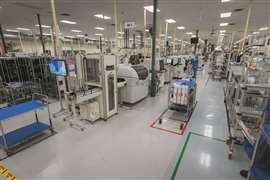 John Deere Fargo, North Dakota electronics manufacturing facility
Machines in demolition, recycling or quarrying may face repeated impacts, contamination, moisture and thermal swings in combinations that are difficult to replicate unless they are deliberately designed and tested for.
For Weishaar, that is the essence of ruggedisation. Rugged electronics are “designed to operate in these conditions, but crucially, they also need to be proven there. That’s the key.
“It’s not just about selecting the right components; it’s about safeguarding the design as a whole and testing to meet the parameters.”
Dougherty makes the point that ruggedness is not solely an engineering matter.
He says, “It’s not just about designing electronic systems to withstand these conditions, it’s also about being able to manufacture them to withstand those conditions.”
In practice, that means process control, assembly expertise and prototype-to-production consistency all play a role in whether a module will survive in the field.
Reliability is not just about the box
One of the more striking observations from the discussion is that electronics themselves are not always the weak link they are assumed to be.
“In many ways the electronics outlast the mechanical parts on these machines,” says Weishaar. Where problems often arise, he argues, is in “the interconnect systems – particularly harnesses and connectors”.
Dougherty describes a familiar industry pattern he refers to as “swapnostics”: replacing a controller, display or other module because it appears to be the problem, when the real issue lies elsewhere in the system.
 Dan Dougherty
“Swapnostics is not really getting to the root cause of a system issue,” he says. “And a lot of the time, it could be as simple as a wiring harness issue or some other system related issue.”
For OEMs, that has implications far beyond service efficiency. Misdiagnosis drives unnecessary component replacements, creates issues in terms of warranty analysis and can leave underlying integration problems unresolved.
In a market where uptime is directly tied to customer revenue, that is a costly blind spot.
The real cost question
According to Dougherty, the commercial argument around the use of ruggedised electronics is often framed too narrowly.
He notes that OEMs may have to spend more on premium-grade components and validated designs to achieve the highest levels of durability for equipment. The bigger business issue, though, is whether that premium reduces lifetime cost.
A less costly module that performs poorly in the field can quickly become expensive once service interventions, lost uptime, reputational damage and repeat failures are factored in.
In that sense, rugged electronics are not simply a procurement decision; they are part of the total cost of ownership equation.
Dougherty says, “There is a lot of innovation that’s happening in this space today, especially in autonomy – and these features are being used to set machines apart in the market.”
That raises the stakes again. If digital capability is being used as a competitive differentiator, then it’s a non-negotiable that the supporting electronics are dependable.
A feature that works in a demo but not consistently in the field becomes not just a technical problem, but a brand problem.
Partnering for the full stack
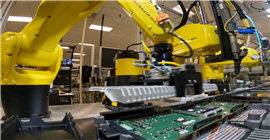 Robots are used to manufacture John Deere’s Vision Processing Units
That is one reason more OEMs are reassessing how much electronics capability they want to build internally.
For the largest manufacturers, deep in-house electronics expertise may remain a core competency. But for many small and mid-sized OEMs, the economics are different. Dougherty says they often have to ask, “What are we going to make as our core competency?”
The challenge is that modern electronics development spans hardware, software, validation, manufacturing, sourcing and lifecycle planning.
He believes many OEMs will say “it’s just too much for us to invest in, so we’re going to find a good partner to do that.”
That decision is no longer just about product design. It is also about systems integration and supply continuity.
Weishaar says early involvement can help suppliers better understand what customers truly need and ensure the end result is “cost optimized” as well as robust.
Dougherty adds that for more advanced applications – especially in electrification and autonomy – early collaboration can bring significant advantages, with success dependent on making sure systems work “harmoniously at an early stage of vehicle development.”
Then there is the supply chain issue. “It’s not just about having something that works,” says Weishaar, “it’s about having something that works long term.”
That point has gained weight in recent years as OEMs have faced component shortages and redesign pressure. Dougherty argues that “the ability to source, select and manage components over time is as important for this industry as the ruggedization of the electronics itself.”
For sectors where equipment remains in service for decades, that long-life mindset matters.
Dougherty says OEMs need to be “very intentional about component selection and be well prepared for obsolescence and long-term support realities”.
A strategic design choice
 John Deere Power Electronics manufacturing facility
The broader lesson is that rugged electronics should not be treated as a late-stage specification issue.
As off-road machines become more connected, more automated and more software-driven, electronic reliability is moving closer to the centre of machine strategy – affecting uptime and lifecycle cost, as well as how confidently OEMs can bring advanced functions to market.
Importantly, trusted electronics systems will increasingly affect machine and brand differentiation.
“The OEMs that will succeed in electronics moving forward,” says Dougherty, “are the ones that get it right in terms of a full technology stack execution.”
For off-road manufacturers, that may be the key takeaway. In the race to add intelligence to machines, the real competitive advantage may not come from adding more electronics, but from making sure the electronics are rugged enough to earn trust over the long haul.
--------
This article was produced by KHL Content Studio, in collaboration with experts from John Deere Electronics
--------
All images courtesy of John Deere Electronics
--------