Liebherr to deliver 3,000 tonne crane
18 July 2018
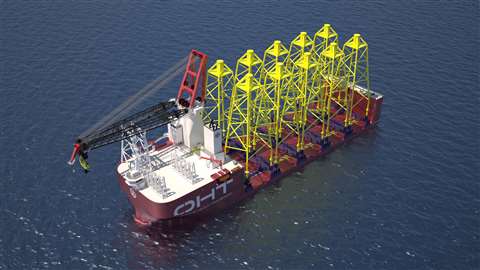
A 3,000 tonne capacity Liebherr type HLC 150000 heavy lift offshore crane will be fitted to a new semi-submersible offshore wind farm foundation installation vessel.
China Merchants Heavy Industry will build the vessel for Oslo, Norway-based Offshore Heavy Transport. It will be used for the installation of jackets, monopiles and mono buckets for wind turbines. Other work will include decommissioning and heavy-duty transport.
Liebherr worked with OHT, Ulstein Design & Solution, DNV-GL and CMHI to develop the design. The 216.3 metre ship will be built at the CMHI dock in Haimen. Contracts were signed on 6 July by CMHI and Liebherr in China. Operations using the new equipment are due to start in 2020. The crane will be built at Liebherr’s Rostock plant on the north east coast of Germany.
The lattice boom crane is a design with a slew bearing and also a foldable A-frame to allow passage under bridges. Its boom will be more than 70 metres. Submerging the 48,000 dwt vessel when in operation will increase stability and allow operation in almost any weather, Liebherr said. A split hook operating mode allows 1,500 tonnes to be carried separately on each hook.
Commenting on the deal, Armin Seidel, Liebherr area sales manager for offshore cranes, said, “Since 2016 we have been working very closely with OHT targeting an efficient design to meet the project requirements and thereby decreasing the costs of installing wind farms on high seas. We have now succeeded in doing this and also achieved an optimal balance between weight and performance.”