Faymonville launches 19 axle in North America

01 June 2021
Faymonville has unveiled the latest product in their HighwayMAX trailer porfolio, which now includes a new high-tech product for the North American transport market. The HighwayMAX Dolly&Booster is the fastest within the 19-axle class, the company said.
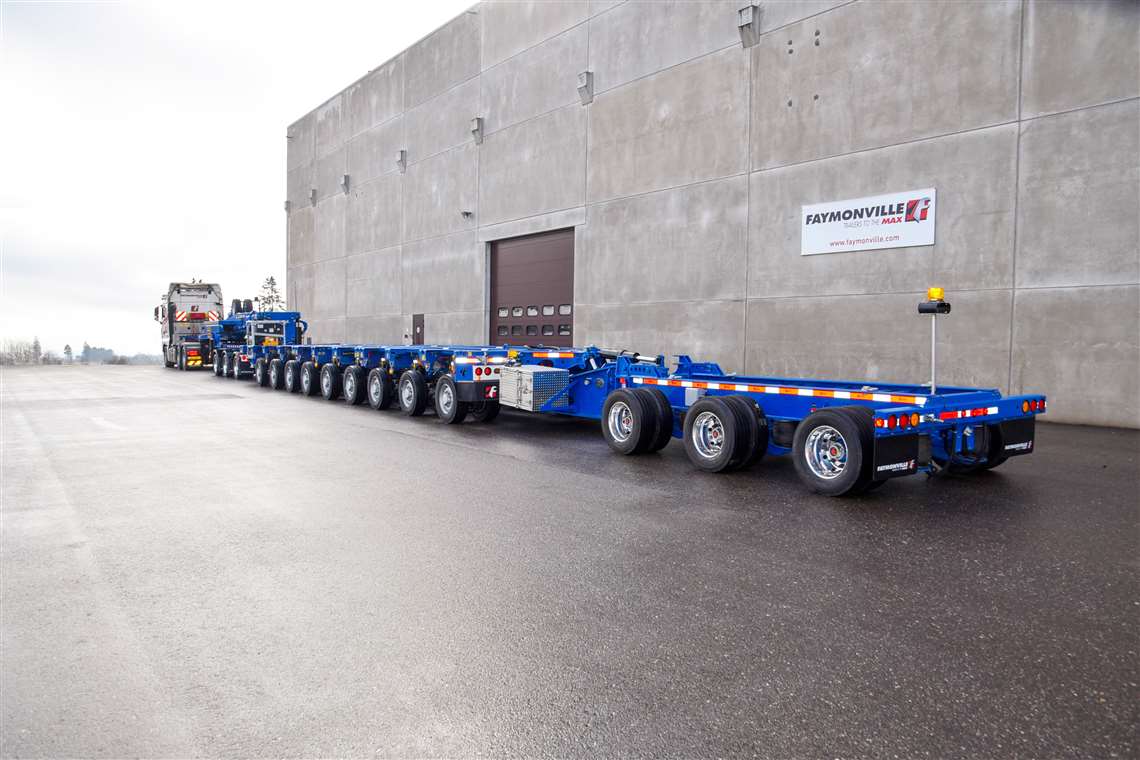 The HighwayMAX Dolly&Booster was designed for the North American transport market.
The HighwayMAX Dolly&Booster is an extendable super heavy haul trailer composed of nine hydraulically steered pendle-axles, a 3-axle jeep dolly and a 3-axle nitro booster. Including the truck, this unit creates a 19-axle combination and achieves a legal payload capacity of about 240,000 pounds at 20,000 pounds per axle.
Besides fast mobilization, customers benefit from flexible use as the jeep dolly and booster are detachable. As the jeep and/or booster can be loaded on the trailer for empty runs, the HighwayMAX Dolly&Booster offers low operation costs without the need for expensive and time-consuming permits. The truck & trailer combination length is less than 110 feet long and the loading platform can be extended up to 82 feet. The spacing between axle tridems is adaptable to 14 feet, 16 feet, 18 feet and 20 feet.
Excellent maneuverability is achieved thanks to the pendle-axle technology with 23.6 inches of stroke. The trailer is king-pin steered with a steering angle up to 60 degrees.
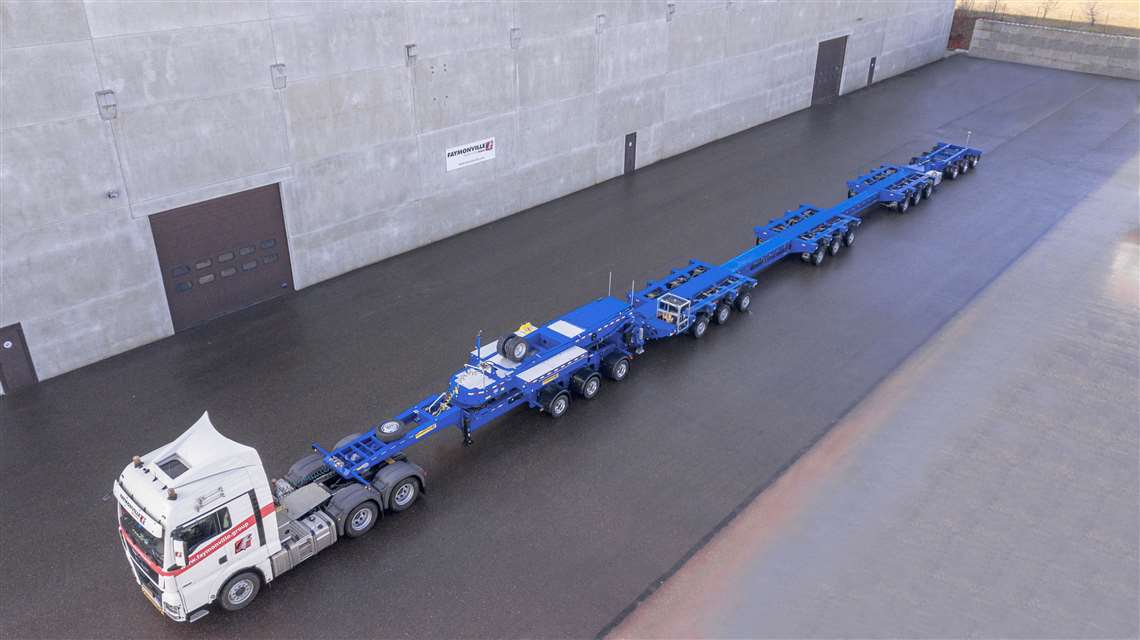 The HighwayMAX Dolly&Booster is composed of nine hydraulically steered pendle-axles, a 3-axle jeep dolly and a 3-axle nitro booster.